Short answer: AI SEO services can be worth it for enterprise brands when they are tied to measurable visibility, technical fixes, and business-critical journeys. They are not worth it when they are sold as a generic content package with AI terminology added on top.
The enterprise question is not whether AI will replace search. It is more practical: when a prospect asks ChatGPT, Google AI Overviews, Gemini, Perplexity, Claude, or Copilot for a recommendation, comparison, local option, or trusted provider, does your brand appear, get cited, and look credible enough to enter the shortlist?
For hotel groups, franchise networks, healthcare brands, retailers, MSPs, and agencies managing large site fleets, that shortlist matters. AI answers compress discovery. Instead of scrolling through ten blue links, buyers may see three to six named options, a few cited sources, and a summary that shapes the next search, call, booking, or RFP.
That is where AI SEO services earn their keep, if they start with proof.
What AI SEO services should mean in 2026
AI SEO is not a replacement for SEO. It is a broader operating model that combines three disciplines:
- Classic technical SEO: making pages crawlable, fast, indexable, internally connected, and easy for search systems to interpret.
- AEO, or Answer Engine Optimization: structuring content so it directly answers high-intent questions and can be used in AI summaries, featured answers, and conversational results.
- GEO, or Generative Engine Optimization: improving how generative engines understand, mention, cite, and compare your brand across prompts and sources.
In practice, AI SEO services should help an enterprise brand answer four questions:
- Which AI engines mention us today?
- Which prompts surface our competitors instead?
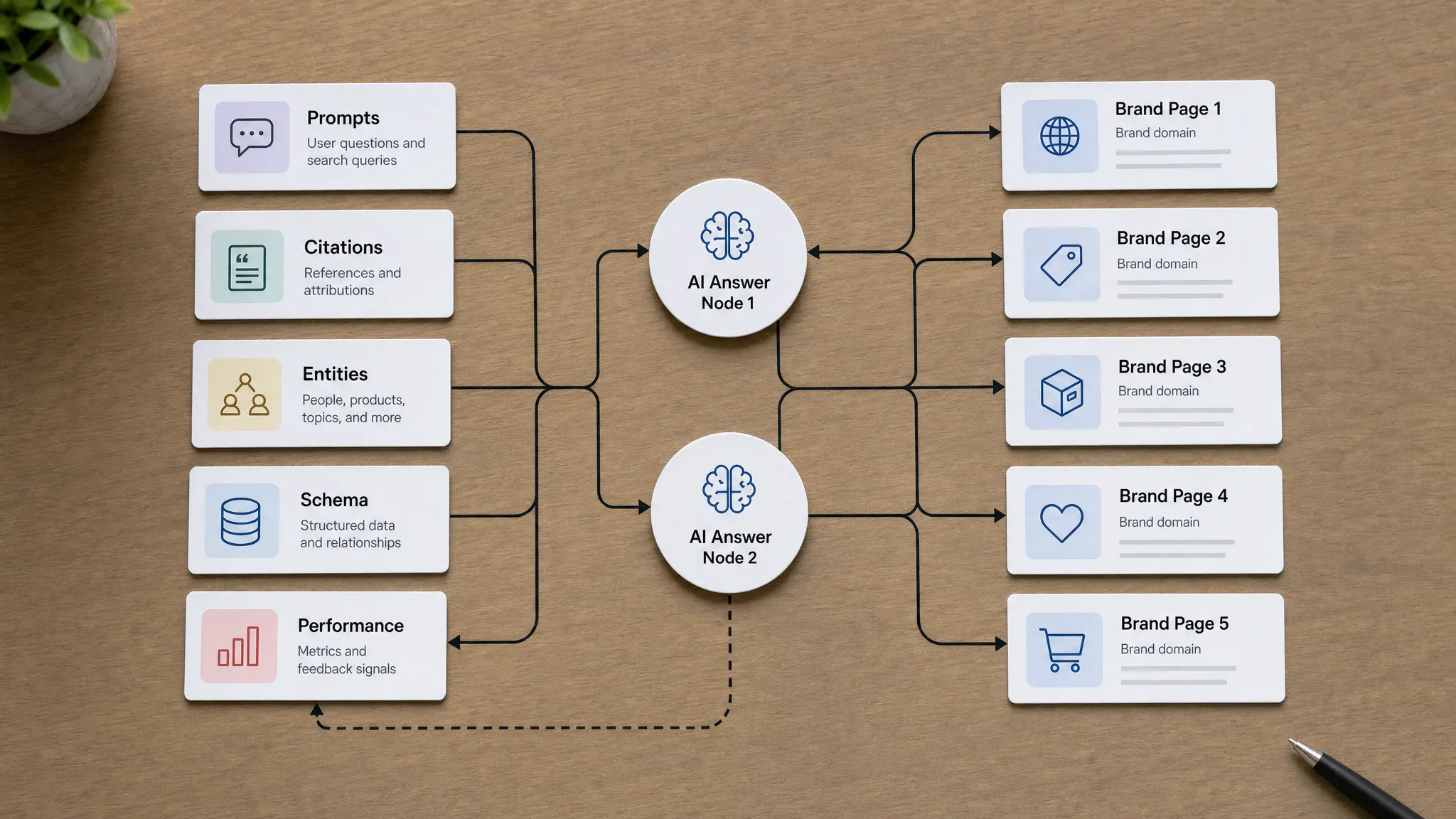
- Which pages, entities, citations, and structured data influence those answers?
- Which fixes can improve visibility without weakening brand accuracy or compliance?
This matters because the systems behind AI answers are still grounded in web signals. Google’s own guidance for AI features and your website continues to emphasize the fundamentals: make content accessible, eligible for search, and clear enough to be understood. In other words, AI visibility depends on the same foundation many enterprise sites still struggle to maintain at scale.
A hotel chain with 80 location pages, a healthcare network with hundreds of provider pages, or a retailer with thousands of product URLs does not need more disconnected content. It needs consistent entity signals, trustworthy answers, clean crawl paths, structured data, and measurable share of voice across the prompts that influence demand.
Why the enterprise ROI calculation is different
For a small site, AI search visibility may be an experiment. For an enterprise brand, it is a distribution and governance problem.
Large brands often have the ingredients AI systems look for, including brand authority, reviews, product depth, local relevance, expert content, and third-party citations. The problem is that those signals are frequently fragmented across CMS instances, franchise microsites, outdated location pages, inconsistent schema, thin service pages, slow templates, and disconnected PR or knowledge-base assets.
That fragmentation creates blind spots. AI can only reuse what it can identify, crawl, interpret, and trust.
A Gartner forecast from 2024 projected that traditional search engine volume could decline by 25% by 2026 due to AI chatbots and virtual agents. Forecasts should not be treated as guarantees, but the direction is clear: more discovery is moving into answer environments, not just search result pages.
For enterprise teams, the business risk is not only less organic traffic. It is loss of consideration before the click. If a traveler asks for family-friendly hotels near a convention center, a patient asks for a clinic that treats a specific condition, or an IT leader asks for MSPs serving a regulated industry, the AI-generated shortlist can shape what happens next.
The value of AI SEO services comes from improving your odds of appearing accurately in those moments, then proving whether the work changed visibility, citations, and downstream engagement.
Where AI SEO services create measurable value
A useful AI SEO program does not begin with a content calendar. It begins with an AI visibility baseline.
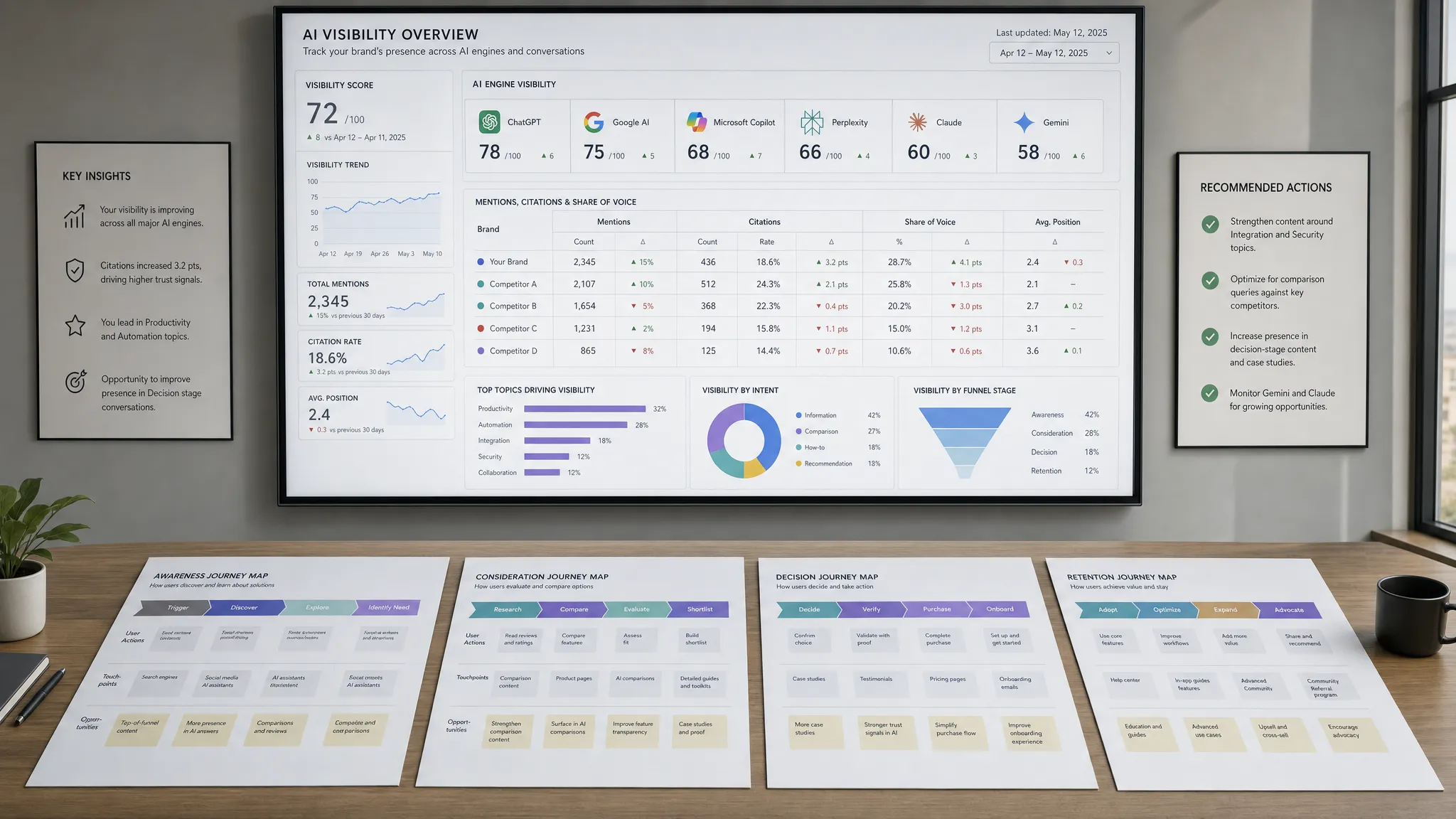
That baseline should test prompts across the engines your buyers use, including ChatGPT, Google AI Overviews, Gemini, Perplexity, Claude, and Copilot. It should distinguish between a brand mention, a cited source, a recommendation, and a comparison. Those are not the same signal.
| Workstream | What it fixes | Business effect | Proof to ask for |
|---|---|---|---|
| AI visibility scans | Finds where your brand appears or is absent across AI engines | Shows whether you are entering high-intent shortlists | Prompt-level reports by engine and journey |
| Brand mention and citation tracking | Separates name recognition from source authority | Reveals whether AI systems trust your pages enough to cite them | Mention rate, citation rate, and cited URLs |
| Share-of-voice monitoring | Compares your presence against competitors | Identifies markets, services, or categories where rivals dominate | Competitor visibility by prompt cluster |
| Entity cleanup | Aligns brand, location, product, service, and expert signals | Reduces confusion in AI-generated answers | Consistent names, descriptions, profiles, and schema |
| Technical SEO fixes | Improves crawlability, internal linking, indexability, and performance | Helps search and AI systems reach the right pages faster | Crawl reports, Core Web Vitals, index coverage, log data |
| Structured data and schema | Labels key facts in machine-readable form | Increases clarity for products, locations, FAQs, reviews, services, and organizations | Validated schema mapped to page purpose |
| AI-ready content recommendations | Turns vague pages into answerable assets | Improves usefulness for comparison, local, and decision prompts | Prioritized page-level recommendations |
| Governance and CMS publishing | Makes fixes repeatable across many pages | Reduces manual bottlenecks for multi-site teams | Workflow, templates, and before/after reporting |
Structured data is a good example. Google’s structured data documentation does not promise inclusion in rich results, and schema alone will not make a weak page authoritative. But it does help search systems understand the page. For enterprise brands, that clarity compounds across location pages, product pages, service lines, events, reviews, and FAQs.
The same is true for llms.txt. It is an emerging file convention intended to help AI systems understand important site content, but it is not a substitute for crawlable pages, strong internal links, schema, and authoritative content. Treat it as supporting documentation, not a shortcut.
The strongest use cases by enterprise type
AI SEO services are most likely to be worth the investment when the brand has many decision paths, many pages, and many competitors that can be recommended instead.
For hotel groups and travel brands, the priority is often local and intent-specific discovery. AI answers may mention hotels for family travel, business stays, pet-friendly rooms, walkability, event access, or destination comparisons. A generic property page may not be enough. The page needs clear amenities, neighborhood context, policies, reviews, transportation details, and structured local signals.
For multi-site healthcare, education, and retail brands, the problem is usually consistency. Locations may have different hours, services, staff, reviews, and compliance requirements. AI systems may mix outdated facts from directories, old pages, and third-party sources. Services should focus on entity accuracy, location schema, service-page depth, citation cleanup, and internal linking between brand, region, location, and service pages.
For IT service providers and MSPs, AI search often behaves like a comparison assistant. Prospects ask about providers for specific industries, compliance needs, regions, platforms, or company sizes. Worthwhile work includes strengthening service entities, case-study discoverability, comparison content, author expertise, and third-party validation.
For mid-market e-commerce and WooCommerce brands, the opportunity sits across product discovery, buying advice, and category education. AI engines may answer questions such as which product fits a use case, how two products compare, or which retailer carries a certain item. Product schema, inventory clarity, category guides, reviews, and page performance all affect whether the brand is findable and credible.
For agencies and in-house teams, the value is operational. AI SEO services are worth it when they provide repeatable diagnostics, prioritized fixes, and reporting that can be applied across multiple brands or site sections. If you are still defining platform requirements, this guide on how to choose an SEO platform for AI visibility outlines the capabilities that matter beyond traditional rank tracking.
What to measure before calling it ROI
AI SEO ROI is easy to overstate if the only metric is traffic. AI-generated answers may influence behavior before a user clicks. Some users will search your brand later. Some will visit through referral paths that analytics tools do not classify cleanly. Some will convert after seeing your brand cited repeatedly across research sessions.
That does not mean you cannot measure it. It means the measurement model needs more than rankings.
The most useful baseline includes:
- Prompt coverage: the percentage of target prompts where your brand appears.
- Brand mention rate: how often your brand is named, even without a citation.
- Citation rate: how often your pages are used as cited sources.
- Citation quality: whether the cited page is accurate, current, and aligned with the journey.
- Share of voice: how your visibility compares with competitors by prompt cluster.
- Recommendation position: whether your brand appears as a primary option, secondary mention, or not at all.
- Answer accuracy: whether AI systems describe your locations, services, products, prices, policies, or credentials correctly.
- Technical readiness: crawlability, indexability, internal linking, page performance, schema validity, and metadata quality.
- Business impact indicators: branded search lift, assisted conversions, organic landing page performance, AI referral traffic where available, calls, bookings, form fills, and qualified leads.
The goal is not to prove that every AI answer creates a direct click. The goal is to show whether a set of fixes improved discoverability, accuracy, and consideration on the journeys that matter.
A practical example: if an enterprise healthcare brand is absent from 60 tested prompts related to urgent care, pediatric care, and same-day appointments in key markets, the first win is not a traffic spike. The first win is identifying which location and service pages are missing the facts, schema, internal links, and citations needed to be considered.
When AI SEO services are worth it
AI SEO services are usually worth evaluating when at least three of the following are true:
- Your buyers research through comparison, recommendation, or local-intent questions.
- Your brand has many locations, products, service lines, or regional variations.
- Competitors appear in AI answers where your brand does not.
- Your site has technical debt, slow templates, duplicate content, or weak internal linking.
- Your brand facts differ across your website, directories, review sites, partner pages, and knowledge panels.
- Your team needs governance for schema, metadata, FAQs, and page updates across a large CMS.
- You need reporting that executives can understand without reading crawl logs or prompt transcripts.
The enterprise advantage is scale. A fix to a location template, product schema pattern, FAQ structure, internal link module, or service-page format can improve hundreds or thousands of pages. That is where AI SEO differs from one-off optimization.
The best programs also improve classic SEO. Faster pages help users. Better internal links help crawlers and customers. Clearer service pages improve conversion. Stronger structured data improves machine understanding. Better entity consistency reduces confusion across search, maps, AI answers, and third-party platforms.
When they are probably not worth it
AI SEO services are not worth the spend if the vendor cannot explain how visibility is measured.
Be cautious if the offer is mostly AI-written articles, vague generative search advice, or a dashboard with no prompt methodology. Enterprise brands need traceability: which prompts were tested, which engines were used, which answers changed, which pages were cited, and which fixes were shipped.
They are also a poor fit when the brand is not ready to act on findings. If technical recommendations sit in a backlog for nine months, or local data is owned by teams that cannot update it, the audit may be accurate but commercially limited.
The biggest red flags are simple:
- No before/after baseline.
- No distinction between mentions, citations, and recommendations.
- No competitor share-of-voice view.
- No technical SEO diagnostics.
- No schema or entity strategy.
- No plan for CMS implementation.
- No way to prioritize fixes by revenue journey.
- Guaranteed rankings or guaranteed AI answer placement.
No responsible provider can guarantee that a generative engine will cite a specific page. The work is about improving eligibility, clarity, authority, and usefulness, then measuring changes over time.
Build internally, hire services, or use a platform?
Enterprise brands usually have three options.
| Model | Best fit | Main limitation |
|---|---|---|
| Internal SEO team only | Mature teams with technical, content, analytics, and engineering capacity | Hard to scale AI engine testing and prompt monitoring manually |
| Agency or consultant services | Brands needing strategy, implementation support, or cross-team coordination | Quality varies, especially if the offer is content-heavy and measurement-light |
| AI visibility platform plus team workflow | Multi-site brands, agencies, and enterprise teams needing repeatable scans and fixes | Still requires human judgment, governance, and implementation ownership |
The strongest model is often hybrid. Internal teams know the business, compliance requirements, content standards, and conversion goals. A specialized platform or service adds AI visibility measurement, competitor monitoring, prompt mapping, and prioritized technical recommendations.
For brand teams building the internal checklist, CapstonAI’s AI search readiness checklist for brand teams is a useful way to assess crawlability, entities, schema, metadata, and content readiness before investing heavily.
What a credible 90-day AI SEO engagement looks like
A useful engagement should be specific enough to create momentum, but flexible enough to account for how AI answers change across engines.
| Phase | Focus | Output |
|---|---|---|
| Days 1 to 15 | Baseline AI visibility | Prompt set, engine coverage, competitor share of voice, mention and citation report |
| Days 16 to 35 | Technical and entity diagnostics | Crawlability issues, schema gaps, page performance review, internal linking opportunities, entity inconsistencies |
| Days 36 to 60 | Priority fixes | Updated metadata, FAQ structure, schema, internal links, page templates, location or product data improvements |
| Days 61 to 90 | Content and citation strengthening | Journey-specific page improvements, source alignment, expert signals, third-party citation opportunities |
| Ongoing | Measurement and governance | Before/after reports, alerts, CMS workflows, prompt expansion, competitive monitoring |
This timeline is not a universal prescription. A regulated healthcare network may need more compliance review. A retailer may move faster on templates but slower on product data. A hotel group may focus first on high-value destinations, amenities, and seasonal demand.
The principle is the same: measure, fix, publish, remeasure.
How to evaluate an AI SEO services provider
Before signing, ask for clarity on methodology. Good answers should be concrete, not theoretical.
Start with prompt design. The provider should map prompts to real buyer journeys, such as discovery, comparison, local evaluation, product selection, troubleshooting, and purchase readiness. Enterprise prompts should include branded, non-branded, competitor, category, local, and problem-based variations.
Then ask how they separate AI visibility signals. A brand mention is useful, but a cited source is stronger. A recommendation in a top answer is different from being listed as one of many options. A hallucinated or outdated answer may be worse than no mention at all.
Technical depth also matters. AI SEO services should not ignore crawlability, internal linking, page performance, canonicalization, structured data, XML sitemaps, robots directives, and template quality. If a service provider cannot connect technical fixes to AI visibility, it is likely repackaged content marketing.
Finally, ask how trust signals are improved. AI systems tend to favor sources that are clear, consistent, specific, and corroborated. Expert authorship, entity clarity, third-party references, current pages, reviews, and structured data all help. This deeper guide to AI trust signals that make brands more citable explains how those signals support citation potential.
The verdict: worth it, if the work is measurable
AI SEO services are worth it for enterprise brands when they help the organization see and fix what AI systems currently miss.
That means the engagement should produce a baseline, not just recommendations. It should connect AI prompts to business journeys, not just keywords. It should improve technical SEO, schema, entities, internal linking, metadata, FAQs, citations, and page performance. It should track share of voice against competitors. And it should make implementation realistic inside the CMS and governance model your teams already use.
They are not worth it if the offer is generic, content-only, or built on promises no one can verify.
The right question for enterprise teams is simple: if AI cannot see your business accurately today, what would it take to make the right pages visible, trusted, and reusable tomorrow?
Frequently Asked Questions
What are AI SEO services? AI SEO services help brands improve how they appear in AI-generated answers and AI-assisted search. The work usually combines technical SEO, Answer Engine Optimization, Generative Engine Optimization, structured data, entity clarity, content improvements, and visibility measurement across tools like ChatGPT, Gemini, Perplexity, Claude, Copilot, and Google AI Overviews.
How are AI SEO services different from traditional SEO services? Traditional SEO focuses mainly on rankings, crawlability, content, links, and organic traffic from search engines. AI SEO adds measurement of brand mentions, citations, recommendations, prompt coverage, and competitor share of voice inside generative engines. The best programs do both because AI visibility still depends on strong SEO foundations.
Can AI SEO services guarantee that my brand appears in ChatGPT or Google AI Overviews? No responsible provider can guarantee placement in a specific AI answer. What they can do is improve the signals that make your brand easier to understand, cite, and recommend, then measure whether visibility changes over time.
What should enterprise brands audit first? Start with high-intent journeys where AI answers could influence revenue, such as local searches, product comparisons, service recommendations, destination research, and vendor shortlists. Then measure brand mentions, citations, competitor presence, answer accuracy, schema quality, crawlability, internal linking, and page performance.
Is llms.txt required for AI SEO? No. llms.txt is an emerging convention that can help document important content for AI systems, but it is not a replacement for crawlable pages, structured data, strong internal links, accurate metadata, and authoritative content.
Start with a free AI visibility audit
Before committing budget to AI SEO services, establish a baseline. You need to know where your brand appears, where competitors win, which pages are cited, and which technical or content gaps are limiting visibility.
CapstonAI helps brands, retailers, agencies, and multi-site teams measure and improve AI visibility across ChatGPT, Google AI Overviews, Gemini, Perplexity, Claude, and Copilot. The platform tracks brand mentions, citations, share of voice, prompt coverage, competitor visibility, and prioritized fixes for AI-ready metadata, FAQ, schema, llms.txt, and CMS publishing.
If AI cannot see your business, CapstonAI makes it visible. Start with a free AI visibility audit and use the results to decide whether AI SEO services are worth the next investment.