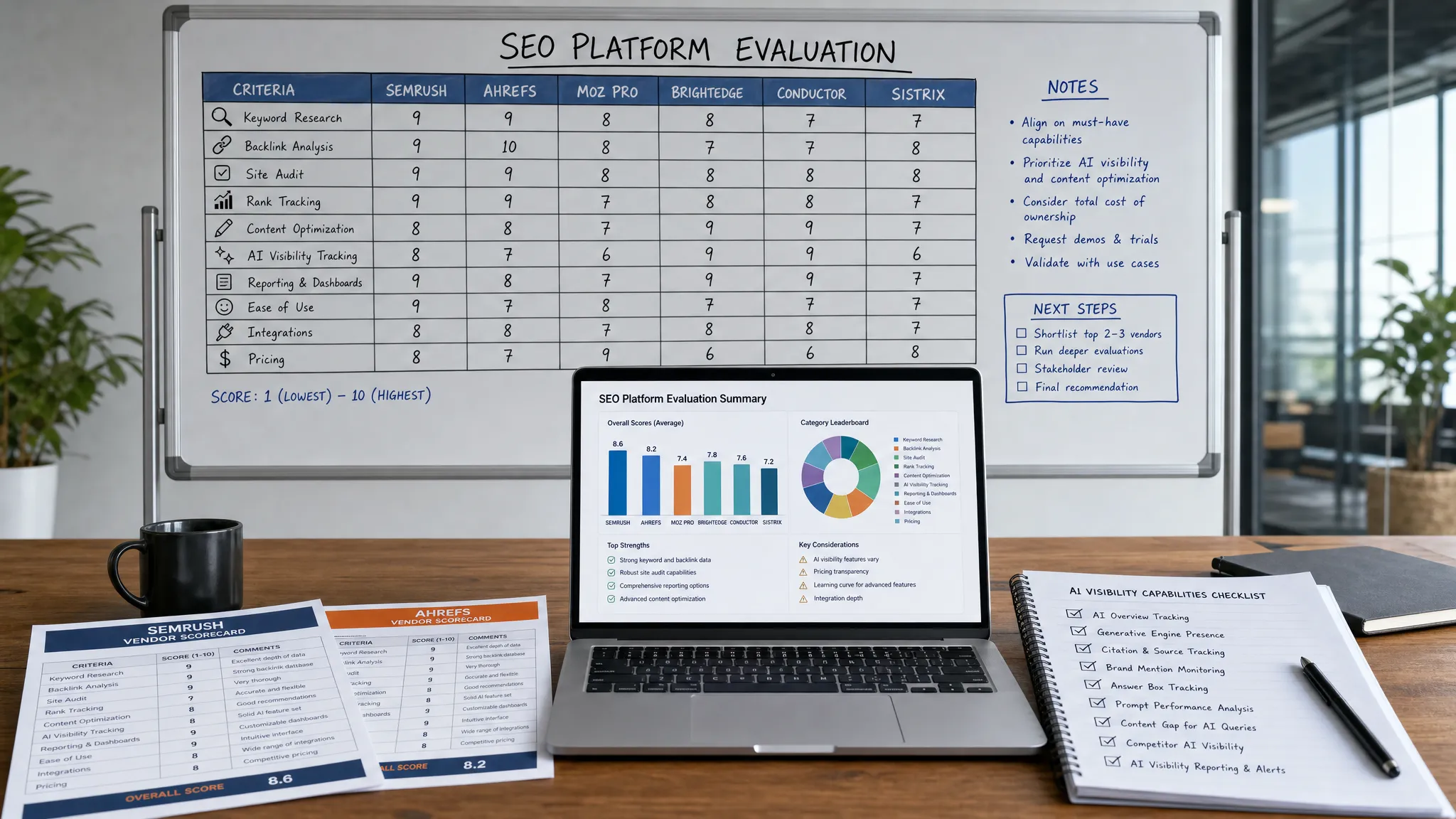
AI visibility is now part of SEO due diligence. Buyers still need keyword tracking, technical audits, content optimization, and reporting. But if your team only measures blue-link rankings, you miss an increasingly important layer of discovery: how AI engines such as ChatGPT, Gemini, Claude, Perplexity, Bing Copilot, and Google AI experiences describe, cite, and recommend your brand.
That changes what you should expect from an SEO platform. The right platform should not simply tell you whether a page ranks. It should show whether your brand appears in AI-generated answers, which competitors appear instead, which sources shape those answers, and what your team can fix to become more visible and citable.
This guide breaks down how to choose an SEO platform for AI visibility, what capabilities matter most, which questions to ask vendors, and how to connect AI search metrics to real business outcomes.
What makes an SEO platform ready for AI visibility?
A traditional SEO platform is designed around search engine results pages, keywords, backlinks, technical health, and organic traffic. Those are still important. AI visibility adds a new measurement layer built around prompts, generated answers, citations, entity understanding, brand accuracy, and recommendation patterns.
In practical terms, your platform needs to help you answer questions like:
- Does ChatGPT mention our brand for buyer-intent questions in our category?
- Are we recommended alongside the right competitors, or missing entirely?
- Do AI engines describe our products, locations, pricing model, or differentiators accurately?
- Which sources are AI systems relying on when they form answers about our market?
- Which pages, FAQs, metadata, and third-party signals should we improve first?
Here is the simplest way to compare the old and new requirements.
| Selection area | Traditional SEO platform | AI visibility requirement |
|---|---|---|
| Core unit of analysis | Keywords and URLs | Prompts, answers, mentions, citations, and entities |
| Main visibility metric | Ranking position | Mention rate, recommendation rate, citation rate, and AI share of voice |
| Competitive view | SERP competitors | Brands recommended in AI answers for the same prompts |
| Optimization focus | Titles, content, links, technical SEO | Answer-ready content, entity clarity, structured data, source authority, and AI-ready metadata |
| Reporting cadence | Weekly or monthly ranking reports | Ongoing monitoring with alerts for answer changes and competitor movement |
| Workflow output | SEO tasks and content briefs | Fix recommendations that improve AI readability, citation potential, and brand accuracy |
The key point: AI visibility is not a replacement for SEO. It is a new layer on top of SEO that requires different data, different reporting, and a more direct connection between diagnosis and action.
Start with the outcome, not the feature list
The SEO software market is crowded, and many tools now use AI language in their positioning. Before comparing platforms, define the outcome your team actually needs.
A brand team may need to protect reputation and ensure AI engines describe the company accurately. An e-commerce team may care about product recommendations in AI shopping journeys. A multi-location business may need city-level tracking. An agency may need repeatable audits and client-ready reporting. A B2B SaaS company may want to appear in comparison prompts such as best tools for a specific use case.
A strong AI visibility platform should support at least five outcomes:
- Baseline your current AI presence: You should be able to scan major AI engines and see where your brand is mentioned, recommended, cited, misrepresented, or absent.
- Map prompts to buyer intent: The platform should organize prompts by use case, funnel stage, product category, geography, and competitor set.
- Benchmark competitors: AI visibility is relative. If a model recommends three competitors and not you, that gap matters even if your Google rankings look healthy.
- Turn gaps into fixes: Reporting alone is not enough. The platform should recommend content, metadata, FAQ, schema, or technical improvements your team can implement.
- Track change over time: AI answers shift as models, sources, and web content change. You need trend lines, alerts, and historical evidence, not one-off screenshots.
If a vendor cannot connect features to these outcomes, the platform may be useful for SEO productivity but weak for AI visibility.
Core capabilities to look for in an AI visibility SEO platform
When evaluating vendors, separate nice-to-have AI features from capabilities that directly affect measurement and improvement. The table below gives you a practical checklist.
| Capability | Why it matters | What to ask the vendor |
|---|---|---|
| Multi-engine AI visibility scans | Different AI engines produce different answers, sources, and recommendations. | Which AI engines do you scan, and how often are results refreshed? |
| Prompt and mention mapping | AI discovery happens through natural-language prompts, not only keywords. | Can we group prompts by audience, location, funnel stage, and product category? |
| Competitor and market tracking | You need to know who is winning recommendations when your brand is missing. | Can we track AI share of voice against selected competitors over time? |
| Citation and source analysis | AI answers are shaped by the sources they retrieve, summarize, or cite. | Can we see which pages or third-party sources influence answers? |
| Accuracy monitoring | Incorrect AI descriptions can harm trust and conversion. | Can we flag inaccurate claims, outdated details, or brand confusion? |
| Automated content recommendations | Teams need prioritized next steps, not just dashboards. | Does the platform suggest content, FAQ, metadata, or technical fixes? |
| Publishing and CMS workflows | Recommendations only create value when they are implemented quickly. | Does the platform integrate with our CMS or support direct publishing workflows? |
| Alerts and dashboards | AI visibility can change suddenly after model updates, content changes, or competitor activity. | Can we receive alerts for critical changes in mentions, recommendations, or sentiment? |
| Multi-location support | Local and regional brands need market-specific visibility, not one global score. | Can we track brand presence by location, region, or store group? |
Do not choose a platform because it has the longest feature list. Choose the one that gives your team the clearest path from measurement to improvement.
Evaluate the quality of the AI visibility data
In AI visibility, methodology matters as much as the dashboard. Two platforms can scan the same AI engine and report different results because they use different prompts, refresh cadences, locations, personalization assumptions, or answer-capture methods.
Ask vendors to explain how they build prompt sets. A good platform should support prompts that mirror real customer behavior, including research questions, comparison queries, local queries, product recommendation requests, and problem-led prompts. For example, a software company should not only track its brand name. It should track category prompts, competitor comparison prompts, pain-point prompts, and integration-related prompts.
You should also check how the platform handles volatility. AI answers are probabilistic. A single answer is not a reliable trend. The platform should help you separate one-off variation from meaningful movement by storing historical results, tracking repeated prompt performance, and showing changes in mention rate or recommendation rate over time.
Evidence capture is another important factor. If a dashboard says your brand was recommended, your team should be able to inspect the answer, prompt, engine, date, citation context, and competing brands. Without that evidence, it becomes difficult to diagnose why performance changed or prove progress to stakeholders.
Finally, look for segmentation. AI visibility can vary by engine, region, language, customer type, and product category. A single blended score may be useful for executives, but your SEO and content teams need granular data to decide what to fix.

Make sure the platform helps you fix what it finds
Many SEO platforms are strong at reporting but weaker at execution. For AI visibility, that gap is expensive because the work often spans SEO, content, product marketing, PR, web development, and local teams.
A useful platform should translate findings into specific recommendations. If AI engines do not understand your brand category, the next step may be clearer entity descriptions and consistent metadata. If you are absent from comparison answers, you may need stronger use-case pages, third-party validation, or pages that directly answer buyer questions. If AI engines cite outdated sources, you may need freshness updates and better canonical content.
Look for workflow support in these areas:
- AI-ready FAQ creation and publishing
- Metadata recommendations for titles, descriptions, and entity clarity
- Structured data guidance for products, organizations, locations, articles, and FAQs
- Content gap recommendations based on prompt clusters
- CMS integration for faster implementation
- Alerts for critical visibility losses or inaccurate AI answers
Structured data is not a magic switch for AI visibility, but it helps search systems and crawlers interpret your content more consistently. Google’s documentation on structured data is still a useful foundation for making key information machine-readable. For AI search, pair structured data with clear, extractable prose that answers real customer questions.
If your team needs a broader readiness framework, CapstonAI’s AI Search Readiness Checklist for Brand Teams is a useful companion to this evaluation process.
Match the SEO platform to your team type
The best SEO platform for AI visibility depends on your operating model. A global retailer, local service brand, and digital agency will not evaluate the same features in the same order.
| Team type | Highest-priority needs | Platform capabilities to prioritize |
|---|---|---|
| Brand marketing team | Brand accuracy, reputation, executive reporting | Mention tracking, accuracy alerts, AI share of voice, competitor dashboards |
| E-commerce team | Product recommendations, category visibility, shopping prompts | Product prompt tracking, structured data support, content recommendations, CMS workflows |
| B2B SaaS team | Category presence, comparison prompts, use-case authority | Prompt mapping, competitor tracking, citation analysis, answer-ready content briefs |
| Agency | Repeatable audits, client reporting, scalable workflows | Multi-client dashboards, exportable reports, prompt templates, automated recommendations |
| Multi-location brand | Local recommendations and regional accuracy | Location-level scans, local prompt sets, multi-location management, critical alerts |
| SEO team inside a larger company | Technical fixes, metadata, content prioritization | AI visibility scans, CMS integration, structured recommendations, historical tracking |
This is where many buying processes go wrong. Teams evaluate a platform based on generic SEO checklists rather than the visibility problems they actually face. If your revenue depends on local recommendations, make multi-location tracking non-negotiable. If your market is comparison-heavy, prioritize prompt mapping and competitor share of voice. If your team is small, prioritize automation and publishing workflows.
Red flags when choosing an SEO platform for AI visibility
AI search is evolving quickly, so it is normal for platforms to differ in methodology. Still, some warning signs should make you pause.
- The platform offers one AI visibility score without showing prompts, answers, sources, or competitors.
- It claims to guarantee placement in AI answers.
- It only tracks branded prompts, which can make performance look better than it is.
- It cannot show historical results or explain answer volatility.
- It has no way to prioritize fixes after detecting visibility gaps.
- It treats AI visibility as the same thing as keyword rankings.
- It cannot separate visibility by engine, market, location, or prompt category.
- It ignores negative or inaccurate mentions and only reports favorable results.
No platform can control how every AI model answers every prompt. What a strong platform can do is measure your presence consistently, identify patterns, surface fixable gaps, and help your team improve the signals that AI systems are likely to rely on.
Use a 30-day evaluation process before you commit
A short pilot is often more revealing than a long sales demo. Use 30 days to test the platform against real prompts, real competitors, and real workflows.
- Define your priority prompt set: Include branded, non-branded, comparison, use-case, local, and purchase-intent prompts that reflect how buyers actually ask questions.
- Choose your competitor benchmark: Select direct competitors, emerging alternatives, marketplaces, publishers, or local competitors depending on your business model.
- Run a baseline scan: Measure mention rate, recommendation rate, citation rate, share of voice, accuracy, and missing-answer patterns across AI engines.
- Review the diagnosis: Check whether the platform explains why you are missing, which sources appear instead, and which content gaps are most urgent.
- Implement a small batch of fixes: Update a few pages, FAQs, metadata fields, or structured data elements so you can evaluate the workflow, not only the report.
- Measure early movement and usability: AI visibility may not change overnight, but your team should be able to see whether the platform makes decisions faster and clearer.
During the pilot, involve the people who will actually use the platform: SEO managers, content leads, product marketers, web teams, local marketing managers, and agency account leads. A tool that looks impressive to executives but creates extra manual work for operators will struggle to produce results.
For a deeper measurement framework, see CapstonAI’s guide on how to measure AI performance across search engines.
Connect AI visibility metrics to business value
AI visibility is still an emerging channel, so leadership may ask how it ties to revenue. The answer is to track leading indicators first, then connect them to downstream outcomes.
| Metric | What it tells you | Why it matters |
|---|---|---|
| Mention rate | How often your brand appears in AI answers for tracked prompts | Shows baseline awareness in AI discovery journeys |
| Recommendation rate | How often AI engines recommend your brand as a solution | Indicates influence in consideration and purchase decisions |
| Citation rate | How often your owned or third-party content is cited | Helps identify source authority and content trust |
| AI share of voice | Your visibility compared with competitors | Makes AI search performance competitive and measurable |
| Accuracy rate | How often AI answers describe your brand correctly | Protects brand trust and reduces misinformation risk |
| Fix implementation rate | How quickly your team ships recommended improvements | Connects platform usage to operational progress |
| Assisted conversion signals | Changes in branded search, direct traffic, referral traffic, or qualified leads after visibility improvements | Helps connect AI visibility work to commercial outcomes |
Do not expect every AI visibility improvement to map perfectly to last-click attribution. AI search often influences discovery, consideration, and shortlist creation before a user reaches your site. That is why share of voice, recommendation rate, and brand accuracy are important leading indicators.
Where CapstonAI fits in the evaluation
CapstonAI is built for teams that need to measure, improve, and defend AI search visibility across major AI engines. It is especially relevant if your current SEO stack is strong for rankings and traffic but weak for AI mentions, recommendations, citations, and competitor visibility.
Based on the platform’s capabilities, CapstonAI can help teams with AI visibility scans, competitor and market tracking, prompt and mention mapping, automated content recommendations, CMS integration for faster fixes, AI-ready FAQ and metadata publishing, multi-location brand management, share of voice analytics, critical alert dashboards, and a free AI visibility audit.
That does not mean every business should replace its existing SEO tools. In many cases, the better move is to keep your traditional SEO platform for keyword, backlink, crawl, and traffic workflows while adding an AI visibility layer that tracks how AI engines mention and recommend your brand. This combined stack gives you a clearer view of search as it exists in 2026: traditional rankings, AI answers, citations, and recommendation journeys.
If you are still building internal alignment, start with education. CapstonAI’s articles on AI trust signals that make brands more citable and how to improve AI results for your brand can help teams understand which signals to improve before investing heavily in new workflows.
Final checklist before you choose
Before signing a contract, make sure the platform can answer these questions clearly:
- Which AI engines does it track, and how often?
- Can it track prompts that match your real buyers and markets?
- Does it show the full answer context, citations, competitors, and historical changes?
- Can it identify inaccurate or outdated AI descriptions of your brand?
- Does it provide prioritized recommendations your team can implement?
- Does it support your CMS, publishing process, or metadata workflow?
- Can it report AI share of voice by competitor, category, location, or prompt group?
- Does it provide alerts when visibility drops or critical misinformation appears?
- Can non-technical stakeholders understand the dashboards and reports?
- Does the vendor explain methodology transparently?
If the answer is yes to most of these, you are likely evaluating a platform that can support AI visibility as a real growth channel, not just an AI-branded reporting add-on.
Frequently Asked Questions
Is a traditional SEO platform enough for AI visibility? Usually not on its own. Traditional SEO platforms are valuable for rankings, technical audits, backlinks, and traffic analysis, but AI visibility requires prompt tracking, AI answer capture, mention analysis, citation monitoring, and competitor share of voice across AI engines.
What is the most important metric for AI visibility? There is no single universal metric. Most teams should track mention rate, recommendation rate, citation rate, AI share of voice, and accuracy together. A brand that is mentioned often but described inaccurately still has a visibility problem.
How often should AI visibility be measured? For competitive or fast-changing categories, weekly monitoring is a good starting point. Brands with reputation risk, multi-location complexity, or aggressive competitors may need more frequent scans and alerts.
Can an SEO platform guarantee that ChatGPT or Gemini will recommend my brand? No credible platform should guarantee AI recommendations. The right platform can identify gaps, improve AI-readable signals, monitor changes, and help your team increase the likelihood of being accurately mentioned or cited.
What is the difference between SEO, AEO, and GEO? SEO focuses on visibility in search engines and organic results. AEO, or Answer Engine Optimization, focuses on being selected for direct answers. GEO, or Generative Engine Optimization, focuses on visibility in AI-generated responses. AI visibility combines measurement and optimization across these behaviors.
Should agencies offer AI visibility audits to clients? Yes, especially when clients depend on brand discovery, local search, e-commerce recommendations, or competitive category visibility. AI visibility audits can reveal blind spots that traditional ranking reports do not show.
Turn AI visibility into a measurable channel
Choosing an SEO platform for AI visibility is not about chasing a trend. It is about making sure your brand can be found, understood, cited, and recommended in the places where buyers are increasingly asking questions.
If you want to see how AI engines currently mention your brand and where competitors are winning visibility, start with a free AI visibility audit from CapstonAI. Use the audit to establish your baseline, identify fixable gaps, and build a practical roadmap for improving AI search presence across the engines that matter most.