Search engine visibility used to mean one thing: can your page rank high enough in Google or Bing for the right query to earn an impression, a click, and eventually a lead or sale?
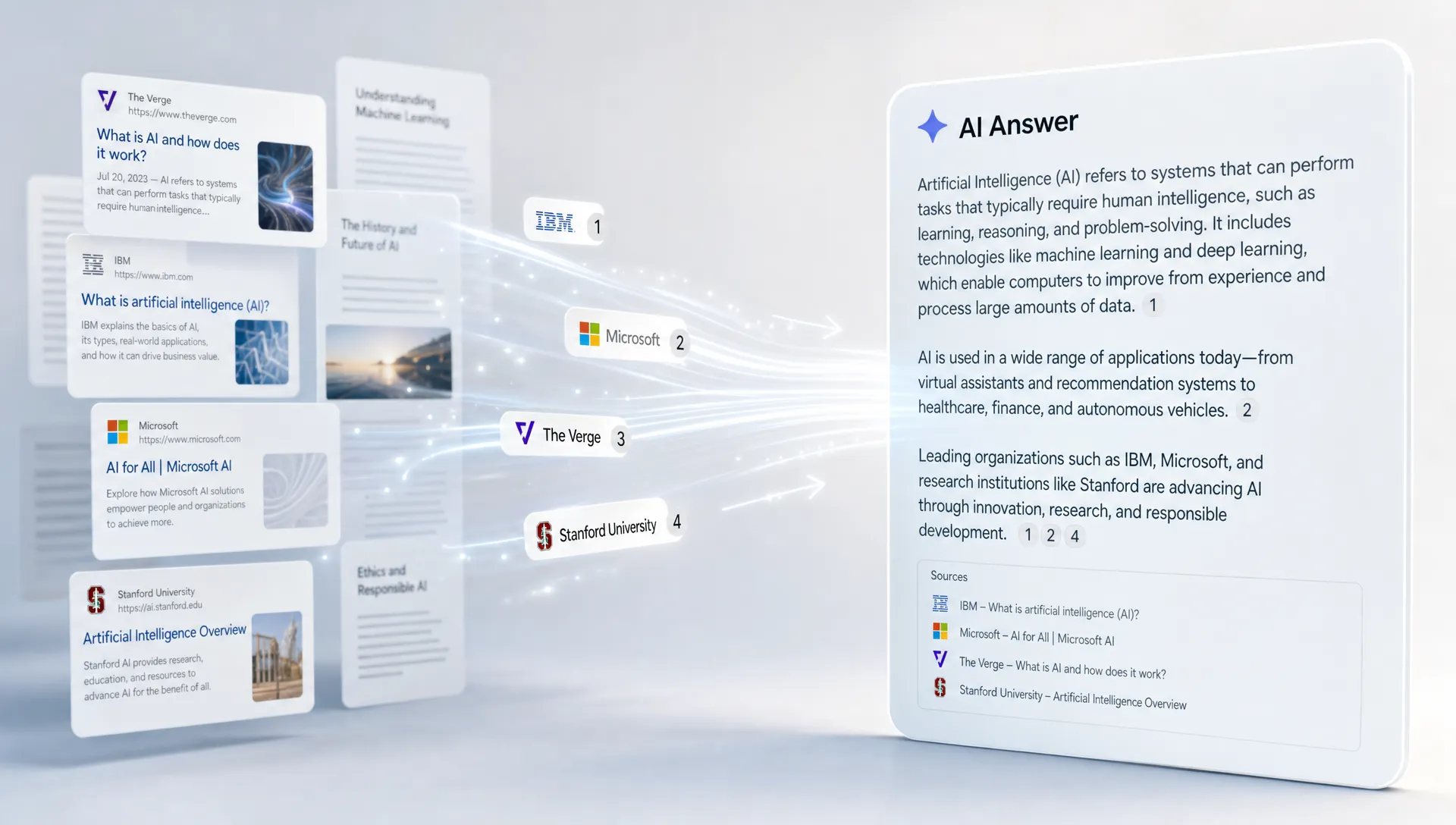
That definition is no longer complete. In 2026, prospects increasingly ask ChatGPT, Google AI Overviews, Gemini, Perplexity, Claude, or Copilot for a summarized answer. They may not scroll a search results page at all. They may see a short list of brands, a cited source, a recommendation, or a synthesized answer that never mentions you.
The business question has changed from, “Do we rank?” to, “Are we included, cited, and described accurately when AI answers our buyers?”
That is where classic SEO, AEO, and GEO meet. Search engine visibility still matters, but AI answers change what visibility looks like, how it is measured, and what teams need to fix first.
Traditional search visibility is page-first
Classic search visibility is built around the search engine results page. A search engine crawls pages, indexes them, ranks them for queries, and displays links, snippets, maps, products, images, or videos.
For a hotel group, that might mean ranking a location page for “boutique hotel near downtown Austin.” For a WooCommerce store, it might mean ranking a category page for “waterproof hiking backpack.” For an MSP, it might mean a service page appearing for “managed IT support for law firms.”
The core unit is usually a URL. You optimize the page, monitor its ranking, measure impressions in Google Search Console, and track clicks, conversions, and revenue.
That model is still essential. If your pages are slow, uncrawlable, thin, duplicated, or poorly structured, both classic search engines and AI systems have less reliable material to work with. But AI answers add another layer because the answer may not simply display your page. It may interpret your business as an entity, compare it to competitors, and use multiple sources to decide whether you belong in the response.
| Visibility dimension | Classic search results | AI answers | Business effect |
|---|---|---|---|
| Primary unit | Ranked URL | Brand, entity, citation, or summarized fact | Visibility can happen without a click, but absence can remove you from consideration |
| User behavior | User scans links and chooses a result | User reads a synthesized answer or asks follow-up prompts | Fewer visible comparison opportunities if you are not named early |
| Measurement | Rankings, impressions, CTR, clicks, conversions | Mentions, citations, share of voice, prompt coverage, accuracy | Teams need to measure inclusion and trust, not only traffic |
| Optimization focus | Pages, keywords, backlinks, technical SEO | Entities, structured answers, source consistency, schema, crawlability | Content must be easy for humans and machines to verify |
| Competitive view | Who ranks above or below you | Who AI recommends, cites, or summarizes instead of you | Rivals can win demand even when your pages rank somewhere on page one |
AI answers are entity-first and context-heavy
Generative engines do not behave like a simple list of blue links. Their systems differ, but AI search experiences typically combine several signals: the model’s learned knowledge, live or recent web retrieval, trusted sources, structured data, user context, and the phrasing of the prompt.
That means two prompts with similar intent can produce different visibility outcomes.
A search query might be “best pediatric urgent care Phoenix.” An AI prompt might be, “Which pediatric urgent care clinics in Phoenix are open on weekends, accept walk-ins, and have good reviews?” The second prompt asks for an answer, not a link list. It introduces attributes, constraints, and comparison logic.
This is why AI visibility depends on more than keyword placement. The engine has to understand who you are, where you operate, what you offer, whether your information is consistent across sources, and whether your pages answer the specific buyer question clearly enough to reuse.
AEO, or Answer Engine Optimization, focuses on making content answer-ready. GEO, or Generative Engine Optimization, focuses on how generative engines discover, trust, synthesize, and cite your brand. Both sit on top of strong technical SEO. If you want a broader comparison of the discipline shift, CapstonAI’s guide to AI SEO vs traditional SEO explains where the practices overlap and where they diverge.
What changes when visibility happens inside an AI answer
The most important change is that AI answers compress the consideration set. A search results page may show 10 organic listings, paid ads, map results, and shopping modules. An AI answer may mention three options, cite two sources, or summarize a category without naming any brand at all.
For brands, retailers, agencies, and multi-location teams, that creates four practical differences.
1. Prompts replace exact-match keywords
Keywords still matter because people use words to express intent. But AI prompts are longer, more specific, and often conversational. They include modifiers such as budget, location, use case, urgency, audience, and constraints.
A franchise education brand might not only care about “math tutoring near me.” It also needs visibility for prompts like, “What tutoring centers help middle school students prepare for algebra placement tests?” That prompt may surface competitors with clearer program pages, stronger local pages, or better third-party mentions.
2. Mentions can matter before clicks
In AI answers, a brand mention can create awareness even if no citation or click follows. A traveler might ask Gemini for a shortlist of family-friendly hotels near a convention center. If your property is included with accurate amenities, you enter the consideration set. If a competitor is mentioned and you are absent, the booking journey may move forward without you.
This does not mean clicks are irrelevant. It means the visibility funnel now starts earlier, at answer inclusion.
3. Citations become trust signals
Some AI engines cite sources. Others cite inconsistently or only in certain answer modes. When citations do appear, they can shape credibility and traffic. A citation to your own page can help users verify details. A citation to a third-party list, review site, directory, or marketplace can influence how your brand is described.
For AI visibility, the question is not only, “Do we have the answer on our site?” It is also, “Do trusted sources confirm the same answer?”
4. Share of voice becomes a search metric
In classic SEO, you may track ranking distribution across keywords. In AI search, you also need to know how often your brand appears compared with competitors across a prompt set.
For example, an MSP might test 100 prompts across industry, location, and service intent. If its brand appears in 14 answers, a competitor appears in 37, and another appears in 22, that gap is an AI share-of-voice problem. The next step is to diagnose why: missing service pages, weaker citations, thin local proof, outdated schema, or poor crawlability.
How to measure visibility in AI answers
AI visibility measurement starts with realistic prompt mapping. A prompt map is a structured set of questions your buyers, patients, guests, franchise customers, or procurement teams might ask AI systems during research and decision-making.
Good prompt maps cover the full journey: broad discovery, comparison, local intent, problem solving, pricing questions, service fit, objections, and next steps. They should also include competitor prompts, because AI engines often answer in comparative language.
If you are building a baseline, track these metrics first.
| AI visibility metric | What it tells you | Example business question |
|---|---|---|
| Prompt coverage | Whether you appear for the prompts that matter | Are we visible when buyers ask category and local questions? |
| Brand mention rate | How often your brand is named | Do AI engines include us in the shortlist? |
| Citation rate | How often your pages or trusted sources are cited | Are we a source of record for our own facts? |
| Share of voice | How your mentions compare with competitors | Which rivals are capturing answer space? |
| Accuracy | Whether the answer describes you correctly | Are hours, locations, products, or services wrong? |
| Sentiment and positioning | How favorable or specific the description is | Are we described as premium, local, affordable, specialized, or generic? |
| Page readiness | Whether key pages are crawlable, fast, structured, and answer-ready | Can AI systems parse and reuse our content? |
This is measurement first, not guesswork. CapstonAI’s overview of AI visibility goes deeper into mentions, citations, share of voice, and accuracy as practical metrics for brands that need to know how AI engines see them.

Why classic technical SEO still matters in AI answers
AI answers may look new, but many visibility failures start with familiar technical problems.
If a page is blocked from crawling, buried in a weak internal linking structure, missing clear entity information, or too slow to render reliably, it is harder for search engines and AI systems to use. If schema is missing or inconsistent, machines have to infer what the page means. If location pages are duplicated with only city names swapped, they may not provide enough distinct evidence to support local recommendations.
Technical SEO is not just an engineering checklist. It affects whether your business facts can be discovered, trusted, and reused.
| Technical element | Why it matters for AI visibility | Business impact |
|---|---|---|
| Crawlability | Search and AI retrieval systems need access to key content | Important pages can be absent from answers if they are not discoverable |
| Internal linking | Links clarify page importance and topical relationships | Service, location, and category pages gain stronger context |
| Structured data and schema | Schema identifies products, locations, FAQs, reviews, organizations, events, and other entities | AI systems have clearer facts to interpret and cite |
| Metadata | Titles and descriptions frame page relevance | Better snippets and clearer page purpose support discovery |
| Page performance | Faster pages improve user experience and crawl efficiency | Better conversion potential and fewer technical barriers |
| Content freshness | Updated information reduces mismatch across sources | Fewer wrong hours, outdated offers, or obsolete service claims |
| llms.txt | An emerging file format some teams use to point AI systems to important resources | Can help organize AI-readable guidance, but it does not replace robots.txt, schema, or strong content |
The practical takeaway is simple: AI search does not make technical SEO obsolete. It makes technical clarity more valuable because generative engines prefer information they can parse, corroborate, and summarize.
For teams building their first benchmark, this guide on how to check site visibility across Google and AI engines is a useful next step after you define your prompt set.
What AI-visible content looks like
AI-visible content is not longer content by default. It is clearer content.
A strong page gives both humans and machines the same signals: who the page is for, what problem it solves, what entity it describes, what facts are current, and what next action makes sense.
For a hotel location page, that might mean clearly marked amenities, neighborhood context, parking details, pet policies, accessibility information, nearby landmarks, room types, and booking paths. For a healthcare franchise, it might mean services, accepted insurance, age ranges, hours, provider details, location schema, and appointment instructions. For an e-commerce category page, it might mean product attributes, comparison guidance, shipping facts, return policy details, and FAQ schema.
A good AI-ready page often includes:
- A concise answer near the top for the primary question the page should satisfy.
- Clear entity definitions, such as brand, product, location, practitioner, service, or category.
- Structured data that matches visible page content.
- Internal links to related service, category, location, comparison, and FAQ pages.
- Evidence points such as specifications, policies, credentials, case examples, or current availability.
- Plain-language FAQs that answer follow-up questions without hiding important details.
The goal is not to write for robots. The goal is to remove ambiguity. When your page is specific, structured, and consistent, it is easier for AI systems to use and easier for buyers to trust.
AI answers reward consistency across your source ecosystem
Your website is the source you control most, but it is not the only source AI systems may encounter. For many categories, generative engines use or reflect information from directories, review platforms, marketplaces, business profiles, partner sites, knowledge panels, social profiles, news coverage, and industry pages.
This creates a source consistency problem. If your site says one thing, your Google Business Profile says another, a directory lists old hours, and a review platform uses a previous brand name, AI answers may become vague, wrong, or competitor-heavy.
For multi-site and franchise brands, this is especially important. A single brand may have hundreds of locations, each with slightly different services, hours, staff, inventory, or compliance requirements. AI engines need consistent entity signals at both the brand level and the location level.
Agencies also need to think beyond web pages when campaigns span multiple channels. For example, a franchise campaign might combine landing pages, local SEO, email, paid search, and offline outreach managed through a direct mail and omnichannel automation platform. If the offer, location details, and attribution paths are inconsistent across channels, AI answers and human users can both lose confidence.
Examples by industry
The difference between classic search visibility and AI answer visibility becomes clearer when you look at real buyer behavior.
Hospitality and travel groups
A traveler might no longer search only “hotel near Miami cruise port.” They might ask, “What are the best hotels near the Miami cruise port for a family arriving late with two kids?”
That answer may favor properties with clearly stated late check-in, shuttle details, family room options, cancellation terms, and third-party corroboration. A hotel can rank for a keyword and still be absent from the AI shortlist if those details are unclear or scattered.
Multi-site healthcare, education, and retail brands
A parent, patient, or shopper often asks AI for a filtered recommendation: nearby, open now, accepts a certain requirement, offers a specific service, and has credible reviews.
For these brands, AI visibility depends on local page quality, schema consistency, review signals, service specificity, and accurate location data. Thin location pages are a common blind spot because they may exist for SEO coverage but fail to answer the detailed prompts that AI systems synthesize.
IT service providers and MSPs
B2B buyers use AI tools to compare vendors, clarify technical needs, and build shortlists. Prompts may include industry fit, compliance needs, response times, cloud platforms, cybersecurity capabilities, and contract models.
An MSP with generic service pages may struggle to appear in AI answers for specific use cases. Better visibility comes from precise service definitions, industry pages, proof points, security credentials where applicable, case-style content, and strong internal linking between problems, services, and outcomes.
Mid-market e-commerce and WooCommerce stores
E-commerce visibility is moving from category rankings to product recommendations and comparison answers. AI systems may summarize which product is best for a use case, which features matter, and what tradeoffs buyers should consider.
Product schema, unique product descriptions, comparison tables, availability, shipping information, return policies, and buyer FAQs all help. Duplicate manufacturer copy gives AI systems little reason to cite or mention your store over a marketplace, publisher, or competitor.
What to fix first
The best starting point is not to rewrite every page. Start by finding where visibility is missing and why.
Begin with a focused audit across Google and major AI engines. Test prompts that reflect real buyer journeys, not only head terms. Compare your brand against known competitors. Record whether you are mentioned, cited, accurately described, or absent.
Then prioritize fixes based on business value. A hotel group may start with top revenue locations and high-intent travel prompts. A healthcare franchise may start with appointment-driving services and local pages. A WooCommerce store may start with top categories and products where AI systems already recommend competitors.
A practical AI visibility workflow looks like this:
- Map the prompts that influence discovery, comparison, and conversion.
- Scan ChatGPT, Google AI Overviews, Gemini, Perplexity, Claude, and Copilot for mentions, citations, and competitors.
- Identify missing or inaccurate entity information across your site and external sources.
- Fix crawlability, internal linking, metadata, schema, FAQ structure, and page performance.
- Publish clearer answer blocks, comparison content, location details, and product or service facts.
- Monitor before/after changes in mention rate, citation rate, share of voice, and accuracy.
CapstonAI is built around this measurement-first approach. It scans AI visibility across multiple engines, tracks brand mentions and citations, maps prompts that surface you or your rivals, and turns findings into prioritized recommendations for AI-ready content, schema, metadata, and technical fixes.
FAQ
Is search engine visibility still important if AI answers reduce clicks? Yes. Search visibility still supports discovery, credibility, and traffic. AI answers add another layer, where your brand also needs to be mentioned, cited, and accurately summarized before a user clicks.
What is the difference between AEO and GEO? AEO focuses on making content clear enough to answer specific questions. GEO focuses on how generative engines discover, interpret, cite, and recommend your brand across AI answer environments.
Do AI answers use structured data and schema? Structured data is not the only signal, but it helps machines understand entities, page purpose, products, locations, FAQs, and other facts. Schema should match visible content and be paired with strong crawlability and internal linking.
What is AI share of voice? AI share of voice measures how often your brand appears in AI answers compared with competitors across a defined set of prompts. It is useful because AI answers often show only a small shortlist of options.
Can llms.txt replace SEO work? No. llms.txt is an emerging way to point AI systems toward useful resources, but it does not replace crawlable pages, schema, metadata, internal links, page performance, or accurate content.
Start with a free AI visibility audit
If AI can’t see your business clearly, it cannot reliably recommend it. The fix starts with proof: where you appear, where competitors appear, which sources AI cites, and which pages need technical or content improvements.
Start with a free AI visibility audit from CapstonAI. You will see how ChatGPT, Google AI Overviews, Gemini, Perplexity, Claude, and Copilot mention your brand, where they miss you, and which fixes can make your most important pages easier for AI systems to read, trust, and reuse.