Improving Google search visibility is no longer the same thing as moving one page from position 7 to position 4. Rankings still matter, but they are only one signal inside a much larger search surface: AI Overviews, local packs, map results, product grids, featured snippets, brand panels, video carousels and AI assistants that summarize the web before a user ever clicks.
For hotels, franchise networks, MSPs, WooCommerce stores and agencies, the practical question is not “Did we gain a ranking?” It is “When prospects search or ask AI for help, does our business appear as a credible option, with accurate information and a reason to trust us?”
That shift changes the work. You improve visibility by making your brand easier for Google and generative engines to crawl, understand, verify, mention and cite. Rankings become a diagnostic, not the whole strategy.
What Google search visibility means now
Google search visibility is the measurable presence of your brand, pages, products, locations and expertise across the places users discover answers. That includes classic organic listings, but also AI-generated answers and third-party citations that influence what Google and other AI systems reuse.
A user looking for “best boutique hotel near downtown Austin for a small conference” may see an AI Overview, a hotel pack, review snippets, comparison content and traditional blue links. A buyer searching “managed IT provider for healthcare clinics” may get vendor roundups, Reddit threads, review platforms, Google AI Mode responses and a short list of firms pulled from authoritative pages.
In both cases, visibility depends on more than one URL ranking well.
| Old ranking mindset | Visibility mindset |
|---|---|
| Track a fixed keyword position | Track presence across Google features, AI answers and citations |
| Optimize one page for one keyword | Build topic, entity and journey coverage |
| Treat traffic as the only outcome | Measure impressions, mentions, citations, leads and bookings |
| React to every ranking movement | Prioritize fixes that improve crawlability, trust and answer quality |
| Compete only in organic results | Compete across AI Overviews, Gemini, Perplexity, ChatGPT, Claude, Copilot and vertical search |
This is why rank tracking alone can mislead an otherwise strong team. A page may hold a decent organic position but be absent from AI Overviews. A competitor may rank lower but appear in an AI answer because their brand is mentioned in more trusted third-party sources. CapstonAI has covered this broader shift in more depth in how search ranking is evolving beyond blue links.
Start with a visibility baseline, not a ranking report
Before changing copy or publishing new pages, establish what Google and AI engines can already see. A useful baseline should answer four questions:
- Which pages receive impressions but fail to earn clicks, citations or conversions?
- Which prompts and search queries surface your competitors but not you?
- Which brand facts are inconsistent across your site, listings, schema and third-party mentions?
- Which high-value pages are slow, thin, uncrawlable or missing structured data?
Google Search Console is still the first stop. Look at queries, pages, countries, devices and click-through rate. Segment branded and non-branded terms because each tells a different story. Branded visibility reflects trust and demand capture. Non-branded visibility reflects discovery.
Then expand beyond Google Search Console. Test prompts in ChatGPT, Google AI Overviews, Gemini, Perplexity, Claude and Copilot. For a hotel group, that might include “family-friendly hotel in [city] with parking” and “best hotel near [conference venue].” For an MSP, prompts might include “HIPAA compliant managed IT services in [region]” and “compare MSPs for dental practices.”
Track whether your brand is mentioned, whether your site is cited and which competitors appear. This is AI share of voice: the percentage of relevant prompts or AI results where your brand appears compared with competitors. If you need a process for the measurement side, this guide explains how to check site visibility across Google and AI engines.
CapstonAI approaches this measurement across multiple engines and assistants, including brand mentions, citations, share of voice, competitor visibility and prompt mapping. The point is to find the gap before choosing the tactic.
Make your brand entity clear enough to be reused
Search systems do not only evaluate pages. They also evaluate entities: identifiable people, organizations, places, products, services and concepts. If Google or an AI model cannot confidently connect your business name to your locations, services, categories and proof points, visibility becomes fragile.
For a multi-location healthcare brand, entity clarity means each clinic has a consistent name, address, phone number, service list, practitioner details and local references. For a travel group, it means each property has clear amenities, room types, neighborhood context, review signals and booking paths. For an e-commerce store, it means product names, categories, variants, shipping details and brand relationships are unambiguous.
Good entity work includes:
- Consistent organization, local business and product information across your website, Google Business Profile, directories, review sites and partner pages
- Descriptive About, Contact, Location, Service and Category pages that connect your brand to real-world facts
- Schema markup for Organization, LocalBusiness, Product, FAQPage, BreadcrumbList and Article where appropriate
- SameAs links to official profiles when they genuinely represent the business
- Internal links that connect locations, services, categories and supporting content in a logical way
Google’s own Search Essentials remain clear on the foundation: make pages crawlable, useful and understandable. GEO and AEO build on that foundation, they do not replace it.
Write for answers, not just keywords
Answer Engine Optimization, or AEO, is the practice of structuring content so search and AI systems can extract a concise answer. Generative Engine Optimization, or GEO, is broader: it improves the likelihood that generative engines mention, cite or recommend your brand by strengthening content, entity signals and external evidence.
The business effect is simple. If a buyer asks a specific question and your page contains a specific, verifiable answer, your brand has a better chance of being included in the discovery path. If your answer is buried under generic copy, AI systems may use someone else’s content instead.
A strong answer-ready page usually has four qualities. It states the answer early, supports it with evidence, uses clear headings that match user intent and includes structured data where it fits the page type.
| Page type | Visibility improvement | Business effect |
|---|---|---|
| Hotel location page | Add direct answers about parking, pet policy, check-in, nearby venues and room types | More qualified booking traffic and fewer abandoned sessions |
| Franchise location page | Clarify services, coverage area, hours, reviews and staff credentials | Stronger local discovery and trust before contact |
| MSP service page | Explain supported industries, compliance needs, response model and onboarding process | Better fit from leads and clearer differentiation |
| WooCommerce category page | Add buying guidance, product attributes, FAQs and comparison language | More long-tail discovery and improved product confidence |
| Agency service page | Show process, deliverables, proof, tools and client fit | More credible evaluation by prospects and AI summaries |
Avoid turning every page into an FAQ dump. AEO works best when answers sit inside a useful journey: context, decision criteria, proof, next steps and conversion paths. Google and AI assistants need extractable answers, but humans still need confidence.
Strengthen the technical layer that visibility depends on
Technical SEO is not separate from AI visibility. It is the access layer. If a page is blocked, slow, duplicated, poorly linked or missing basic metadata, AI systems have less reliable material to work with.
Focus on the technical issues that have a direct visibility effect:
- Crawlability: Confirm important pages are indexable, linked internally and not accidentally blocked by robots.txt, noindex tags or canonical errors.
- Metadata: Write unique title tags and meta descriptions that describe the page’s real purpose. Metadata helps search systems classify the page and helps users choose it.
- Structured data and schema: Use schema to clarify entities, breadcrumbs, products, services, reviews and FAQs where the content supports it.
- Internal linking: Link from authority pages to important service, category and location pages using descriptive anchors.
- Page performance: Improve Core Web Vitals because slow pages reduce user satisfaction and can weaken conversion even when visibility improves.
- llms.txt: Publish a clear llms.txt file when it supports your content governance strategy, especially if you want AI systems and tools to understand preferred resources.
Google’s Core Web Vitals thresholds provide practical performance targets: Largest Contentful Paint at 2.5 seconds or faster, Interaction to Next Paint at 200 milliseconds or faster and Cumulative Layout Shift at 0.1 or lower, according to web.dev’s Core Web Vitals guidance. These numbers are not arbitrary SEO trivia. A faster page helps more visitors complete the next action, whether that is a booking, form submission, quote request or product purchase.
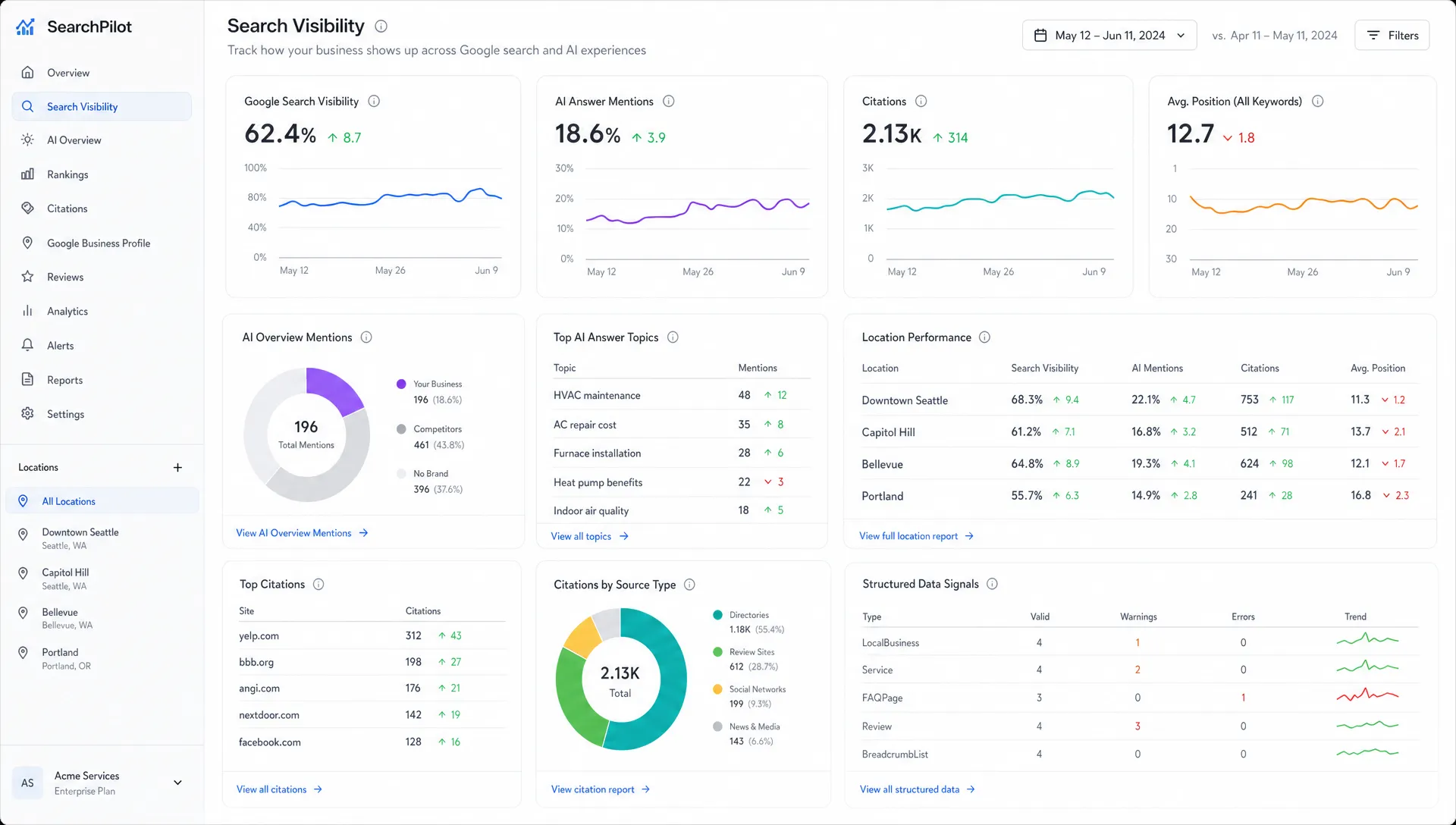
CapstonAI’s optimization workflow connects these technical signals with AI visibility findings. For example, if an important location page is never cited in Google AI Overviews or Perplexity, the fix may be a mix of schema, internal links, clearer answer sections and stronger third-party proof rather than another round of keyword edits.
Build proof outside your own website
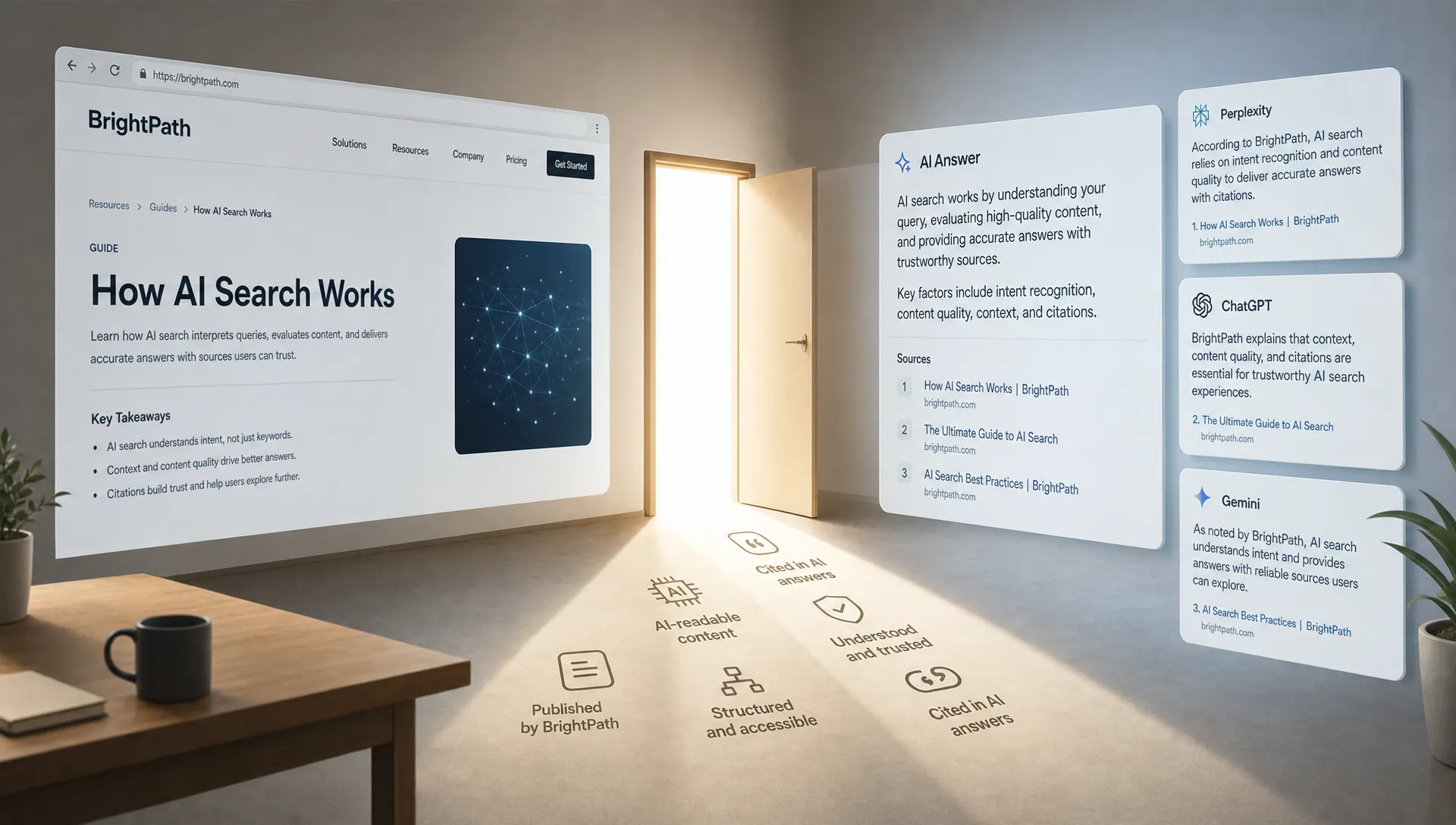
AI systems rely heavily on corroboration. Your website can say you are the best MSP for clinics or the most convenient hotel near an event venue, but external sources help search systems decide whether that claim is credible.
Useful proof can come from review platforms, local directories, industry associations, partner pages, editorial mentions, case studies, comparison guides, startup directories and reputable media coverage. For a new product launch, funding announcement, hotel opening or agency milestone, structured PR can help create verifiable third-party references. Services like press release distribution for broad media visibility can support this when the announcement is real, specific and aligned with your broader entity strategy.
The goal is not to buy noise. It is to create consistent, confirmable signals that reinforce who you are, what you offer and why the market should trust you.
A good external visibility checklist includes:
- Accurate NAP data for every location, meaning name, address and phone number
- Consistent category and service descriptions across directories
- Review profiles that reflect current customer experience
- Earned or distributed media mentions for meaningful company updates
- Partner and association pages that link to the correct official page
- Case studies with specific industries, problems and outcomes where confidentiality allows
For agencies managing multiple client sites, this is often where the hidden opportunity sits. The client may have decent content and acceptable rankings, but AI engines may cite review sites, directories or competitors because the client’s external evidence is incomplete.
Use internal linking to shape discovery paths
Internal links tell Google which pages matter and how concepts connect. They also help users move from research to action. For AI visibility, internal links make your site’s entity graph easier to interpret.
A hotel site should connect city guides to property pages, property pages to amenities, amenities to meeting spaces and meeting space pages to inquiry forms. A franchise brand should connect national service pages to local pages, local pages to nearby service areas and blog content to the most relevant conversion page. An e-commerce store should connect buying guides to categories, categories to products and products to support content.
The anchor text should be natural but specific. “Book a pet-friendly room in Denver” gives more context than “learn more.” “Managed IT services for healthcare clinics” gives more context than “services.”
This does not require overengineering. Start with the top 20 pages that drive revenue or qualified leads. For each page, identify the three to five pages that should support it, then add links where they genuinely help the reader.
Improve visibility for local and multi-location brands
Local visibility is especially sensitive to consistency. Google and AI systems compare your site against Google Business Profile, reviews, maps, directories and other local references. If those sources disagree, your visibility can weaken even when your website looks polished.
For each location, confirm the basics first: official business name, address, phone number, hours, services, categories, images, booking links and review response process. Then make sure the location page is not a thin copy of every other location page. Add neighborhood context, staff credentials, service availability, parking, accessibility details, local testimonials and nearby landmarks where relevant.
For multi-site brands, location pages are often the pages most likely to convert. They are also the pages most likely to be duplicated, outdated or disconnected from the rest of the site. Fixing them improves classic local SEO and gives AI engines clearer facts to reuse.
Prioritize fixes by business impact
The fastest way to waste SEO budget is to treat every ranking fluctuation as urgent. A better system scores visibility issues by impact and fixability.
| Signal | What it may indicate | Practical fix | Business effect |
|---|---|---|---|
| High impressions, low clicks | SERP result is visible but not compelling | Improve title, meta description, rich result eligibility and page intent match | More qualified visits from existing demand |
| AI mentions competitors, not you | Weak entity signals or external proof | Improve service pages, schema, citations and third-party references | More presence in AI-assisted discovery |
| Page ranks but does not convert | Intent mismatch or weak offer clarity | Add decision criteria, proof, FAQs and stronger calls to action | More leads, bookings or sales without needing more traffic |
| Important page not indexed | Crawl or canonical issue | Fix indexability, internal links, sitemap and canonical tags | Restores eligibility for search visibility |
| Strong page is never cited | Content is useful but not extractable | Add concise answer blocks, structured data and clearer headings | Better chance of inclusion in AI summaries |
This approach keeps teams focused. A ranking report tells you what moved. A visibility diagnosis tells you what to fix.
A 30 day plan to improve Google search visibility
You do not need to rebuild your entire website to make progress. A focused 30 day plan can reveal the highest-value issues and start correcting them.
Days 1 to 5: Establish the baseline. Pull Search Console data, identify top pages by impressions and conversions, test priority prompts in ChatGPT, Gemini, Perplexity, Claude, Copilot and Google AI Overviews, then document competitor mentions and citations.
Days 6 to 10: Fix access and metadata issues. Review crawlability, indexation, canonicals, sitemap coverage, title tags, meta descriptions and obvious performance problems on revenue pages.
Days 11 to 17: Improve answer readiness. Add concise answer sections, decision criteria, proof points, FAQs and schema to the pages that already match high-intent searches.
Days 18 to 23: Strengthen entity and location signals. Update Organization, LocalBusiness, Product or Service schema where appropriate. Align your website with Google Business Profile, directories, review sites and partner listings.
Days 24 to 30: Recheck visibility and prioritize the next sprint. Compare prompts, citations, impressions, click-through rate and conversions against the starting baseline. Keep what improved, then move to the next group of pages.
For teams working specifically on Google’s conversational search layer, CapstonAI’s guide to optimizing for Google AI Mode goes deeper into query fan-out, answer formats and cited responses.
Frequently Asked Questions
Does ranking still matter for Google search visibility? Yes. Rankings remain useful, but they are no longer enough. Visibility now includes AI Overviews, local packs, citations, brand mentions, maps, shopping results and other surfaces that influence discovery before a click happens.
What is the difference between SEO, AEO and GEO? SEO improves crawlability, relevance and performance in search engines. AEO structures content so answer engines can extract clear responses. GEO strengthens your brand’s chance of being mentioned or cited by generative engines like ChatGPT, Gemini, Perplexity, Claude, Copilot and Google AI Overviews.
How do I know if AI engines can see my business? Test relevant prompts across multiple AI engines, record whether your brand appears, check which sources are cited and compare your share of voice against competitors. Then inspect whether your pages have clear entity signals, schema, crawlability and external proof.
Should every page have FAQ schema? No. FAQ schema should only be used when the page contains genuine questions and answers that help the user. Forced FAQ sections can dilute quality. Use structured data to clarify real content, not to decorate weak pages.
What should a multi-location brand fix first? Start with location accuracy, unique location pages, Google Business Profile consistency, reviews, LocalBusiness schema, internal links from service pages and clear calls to action. These fixes support local SEO and AI answer visibility at the same time.
Start with a free AI visibility audit
If your team is still measuring success only through keyword positions, you may be missing where prospects now make decisions. AI search can mention a competitor, cite a directory or summarize an outdated page before a visitor reaches your site.
CapstonAI helps brands, retailers and agencies measure and improve visibility across Google AI Overviews, Gemini, ChatGPT, Perplexity, Claude and Copilot. It tracks brand mentions, citations, share of voice and competitor presence, then turns findings into prioritized fixes for metadata, schema, FAQs, internal linking, crawlability, performance and llms.txt.
Start with a free AI visibility audit. If AI cannot see your business clearly, CapstonAI makes it visible enough to measure, improve and defend.