Perplexity and ChatGPT can answer the same commercial question with very different evidence. For brands, that difference matters because a citation is not just a link. It is a trust signal, a discovery path and a clue about what an AI system considers authoritative enough to reuse.
If Perplexity cites your competitor’s buying guide but ChatGPT mentions your brand without a source, those are two different visibility problems. One affects referral traffic and source credibility. The other affects brand recall, shortlisting and how confidently a buyer may act on the answer.
AI search tracking should separate three outcomes:
- No visibility: Your brand is not mentioned or cited.
- Brand mention: Your brand appears in the answer, but no owned or trusted source is cited.
- Citation: Your website, profile, product page, location page or another favorable source is linked or referenced.
That distinction is now central to Generative Engine Optimization (GEO), which focuses on how generative engines surface brands, and Answer Engine Optimization (AEO), which focuses on making content easy to use in direct answers. Both still depend on classic technical SEO: crawlability, internal linking, structured data, entities, schema and page performance.
Perplexity vs ChatGPT: the citation difference in plain terms
Perplexity is designed around sourced answers. Its interface usually foregrounds source cards and inline citations, which makes citation tracking more visible to marketers. ChatGPT behaves differently. It can answer from model knowledge, use web search when available or cite sources in search-backed responses. OpenAI describes ChatGPT search as a way to get timely answers with links to relevant web sources, but citation behavior still varies by prompt, interface, user settings and query type.
That means Perplexity often gives you a clearer source trail, while ChatGPT may give you a broader brand visibility signal. You need both.
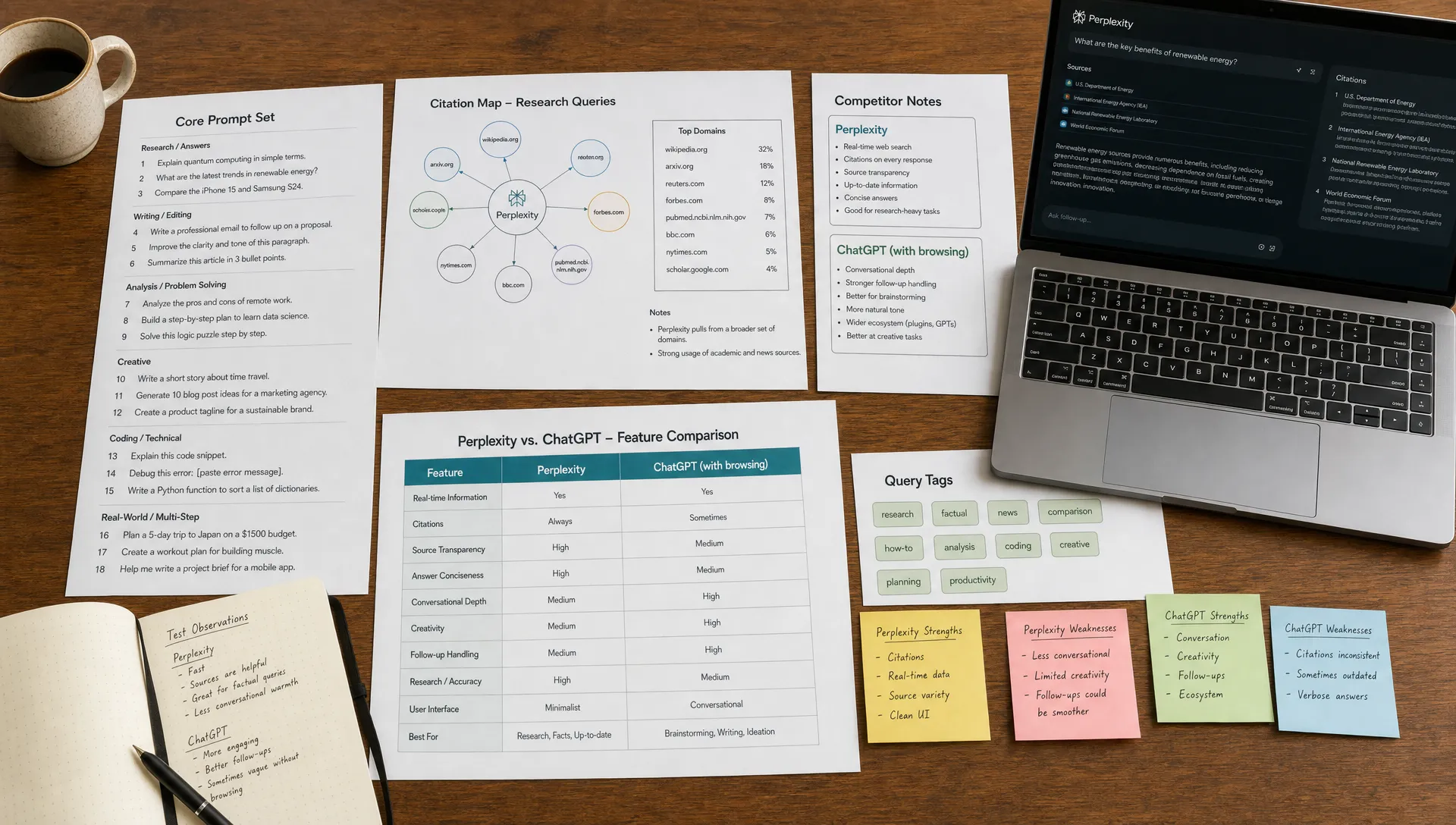
| Citation behavior | Perplexity | ChatGPT | What brands should track |
|---|---|---|---|
| Source visibility | Sources are usually prominent in the answer experience | Sources may appear in search-backed responses, but not in every answer | Citation rate by prompt type and engine |
| Brand mention without link | Less useful as a standalone signal because citations are central to the format | More common, especially for broad or memory-based answers | Mention rate separate from citation rate |
| Freshness sensitivity | Often pulls from current web sources for timely queries | Stronger when search is invoked, weaker when the answer relies on general model knowledge | How quickly new pages or updates appear in answers |
| Citation granularity | Often cites specific pages used to form the answer | May cite sources at the end or alongside statements, depending on experience | Whether the cited URL is the best page for conversion |
| Competitor visibility | Easy to see which competing sources support the answer | Can surface competitors as recommendations even without clear citation paths | Share of voice across prompts |
| Local and commercial intent | Often cites listings, directories, review pages and destination content | May synthesize from broader entity knowledge and web results | Which source types influence bookings, leads or sales |
The practical takeaway is simple: do not ask, “Are we visible in AI?” Ask, “Where are we mentioned, where are we cited and which pages are being trusted?”
What Perplexity citations tend to reveal
Perplexity is useful for diagnosing whether your pages are answer-ready. Because it usually shows sources, you can inspect the pages that support an answer and compare them with your own.
For example, a travel group might test: “best family-friendly hotels near downtown Nashville with parking.” If Perplexity cites OTA pages, listicles and competitor location pages, but not the hotel’s own location page, the issue may not be brand awareness. The issue may be that the owned page does not clearly answer the attributes AI needs to reuse: neighborhood, parking details, room types, family amenities, policies and nearby landmarks.
For e-commerce, Perplexity can expose whether AI systems prefer category guides, product pages, marketplace listings, review sites or third-party comparisons. If the answer cites an outdated buying guide instead of your current product page, you may have a freshness and internal linking problem. If it cites a reseller instead of your canonical product page, you may have an entity and authority problem.
Perplexity citations are especially helpful for finding:
- Pages that AI systems consider more complete than yours
- Outdated third-party pages that still influence answers
- Missing comparison, FAQ or buying-guide content
- Prompts where competitors consistently own the source set
- Pages that are crawlable but not structured enough to be reused confidently
This is where GEO connects directly to business outcomes. A cited page can capture referral visits, but it also shapes the language AI uses to describe your brand. If the cited source says your hotel is “budget-friendly” when your positioning is boutique or premium, visibility may still be misaligned.
What ChatGPT citations and mentions tend to reveal
ChatGPT is often better treated as both a search surface and a brand memory surface. For some prompts, it cites sources. For others, it produces a recommendation or explanation without an obvious source trail. Both outcomes are useful.
A multi-location healthcare brand, for instance, may be mentioned by ChatGPT in response to “urgent care clinics near Austin with online booking,” but not cited. That suggests the brand entity is recognized, but the assistant may not be using the right owned source. The fix is not only more content. It may require clearer location schema, consistent NAP data, crawlable appointment pages, stronger internal links from service pages to location pages and third-party profiles that reinforce the same facts.
ChatGPT visibility tracking should include citations, but it should also include whether the model describes your brand correctly. For many buyers, the answer itself may be enough to influence a shortlist even if they do not click a source.
If you want to go deeper on this specific engine, CapstonAI has a dedicated guide on how to track brand mentions in ChatGPT and compare your visibility with competitors.
The metrics that matter most
A single screenshot from Perplexity or ChatGPT is not a measurement system. You need repeatable prompts, consistent tagging and enough volume to distinguish a one-off answer from a pattern.
A practical starting point is 40 to 100 prompts per important journey. A hotel group might test destination research, amenity comparisons, event travel, “near me” intent and booking-stage prompts. An MSP might test service comparisons, vendor support questions, compliance use cases and local provider searches.
| Metric | What it measures | Why it matters |
|---|---|---|
| Brand mention rate | Percentage of tested answers that mention your brand | Indicates whether you are entering the AI-generated shortlist |
| Owned citation rate | Percentage of answers that cite your website or controlled assets | Connects AI visibility to traffic, leads and booking paths |
| Favorable third-party citation rate | Percentage of answers citing review sites, partners or media that describe you accurately | Shows whether external proof supports your positioning |
| Competitor share of voice | Your mentions and citations compared with named rivals | Reveals who is winning the AI answer set |
| Prompt-level gap | Prompts where competitors appear and you do not | Creates a prioritized content and technical SEO backlog |
| Citation quality | Whether the cited page is current, relevant and conversion-ready | Prevents AI systems from sending buyers to weak or outdated pages |
| Source diversity | Mix of owned pages, directories, reviews, forums, media and marketplaces | Shows where authority is coming from |
| Freshness lag | Time between a page update and visibility in AI answers | Helps teams understand whether fixes are being picked up |
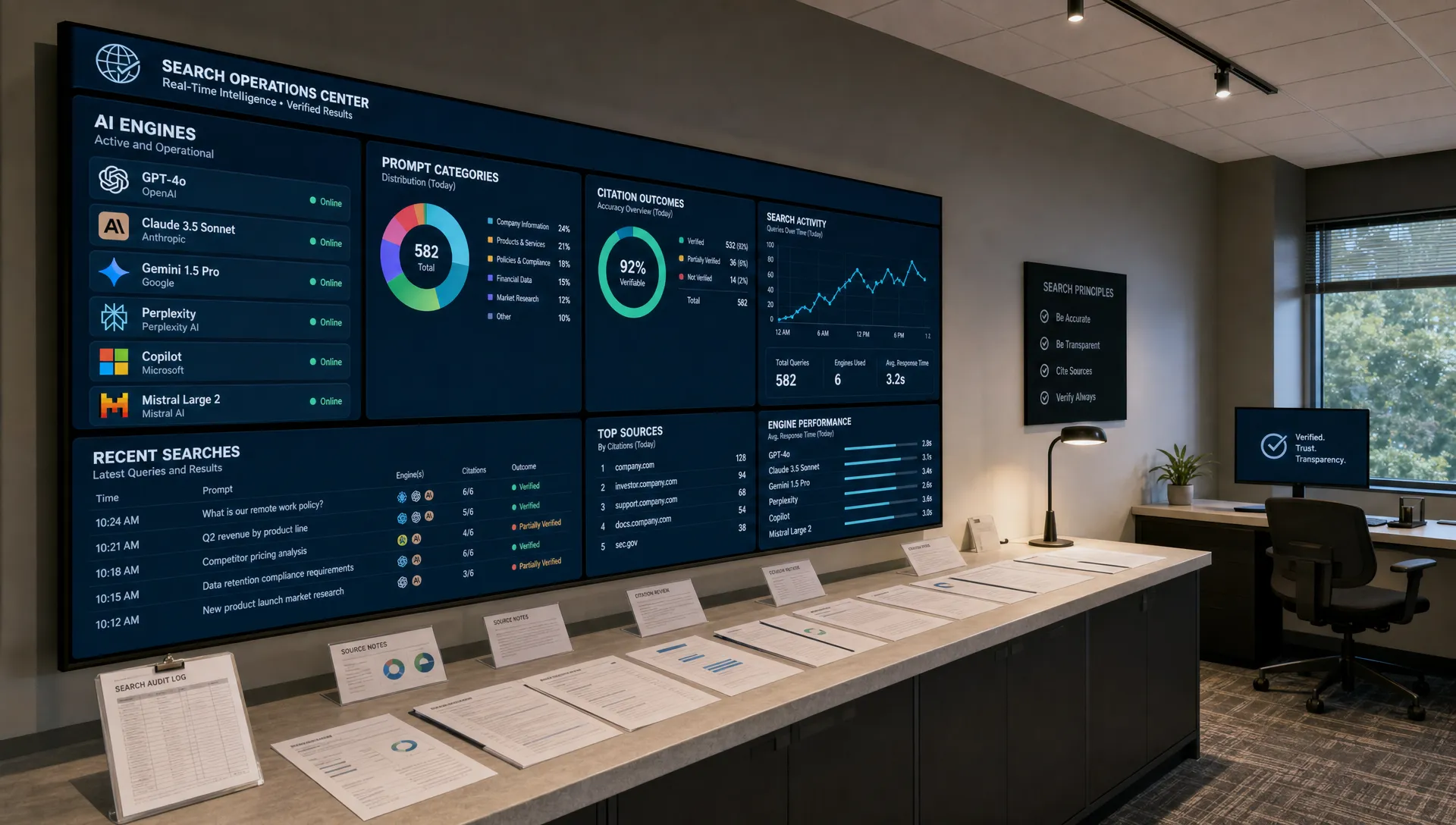
Track these metrics separately for Perplexity, ChatGPT, Google AI Overviews, Gemini, Claude and Copilot. Each engine has different retrieval behavior, but the business question is the same: which brands are being used to answer your prospects?
Prompt categories brands should test
The best prompt set mirrors the buyer journey, not your website navigation. AI users do not always search with neat keywords. They ask comparative, contextual and task-based questions.
For hospitality and travel groups, test prompts around destination fit, amenities, parking, accessibility, loyalty benefits, events, family travel and local attractions. For example: “best hotels near the convention center in Denver with shuttle service” or “where should a family stay in Savannah for a weekend without renting a car?”
For multi-site brands, test service plus location prompts. Healthcare, education and retail chains should monitor how AI systems describe locations, hours, services, eligibility, reviews and booking options. A franchise may rank well in Google, but if ChatGPT cites a directory with stale hours, that creates a credibility gap.
For e-commerce, test product discovery, alternatives, price-sensitive comparisons, use-case prompts and post-purchase questions. A WooCommerce store selling specialty equipment should know whether AI cites its own buying guide, a marketplace listing, a manufacturer page or a competitor’s “best of” article.
For B2B service providers, prompts often happen before a buyer fills out a form. In procurement-heavy categories, a prospect may ask how to audit software waste, review licenses or prepare for renewal negotiations. A Salesforce-focused procurement specialist such as SaaSed’s Salesforce procurement team would want to know whether AI engines cite its audit, SKU review and negotiation content or whether generic SaaS advice sites shape the answer instead.
Why citations differ by engine
Perplexity and ChatGPT differ because generative engines do not all retrieve, rank and present sources in the same way. Even when two systems access the web, they may choose different documents, summarize them differently or attach citations at different levels of detail.
Several factors usually influence which sources appear:
- Crawlability: If important content is blocked, hidden behind scripts or difficult to render, it is less likely to be used reliably.
- Entity clarity: AI systems need to understand who you are, what you offer, where you operate and how your pages connect.
- Content structure: Clear headings, concise answers, tables, FAQs and comparison sections make pages easier to reuse.
- Source authority: Official pages, credible third-party references, reviews, media mentions and partner profiles can reinforce trust.
- Freshness: Updated pages are more likely to match time-sensitive prompts, especially around pricing, availability, policies and events.
- Technical SEO foundations: Fast pages, clean canonicals, useful internal linking, indexable content and valid schema reduce ambiguity.
Structured data is not a magic citation button, but it helps machines interpret entities and relationships. Google’s documentation on structured data for search is still a useful foundation because many AI search experiences depend on the same web clarity that traditional search has rewarded for years.
For a deeper explanation of source selection signals, CapstonAI’s guide to how AI-driven search engines choose sources to cite breaks down the mechanics in more detail.
How to improve citations in both Perplexity and ChatGPT
The goal is not to “trick” AI engines. The goal is to make your most useful, accurate and commercially important pages easy to find, understand and cite.
Start with pages that already matter to revenue: location pages, service pages, product category pages, buying guides, comparison pages, FAQs and support content. Then check whether each page answers the questions AI users actually ask.
A strong AI-ready page usually includes a direct answer near the top, specific details that support the claim, clear entity signals and internal links to related pages. A hotel location page should not only say “great location.” It should name the district, nearby venues, transit options, parking policy, check-in details and amenities that match real prompts. A service page should not only describe capabilities. It should explain use cases, industries served, proof points, service areas and next steps.
Use schema where it reflects visible page content. Organization, LocalBusiness, Product, Service, FAQPage, BreadcrumbList and Review schema can all help when appropriate. Keep the markup accurate. Inflated or mismatched schema can create trust problems and does not help buyers.
Consider publishing an llms.txt file as an emerging AI-readability signal. It can point AI systems toward preferred content, documentation or important pages, but it should not be treated as a replacement for crawlable HTML, sitemaps, schema or sound internal linking.
Page performance also matters. Faster pages are easier for users and crawlers to access, especially on mobile. Performance alone will not guarantee citations, but slow, bloated or script-dependent pages can make your best information harder to retrieve.
A simple tracking workflow for teams
You do not need to boil the ocean. A weekly or monthly workflow can produce enough evidence to guide fixes.
- Build a prompt library: Group prompts by journey stage, location, product category, service line and competitor set.
- Run prompts across engines: Test Perplexity, ChatGPT, Google AI Overviews, Gemini, Claude and Copilot with consistent settings where possible.
- Tag every answer: Record brand mentions, citations, cited URLs, competitor appearances, source type and answer sentiment.
- Map gaps to fixes: Connect missing citations to specific pages, schema issues, crawlability problems or missing content.
- Measure before and after: Re-test the same prompts after updates so your team can see whether visibility, citation rate or share of voice changed.
A simple example: if an e-commerce brand tests 60 prompts and sees competitors cited in 38 answers while its own site is cited in 9, the next question is not “Should we publish more?” It is “Which cited competitor pages answer better than ours, and which technical signals make them easier for AI to trust?”
That is the difference between AI search reporting and AI search optimization.
Common mistakes when comparing Perplexity and ChatGPT
The first mistake is treating all citations as equal. A citation to your homepage may be less valuable than a citation to a high-converting category page. A citation from a third-party review site may be helpful if it is accurate, but harmful if it contains outdated pricing, old locations or weak positioning.
The second mistake is tracking only owned URLs. AI engines may cite directories, review platforms, forums, media coverage, vendor pages and partner profiles. Those sources influence how your brand is described, even when your site is not cited.
The third mistake is ignoring zero-click outcomes. ChatGPT may influence a buyer without sending traffic. If your brand is recommended but not cited, you still need to track the mention, the context and the competitor set.
The fourth mistake is optimizing for one engine only. Perplexity can show clear citation gaps. ChatGPT can reveal brand understanding gaps. Google AI Overviews, Gemini, Claude and Copilot add more surfaces where prospects may encounter your business. A durable GEO and AEO program measures across the full set.
Frequently Asked Questions
Is a ChatGPT brand mention as valuable as a citation? Not always. A mention can influence awareness and shortlisting, but a citation gives the user a source path and can drive traffic. Track both separately because they affect different parts of the buyer journey.
Why does Perplexity cite my competitor but not my website? The competitor’s page may answer the prompt more directly, have clearer structure, stronger external references or better crawlability. Compare the cited page with yours, then fix content gaps, schema, internal links and entity signals.
Can structured data guarantee citations in Perplexity or ChatGPT? No. Schema helps AI systems understand page content and entities, but it does not force a citation. It works best alongside crawlable content, useful answers, strong internal linking, credible third-party signals and good page performance.
How often should brands track AI citations? Monthly tracking is a practical baseline for most brands. Teams in competitive travel, local services, e-commerce or fast-changing B2B categories may benefit from weekly monitoring around launches, seasonal demand or major content updates.
Should I optimize differently for Perplexity and ChatGPT? The foundations overlap, but measurement should be engine-specific. Perplexity is useful for source-level citation analysis. ChatGPT requires attention to both citations and uncited brand mentions, especially for shortlist and recommendation prompts.
Start with a free AI visibility audit
Before changing pages, measure what Perplexity, ChatGPT and other generative engines already see. CapstonAI helps brands track mentions, citations, competitor share of voice and prompt-level gaps across AI search surfaces, then turns those findings into prioritized fixes for content, schema, metadata, crawlability and AI-ready pages.
If AI cannot see your business clearly, it cannot cite it reliably. Start with a free AI visibility audit using CapstonAI’s AI visibility tool and see which prompts surface your brand, which ones surface competitors and which pages need to be fixed first.