An intelligent search engine does not need a prettier version of your website. It needs a website it can access, understand, trust and reuse when someone asks a commercial question.
That distinction matters because search is no longer limited to ten blue links. ChatGPT, Google AI Overviews, Gemini, Perplexity, Claude, Copilot and similar systems can summarize options, compare providers, recommend local businesses and cite sources before a buyer ever lands on your site. If your pages are slow, vague, poorly structured or disconnected from the broader web, the engine may answer with a competitor instead.
Classic SEO still matters. Crawlability, indexability, internal links, metadata and page performance remain the foundation. What changed is the output. Intelligent search engines look for answer-ready content, clear entities, structured data, citations, brand mentions and proof that your business is the right answer for a specific need.
If you are still only tracking traditional positions, you are measuring part of the picture. CapstonAI has covered why website rank alone can miss your AI visibility problem, and the same idea applies here: a page can rank, yet still fail to appear in AI-generated answers.
What counts as an intelligent search engine?
An intelligent search engine is a system that uses search indexes, language models, entity understanding and retrieval to generate or assemble an answer. It may crawl the open web, rely on an existing search index, pull from structured databases or combine several sources in real time.
Traditional search asks: which page best matches this query? Intelligent search asks a broader set of questions:
- Which business, product, place or expert is relevant to the user's intent?
- Which sources explain that entity clearly enough to cite or summarize?
- Which answer is specific, current and trustworthy enough to present directly?
That is why Generative Engine Optimization (GEO), Answer Engine Optimization (AEO) and technical SEO now overlap. GEO focuses on being represented accurately in generated answers. AEO focuses on formatting content so it can answer questions directly. Technical SEO ensures engines can crawl, render and evaluate the underlying site.
For businesses with many pages, locations or products, the challenge is not just writing more content. It is making the existing business reality legible to machines.
1. Crawlable pages with stable technical signals
Before an intelligent search engine can understand your site, it has to reach the right content. That starts with the same technical signals good SEO teams already know: clean status codes, accurate canonicals, XML sitemaps, sensible robots.txt rules, server reliability and pages that do not hide critical content behind fragile scripts.
For AI search, crawlability has a second business effect. If generative engines and the search indexes they depend on cannot consistently access your pages, they have less evidence to use when forming an answer. The result can be outdated recommendations, missing locations, incomplete product details or no mention at all.
A practical technical baseline includes:
- Make core page content available in HTML, not only inside client-side interactions.
- Use 200 status codes for live canonical pages and clear redirects for moved content.
- Keep XML sitemaps current for important pages, including location, product and service pages.
- Avoid blocking useful content, scripts or structured data with robots rules.
- Fix duplicate pages that split signals across near-identical URLs.
Page performance also belongs here. Google’s Core Web Vitals thresholds give useful benchmarks: Largest Contentful Paint under 2.5 seconds, Interaction to Next Paint under 200 milliseconds and Cumulative Layout Shift below 0.1. These metrics do not guarantee AI visibility, but they reduce friction for users and crawlers. For a hotel booking page, product category or clinic appointment page, speed affects both discoverability and conversion.
For a broader build-level checklist, see CapstonAI’s guide to building a website with SEO that AI engines can understand. The short version is simple: intelligent search cannot reward what it cannot reliably read.
2. Clear entities, not vague marketing copy
AI systems rely heavily on entities. An entity is a distinct thing that can be identified and connected to other facts: a brand, hotel, clinic, campus, product, physician, service area, software category or store location.
Many websites make entities harder to understand than they need to be. They use poetic positioning on important pages but leave out basic facts such as service area, exact product type, audience, credentials, amenities, policies, location relationships or parent brand structure.
A multi-location healthcare group, for example, should not force an AI engine to infer which clinics offer pediatric care, which accept walk-ins and which are open on Saturday. A hotel group should make room types, amenities, neighborhood names, accessibility features and booking conditions explicit. A WooCommerce store should expose product attributes, availability, shipping regions and return policies in consistent fields.
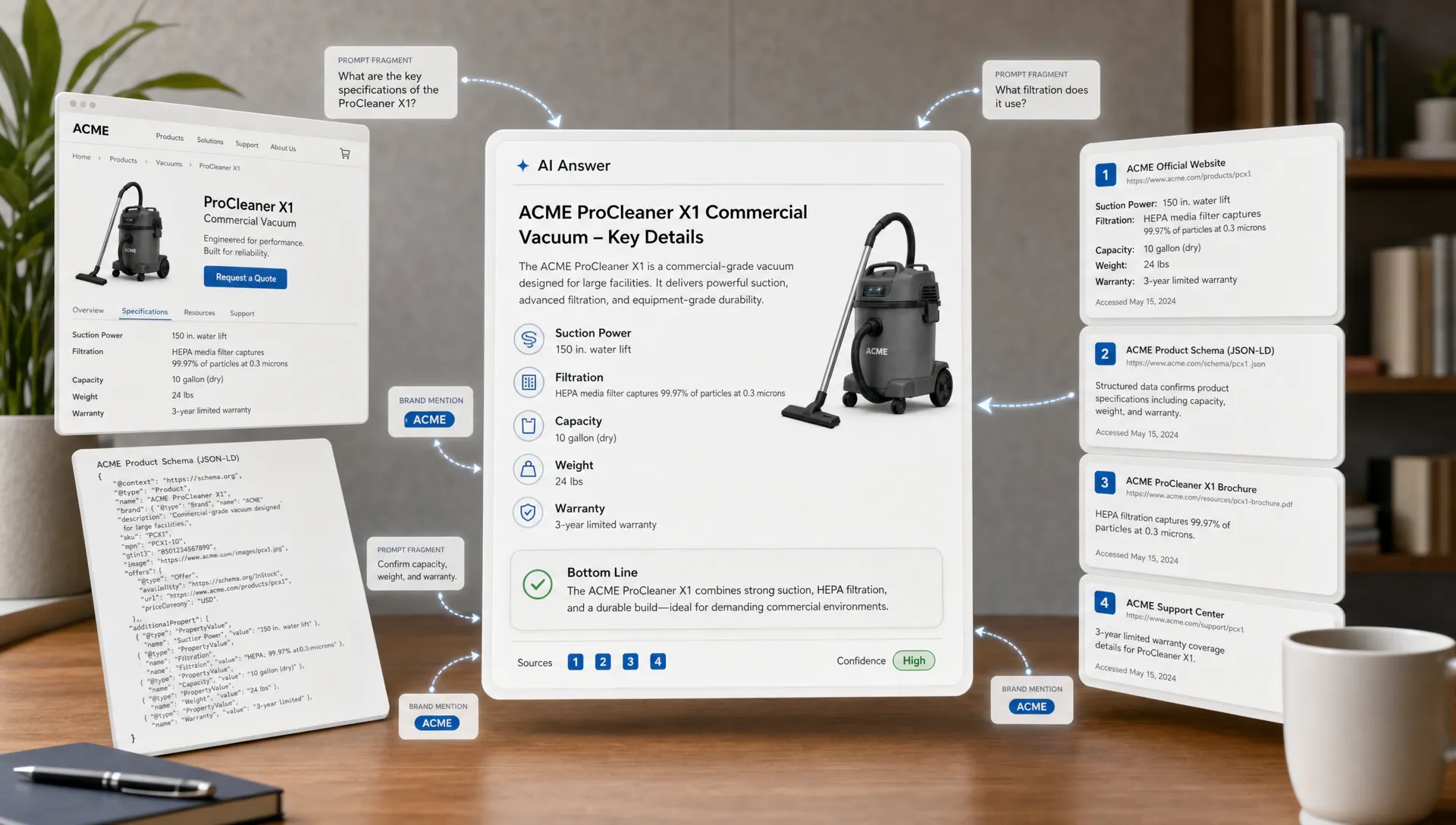
Structured data helps reinforce those facts. Schema markup in JSON-LD can describe the page using types such as Organization, LocalBusiness, Hotel, Product, Service, FAQPage, BreadcrumbList and Article. The markup should match visible page content. Schema that claims more than the page shows can weaken trust rather than strengthen it.
| Website element | What an intelligent search engine needs | Business effect |
|---|---|---|
| Organization page | Legal name, brand name, logo, sameAs profiles, contact points | Reduces confusion with similar brands |
| Location page | Address, geo area, hours, services, phone, booking path | Improves local relevance and appointment or booking intent |
| Product page | Name, price or price range when available, availability, reviews, attributes | Supports comparison and purchase answers |
| Service page | Who it is for, what is included, proof, location or delivery model | Helps engines match the service to specific prompts |
| Author or expert page | Credentials, topical focus, publication history | Builds trust for advisory or YMYL-adjacent content |
Entity clarity is not a technical nicety. It affects whether AI systems can connect your brand to the right category and buyer need.
3. Answer-ready content that matches real prompts
AEO starts with a practical observation: people ask AI systems complete questions. They do not always type short keywords. A travel planner may ask for the best boutique hotel near a conference venue. A parent may ask which tutoring center offers summer math support in a specific city. A retail buyer may ask which store has sustainable linen bedding with fast shipping.
Your website should give engines enough structured, specific content to answer those prompts without guessing.
This does not mean every page needs a giant FAQ block. It means important pages should include concise answers to the questions that affect a decision: who the offer is for, what is included, where it is available, what makes it credible, how it compares and what the next step is.
| Audience | Prompt an AI assistant may answer | Website evidence needed |
|---|---|---|
| Hotel group | Best family-friendly hotel near downtown Austin with parking | Location, amenities, parking policy, room types, nearby landmarks |
| Franchise healthcare brand | Urgent care clinic open Sunday near Raleigh | Individual location hours, services, booking or walk-in rules |
| E-commerce store | Best mid-priced waterproof hiking jacket for women | Product attributes, category guidance, reviews, comparison copy |
| MSP | IT support provider for dental practices in Chicago | Industry focus, service area, proof, security and compliance content |
| SEO agency | WordPress agency that improves AI search visibility | Services, case evidence, technical capabilities, content methodology |
Answer-ready content should be direct. If a page takes six paragraphs to say who it serves, an AI system may prefer a competitor whose page is clearer.
4. Trust signals that can be cited and corroborated
Generative engines tend to perform better when they can corroborate claims. Your website is one source. Reviews, directories, partner pages, knowledge panels, industry databases, press mentions, documentation and customer stories can all contribute to how your brand is represented.
This is where brand mentions and citations become measurable assets. A brand mention is a reference to your business, with or without a link. A citation is a referenced source used in an AI answer or search result. Both matter because intelligent search engines often look beyond your own domain when deciding what to surface.
For visual and experiential brands, the same principle applies. A luxury, beauty or lifestyle company may invest heavily in CGI, immersive worlds and AI-assisted production through a creative-technology studio for ambitious brands, but the campaign still needs crawlable context: project pages, descriptive copy, alt text, credits, transcripts and structured information. AI systems cannot infer the strategic value of a visual experience if the web only exposes a gallery with vague captions.
Strong proof does not have to be long. It has to be specific. A hotel page can reference verified amenities and nearby attractions. A clinic page can show provider credentials and accepted services. An e-commerce page can surface review patterns, product specifications and shipping policies. An MSP can publish service-level details, security practices and industry experience.
5. Internal linking that explains relationships
Internal linking is not only a way to pass ranking signals. It is also a way to explain how your business is organized.
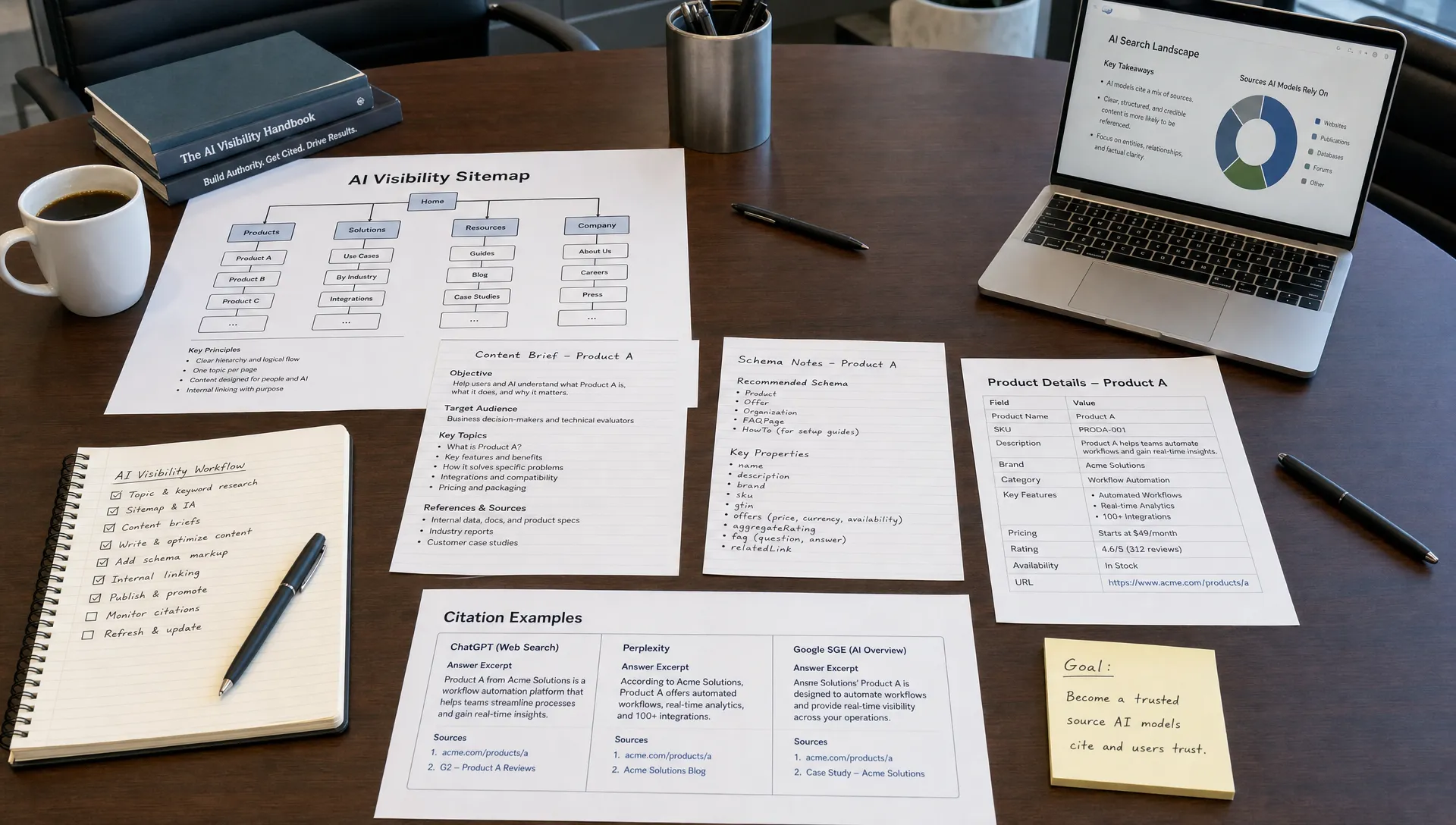
A location page should link naturally to relevant services, nearby areas and booking paths. A product category should link to buying guides, comparison pages and flagship products. A service page should connect to case studies, FAQs, industry pages and proof points. Breadcrumbs should reinforce where each page sits in the site architecture.
This helps intelligent search engines answer relationship questions, such as whether a service is available at a specific location or whether a product belongs to a certain category. It also helps users move from an AI summary into a useful page rather than a generic homepage.
Anchor text should be descriptive without being stuffed. Phrases like pediatric urgent care in Plano, managed IT support for law firms or waterproof hiking jackets give clearer signals than learn more or services.
The shift is part of a larger search pattern where ranking is evolving beyond blue links. Internal links now support not only crawling and ranking but also semantic interpretation.
6. AI-readable metadata, schema and llms.txt
Metadata still matters, but not as a standalone trick. Title tags and meta descriptions help define page purpose in search results and indexes. Open Graph tags influence how pages appear when shared. Schema helps machines interpret visible content. Together, they create cleaner inputs for search and AI systems.
For AI visibility, metadata should be consistent with the page’s actual intent. If a hotel page title says luxury spa hotel in Scottsdale but the page barely mentions spa facilities, the signal is weak. If a product page claims best running shoes for flat feet but lacks fit details, review evidence or product attributes, the engine has little to reuse.
Structured data should be treated as confirmation, not decoration. Good schema answers practical questions:
- What type of page is this?
- Which entity is the page about?
- Which organization owns or publishes it?
- Which locations, products, services, reviews or questions are represented?
- How does this page relate to the rest of the site?
llms.txt is another emerging signal. It is a plain text file, often placed at the root of a domain, that can point AI systems toward important resources, documentation and preferred content paths. It is not a replacement for robots.txt, sitemaps or schema. It is best viewed as an additional guide for AI consumption, especially for sites with documentation, product catalogs, service libraries or many locations.
The business value is practical: cleaner machine-readable guidance reduces ambiguity. Less ambiguity increases the chance that AI systems describe your business accurately.
7. Freshness, change tracking and AI share of voice
AI visibility is not fixed. Model behavior changes, search indexes refresh, competitors publish new content and customer questions evolve. A page that appears in Perplexity today may not appear in Gemini next month. A brand that gets mentioned in ChatGPT for one prompt may be absent for a closely related prompt with higher commercial value.
That is why measurement needs to move beyond rank tracking alone. Useful AI visibility tracking looks at:
- Which prompts surface your brand.
- Which prompts surface competitors instead.
- Whether your brand is mentioned, cited or both.
- Which pages are used as sources.
- How your share of voice changes across engines and assistants.
- Which technical or content fixes improve visibility after publishing.
For a franchise, this can reveal that the corporate brand is visible but individual locations are missing. For an e-commerce store, it can show that buying guides are cited but product pages are not. For an agency, it can identify which client pages need schema, internal links or clearer answers.
CapstonAI is built around this measurement-first workflow. It scans AI visibility across engines and assistants, maps prompts and mentions, tracks competitors, diagnoses blind spots and turns key pages into AI-ready assets through prioritized recommendations. For WordPress-first teams, the goal is not to create another reporting layer. It is to connect the visibility problem to fixes that can be published and tested.
A practical readiness checklist
If you want to know whether your website gives an intelligent search engine enough to work with, start with the pages that influence revenue: location pages, service pages, category pages, product pages, booking pages and high-intent guides.
Use this checklist as a first pass:
- Can a crawler access and render the important content without relying on hidden interactions?
- Does each page name the primary entity, location, product or service clearly?
- Does the content answer real buyer questions in plain language?
- Is structured data present, valid and aligned with visible page content?
- Do internal links connect related services, locations, categories and proof pages?
- Are claims supported by reviews, credentials, case evidence or third-party references?
- Are titles, descriptions, headings and URLs specific rather than generic?
- Is page performance strong enough to support both crawling and conversion?
- Are brand mentions and citations monitored across AI engines?
- Do you know which prompts make competitors visible when you are absent?
The checklist is intentionally operational. AI visibility improves when technical, content and trust signals reinforce the same truth about your business.
What intelligent search engines still cannot infer for you
AI systems are powerful at summarizing information, but they should not be expected to invent your positioning. If your site does not state that a clinic offers occupational health services, that a hotel allows pets under certain conditions or that an MSP specializes in healthcare IT, the engine may omit those facts.
They also struggle with businesses that have inconsistent naming across the web. If your Google Business Profile, website footer, directory listings, social profiles and schema use different names or service categories, the entity becomes harder to trust.
The same is true for visual content. Images, videos, interactive demos and virtual experiences need surrounding text, captions, alt text, transcripts and project context. AI can analyze some media, but web retrieval still depends heavily on text and structured signals.
Your site should not make the engine guess. It should provide the answer, the evidence and the relationship between them.
Frequently Asked Questions
Is AI search optimization the same as SEO? No. SEO remains the foundation because engines still need crawlable, fast and well-structured pages. AI search optimization adds GEO and AEO, which focus on being accurately mentioned, cited and reused in generated answers.
What is the difference between GEO and AEO? GEO, or Generative Engine Optimization, improves how your brand appears in AI-generated responses. AEO, or Answer Engine Optimization, structures content so it can directly answer specific user questions. They work best when supported by technical SEO.
Does schema guarantee visibility in ChatGPT, Gemini or Google AI Overviews? No. Schema helps machines understand page content, but it does not guarantee inclusion. Visibility also depends on crawlability, content quality, citations, entity clarity, user intent match and the behavior of each engine.
What is llms.txt used for? llms.txt is an emerging file format that can guide AI systems toward important pages, documentation or content resources. It should complement sitemaps, robots.txt, structured data and strong internal linking rather than replace them.
How often should a brand audit AI visibility? High-change sites, such as e-commerce, travel, healthcare and franchises, should review AI visibility regularly because prompts, citations and competitor mentions can shift as pages and indexes change. The right cadence depends on how often your market and site content change.
What should multi-location brands prioritize first? Start with location pages. Each page should clearly show the address, hours, services, booking path, local proof, schema and links to related services. This gives AI systems the facts needed to match local intent.
Start with a free AI visibility audit
An intelligent search engine needs clarity, evidence and structure. If your website has those signals, AI systems have a better chance of finding, understanding and citing your business. If the signals are missing, your competitors may become the answer by default.
CapstonAI helps brands, retailers, agencies and multi-location teams see what AI engines see, what they miss and which fixes should come first. Start with a free AI visibility audit to identify blind spots across ChatGPT, Google AI Overviews, Gemini, Perplexity, Claude and Copilot, then turn your key pages into assets AI can read, trust and reuse.