AI has not made SEO irrelevant. It has made SEO harder to measure with old dashboards.
For years, the basic model was simple: rank for a query, win a click, convert the visitor and attribute the lead back to organic search. That model still exists, but it is no longer the whole picture. Prospects now ask ChatGPT, Google AI Overviews, Gemini, Perplexity, Claude and Copilot for answers that summarize multiple sources before a traditional click happens.
The real impact of AI on SEO is showing up in three connected places: traffic, leads and reporting. Some pages lose clicks because answers are resolved in the search experience. Some brands gain demand because they are mentioned or cited by generative engines. Many teams see attribution become less tidy, even when pipeline stays healthy.
The practical question is not “Will AI kill SEO?” It is “Can AI systems see, understand, trust and reuse your business when buyers ask for recommendations?”
What changed: search is now part answer, part retrieval system
Classic search returned a list of ranked pages. AI search returns an answer assembled from web pages, knowledge graphs, product data, reviews, structured information and model memory. In some cases, the answer includes citations. In other cases, it mentions a brand without sending a measurable visit.
That changes the job of SEO in two ways.
First, technical SEO still matters. If a page is slow, blocked, thin, duplicated or hard to crawl, it is less likely to perform well in traditional search and less likely to become useful source material for AI systems.
Second, AI visibility becomes its own measurable layer. A brand needs to know whether it appears in answers, which prompts surface it, which competitors are mentioned instead and whether the answer is accurate enough to influence a booking, lead or sale.
Two newer disciplines fit into that layer:
- AEO, or Answer Engine Optimization: shaping pages so they directly answer buyer questions with clear, verifiable information.
- GEO, or Generative Engine Optimization: improving the likelihood that generative engines can cite, summarize and recommend your brand accurately.
The business effect is straightforward. If a hotel group, franchise, MSP or ecommerce brand is absent from AI-generated answers, it can lose consideration before a prospect reaches a website.
The impact of AI on SEO traffic
The first visible effect is usually traffic volatility. Informational pages are most exposed because AI answers can satisfy simple questions without a click. A user asking “what is the best time to visit Asheville” or “how does managed IT pricing work” may get enough context from an AI answer to continue the journey elsewhere.
That does not mean every organic click disappears. Commercial, local, branded and transactional searches still produce visits, especially when users need availability, pricing, inventory, forms, reviews or direct confirmation. The pattern we observe is more specific: broad educational clicks become less predictable, while high-intent visits matter more.
For reporting, this means a traffic decline is not automatically a demand decline. It may reflect a shift in where the first answer is delivered.
| Query type | Likely AI impact | What to watch |
|---|---|---|
| Simple informational queries | More zero-click answers | Impressions, citations, answer accuracy and assisted conversions |
| Comparison queries | More AI-mediated shortlists | Brand mentions, competitor presence and share of voice |
| Local service queries | Mixed impact, often still click-heavy | Map visibility, location pages, reviews and structured data |
| Branded queries | Usually resilient but more scrutinized | Accuracy of brand facts, sitelinks, reviews and direct conversions |
| Product queries | Depends on product data quality | Feed consistency, schema, reviews, availability and category clarity |
Google AI Overviews made this shift more visible because AI-generated summaries sit inside the traditional results page. If you want a deeper CTR-specific breakdown, CapstonAI has a separate analysis of how AI Overviews affect CTR and what to monitor.
The important point for 2026 planning is that organic traffic alone is now an incomplete proxy for organic influence. A page can influence an AI answer without receiving the first click. A brand can be recommended in a generative answer, then get a later direct visit, branded search or call.
That creates a measurement gap. Closing it requires tracking AI mentions and citations alongside Search Console, analytics and CRM data.
The impact on leads: fewer clean paths, more pre-qualified visitors
AI changes lead generation because it moves research upstream. Buyers can compare options, identify questions, shortlist vendors and eliminate weak candidates before they visit a site.
For a hotel chain, an AI assistant might summarize family-friendly properties near a destination, compare amenities and suggest two or three brands. For an MSP, a buyer might ask Copilot or Perplexity to compare managed security services in a region. For a franchise healthcare brand, a patient might ask which clinic network offers a specific service near them.
If your brand appears with accurate details, the eventual visitor may arrive more informed. If your brand is missing, outdated or incorrectly described, you may not see the lost lead in analytics at all.
This is why lead quality can move differently from traffic volume. Some teams will see fewer sessions from broad content but stable or stronger conversion rates from the visitors who do arrive. Others will see branded demand soften because AI answers keep recommending better-documented competitors.
The lead impact tends to show up in five places:
- More direct and branded traffic after off-site AI research.
- More “how did you hear about us?” answers that mention ChatGPT, Perplexity or Google summaries.
- Lower conversion from generic educational pages if they no longer attract early-stage visits.
- Higher scrutiny of proof points, reviews, pricing clarity, location details and service availability.
- More competitor displacement when AI answers cite a rival’s clearer page.
For ecommerce, the same logic applies at the product and category level. A buyer researching packaging, apparel or accessories may rely on AI summaries before choosing a vendor. A product page for custom woven labels, patches and ribbons shows the kind of category specificity that matters: clear product types, use cases and supporting information give both shoppers and AI systems more concrete material to interpret.
The fix is not to write longer pages for their own sake. The fix is to make each commercially important page answer the questions a buyer would ask before converting.
The impact on reporting: rankings are no longer enough
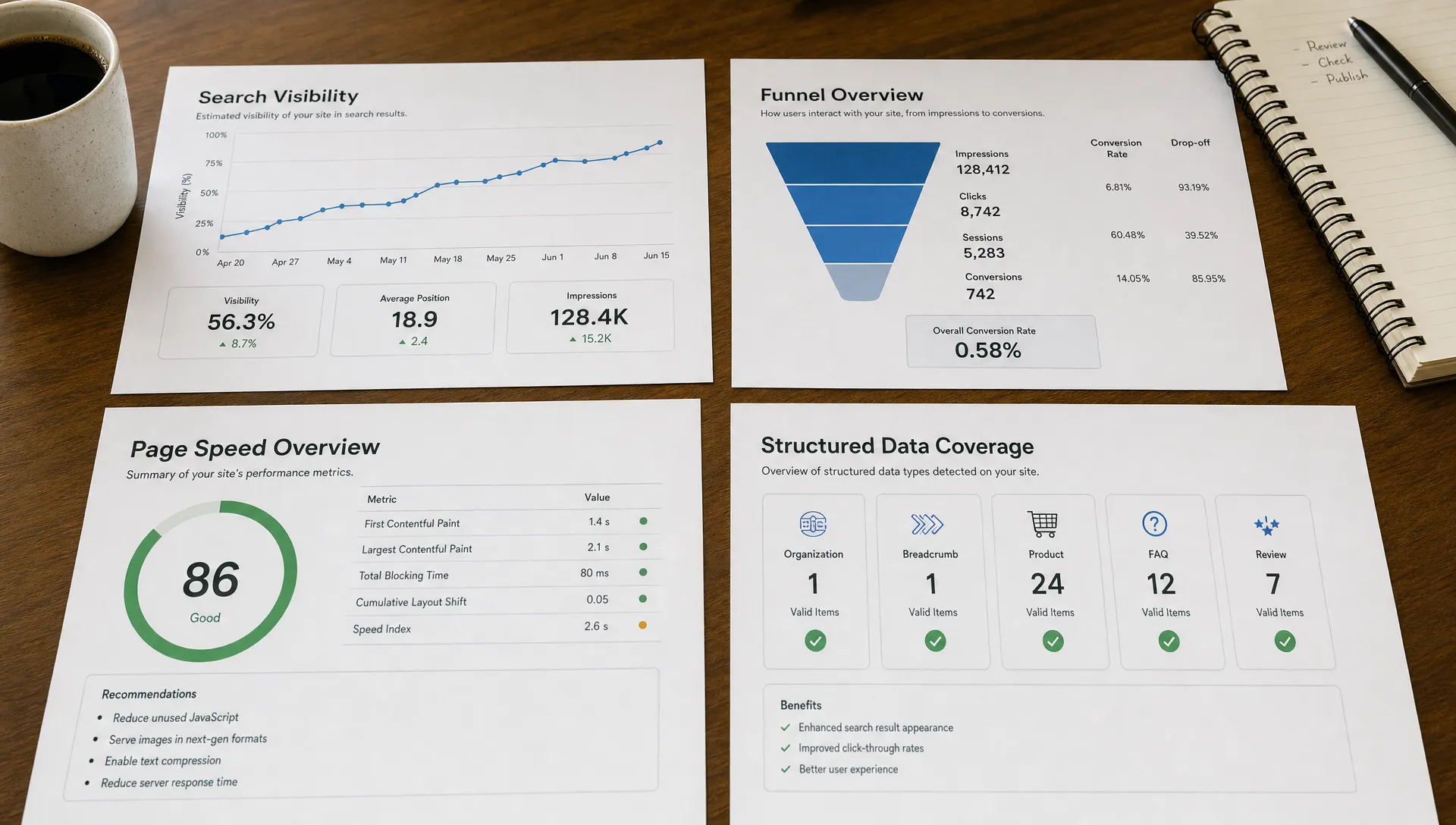
Traditional SEO reporting still has value. Rankings, impressions, clicks, crawl errors, Core Web Vitals, indexed pages and conversions remain necessary. They just no longer explain the full path from search demand to revenue.
AI search adds a new reporting layer:
| Old SEO report question | AI-era reporting question | Business effect |
|---|---|---|
| Where do we rank? | Are we mentioned or cited in AI answers? | Measures whether buyers see you before the click |
| How many clicks did we get? | Which prompts influenced visibility, even without a click? | Captures off-site discovery and demand creation |
| Which keywords converted? | Which buyer questions, prompts and journeys create leads? | Aligns content to intent, not just terms |
| Who outranks us? | Which competitors dominate AI share of voice? | Shows where rivals are winning consideration |
| Did traffic grow? | Did visibility, accuracy and pipeline improve together? | Connects SEO work to revenue outcomes |
This is where many SEO dashboards break. They treat all organic influence as click-based, but AI search can create awareness without a visible referral. Perplexity may send a cited click. ChatGPT may influence a later branded visit. Google AI Overviews may reduce clicks to a top result but still surface the brand as a cited source.
A modern report should separate three layers:
Search performance: rankings, impressions, clicks, CTR, indexed pages, page performance and conversions.
AI visibility: prompt coverage, brand mentions, citations, answer accuracy, sentiment, engine-by-engine presence and share of voice.
Commercial outcomes: assisted conversions, direct and branded lift, form quality, booking quality, pipeline value and customer acquisition cost.
CapstonAI’s guide to weekly SEO tracking for AI search goes deeper into the recurring metrics teams should monitor as this reporting layer matures.
What AI systems need before they can recommend you
AI visibility starts with being understandable. A generative engine cannot reliably recommend a business if the web gives it conflicting facts, thin pages or unclear relationships between services, locations, products and proof.
An entity is a recognized thing: a brand, location, service, product, person, organization or topic. Entity clarity helps AI systems connect “CapstonAI,” “AI visibility platform,” “GEO,” “AEO,” “ChatGPT tracking” and “brand citation monitoring” as related concepts rather than isolated keywords.
The technical foundations are not glamorous, but they are what make AI visibility possible.
Crawlability and indexability
If key pages are blocked, canonicalized incorrectly, buried behind scripts or omitted from internal links, search engines and AI systems have weak source material. This affects traffic because pages may not rank. It affects leads because conversion pages may not be found. It affects reporting because performance looks like a content problem when the real issue is access.
For multi-site brands, crawlability gaps often appear in location pages, service area pages, franchise subfolders and faceted ecommerce URLs.
Structured data and schema
Schema helps machines interpret the role of a page. Organization, LocalBusiness, Product, FAQ, Review, Breadcrumb and Article markup can clarify what a page represents and how it connects to the rest of the site.
Schema does not guarantee an AI citation. It does reduce ambiguity. For a travel group, it can clarify property names, addresses, amenities and review signals. For a retailer, it can clarify product names, prices, availability and categories. For a healthcare franchise, it can clarify services, locations and contact details.
Internal linking
Internal links tell crawlers which pages matter and how topics relate. AI search raises the value of strong topic architecture because engines need context, not just isolated pages.
A location page should link to relevant services, FAQs, booking pages and nearby location content. A product category should link to buying guides, comparison pages, care instructions and high-value products. An MSP service page should link to security, compliance, pricing and implementation content.
Weak internal linking creates orphaned expertise. Strong internal linking turns pages into a readable knowledge base.
Page performance
Slow pages reduce user satisfaction and can weaken conversion, especially on mobile. Page performance also affects crawl efficiency across large sites. For franchises, ecommerce catalogs and agency-managed site fleets, performance debt can spread across hundreds of pages.
The business effect is direct: if an AI-influenced visitor finally clicks through and the page loads slowly or hides the answer, the earlier visibility does not turn into a lead.
AI-ready metadata and llms.txt
Metadata still matters because titles, descriptions, headings and summaries help define the page’s purpose. AI-ready metadata should be specific, consistent and aligned with the page’s actual content.
llms.txt is an emerging convention that can point AI systems to preferred content, documentation or summaries. It should be treated as a helpful signal, not a replacement for crawlable HTML, XML sitemaps, robots.txt discipline, schema or strong internal linking.
How to connect AI visibility to revenue
The strongest AI SEO programs do not start with a list of random prompts. They start with the buyer journey.
A hotel group should map prompts around destination research, amenities, family travel, business travel, nearby attractions, packages and booking objections. A healthcare franchise should map prompts around symptoms, services, insurance, locations, appointment availability and trust signals. An ecommerce team should map prompts around product comparisons, use cases, sizing, materials, care and shipping concerns.
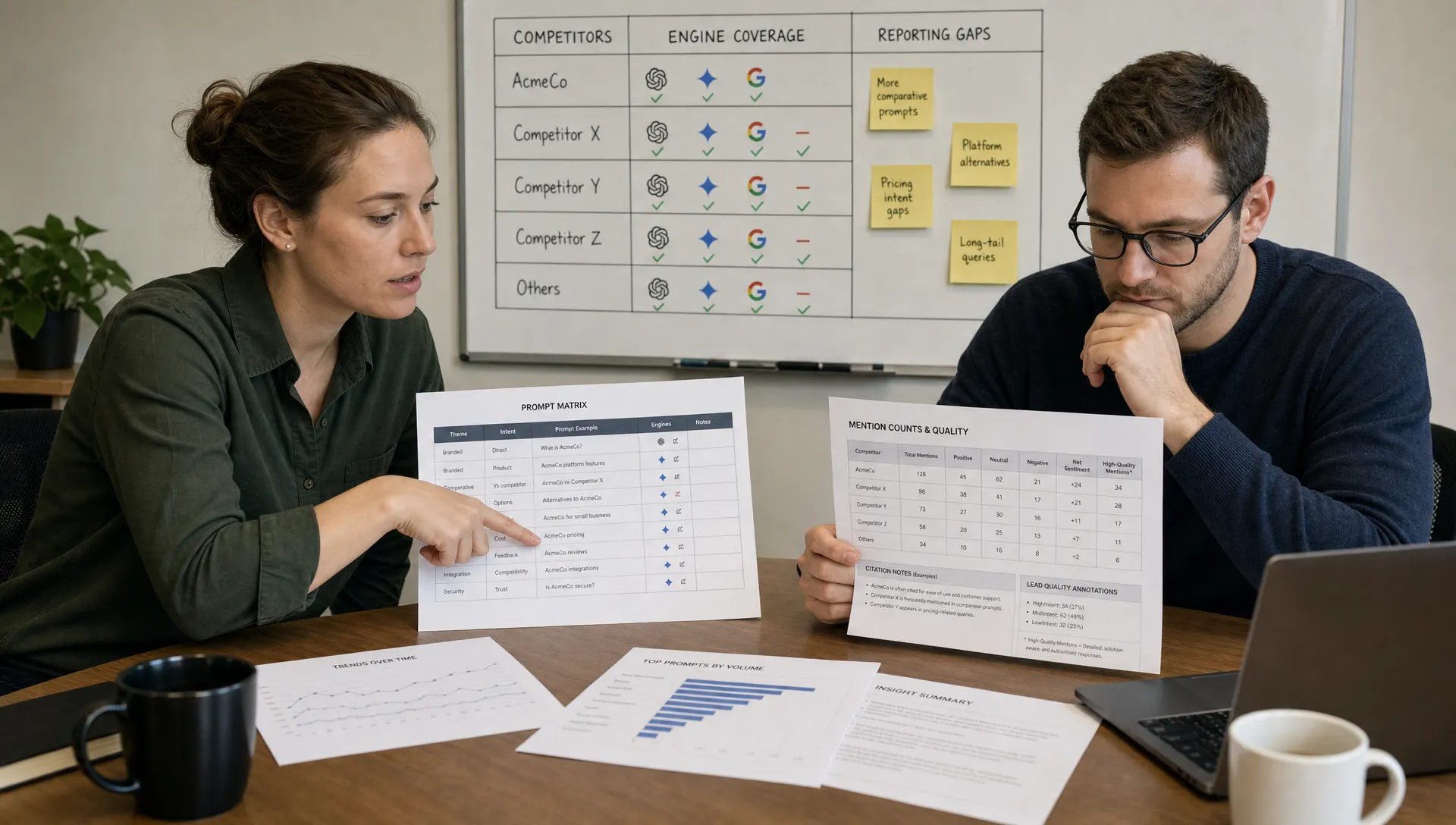
Once those prompt groups exist, reporting becomes more useful. You can see where the brand appears, which competitors appear, whether the answer is accurate and which pages are being cited.
A practical AI visibility report should include:
- Prompt groups by funnel stage, such as discover, compare, choose and convert.
- Brand mention rate across ChatGPT, Gemini, Perplexity, Claude, Copilot and Google AI Overviews.
- Citation rate, including which pages are used as sources.
- Share of voice against named competitors.
- Answer accuracy, including outdated locations, missing products or incorrect service claims.
- Recommended fixes by expected business impact.
The last point matters most. Reporting should not stop at “we are invisible for these prompts.” It should say which pages need schema, which answers need FAQ support, which internal links are missing, which pages load too slowly and which competitor pages are earning citations instead.
A 30-day plan to adapt SEO reporting for AI
You do not need to replace your SEO program. You need to extend it so traffic, leads and AI visibility are measured together.
| Timeframe | Focus | What to do | Output |
|---|---|---|---|
| Days 1 to 7 | Baseline visibility | Scan priority prompts across major AI engines and compare competitors | AI visibility baseline with mentions, citations and share of voice |
| Days 8 to 14 | Technical readiness | Audit crawlability, indexation, schema, metadata, internal links and page speed | Prioritized technical fixes by page type and revenue impact |
| Days 15 to 21 | Content and entity clarity | Improve FAQs, service descriptions, location details, product data and proof points | AI-readable pages that answer buyer questions directly |
| Days 22 to 30 | Reporting integration | Connect AI visibility metrics to analytics, CRM and conversion reporting | A dashboard that explains traffic, leads and off-site AI influence |
This process works because it links diagnosis to action. If Gemini mentions a competitor for “best boutique hotels near downtown Nashville” and your relevant property page has weak amenity details, missing schema and no internal links from the destination guide, the fix is clear. If Perplexity cites a competitor’s managed security page and ignores yours, compare structure, depth, proof, freshness and crawlability before rewriting everything.
AI SEO is not separate from technical SEO, content strategy or conversion optimization. It sits on top of them and exposes where the system is unclear.
What agencies and in-house teams should change now
For agencies, AI search creates a reporting opportunity and an accountability challenge. Clients will ask why traffic changed even when rankings look stable. They will also ask why competitors appear in AI answers when they do not outrank them in the traditional SERP.
The answer requires a broader operating model:
- Keep classic SEO reporting, but add AI visibility scans.
- Report on prompts and buyer journeys, not only keywords.
- Track citations and brand mentions separately from traffic.
- Prioritize fixes that improve both machine readability and user conversion.
- Show before-and-after movement in visibility, accuracy and commercial outcomes.
For in-house teams, the change is similar. SEO, content, analytics, brand, PR and web development need a shared view of what AI systems are saying. An incorrect AI answer may be caused by outdated third-party citations, inconsistent location data, thin pages, weak schema or missing product information. No single team can fix that in isolation.
A platform built for AI visibility can reduce the manual work. CapstonAI helps teams scan multiple generative engines, track mentions and citations, monitor share of voice, map prompts to competitors and prioritize fixes such as AI-ready FAQ, schema, metadata and llms.txt improvements. If you are evaluating tools for this work, use a structured checklist like CapstonAI’s guide on choosing an SEO platform for AI visibility.
Frequently Asked Questions
Is AI replacing SEO? No. AI is changing where search influence happens. Technical SEO, content quality, internal linking, schema and page performance still matter because AI systems depend on accessible, trustworthy source material.
Why can SEO traffic fall while leads stay stable? AI answers can satisfy early research queries before a click happens. Some users later return through branded search, direct traffic, paid search or referral paths. That makes attribution less clean, even when demand remains.
What is the difference between GEO and AEO? AEO focuses on answering specific questions clearly so answer engines can extract useful information. GEO focuses on making brand, product and service information understandable enough for generative engines to mention, cite and recommend it.
Do schema and llms.txt guarantee AI citations? No. Schema and llms.txt reduce ambiguity and improve machine readability, but they do not guarantee inclusion. They work best when combined with crawlable pages, accurate entities, useful content, strong internal links and credible external signals.
What should an AI SEO report include? It should include traditional SEO metrics plus prompt coverage, brand mentions, citations, answer accuracy, competitor share of voice and business outcomes such as leads, bookings, revenue or qualified pipeline.
Start with a free AI visibility audit
If AI search is already shaping how prospects evaluate your brand, the first step is measurement. Find out where you appear, where competitors appear instead, which pages are cited and which technical gaps make your business harder for AI systems to understand.
CapstonAI gives brands, retailers, agencies and site-fleet teams a practical way to measure and improve AI search visibility across ChatGPT, Gemini, Claude, Perplexity, Copilot and Google AI Overviews.
Start with a free AI visibility audit from CapstonAI and turn AI search from an unmeasured blind spot into a trackable growth channel.