Ranked AI lists now sit between many specialty brands and their next customer. A buyer asks ChatGPT, Google AI Overviews, Gemini, Perplexity, Claude or Copilot for the best boutique hotel in a city, the top MSP for a healthcare group or a trusted specialty retailer. The answer often names a short list, gives a few reasons and cites a narrow set of sources.
If your brand is missing from that answer, the customer may never reach your website, even if your classic search rankings look healthy.
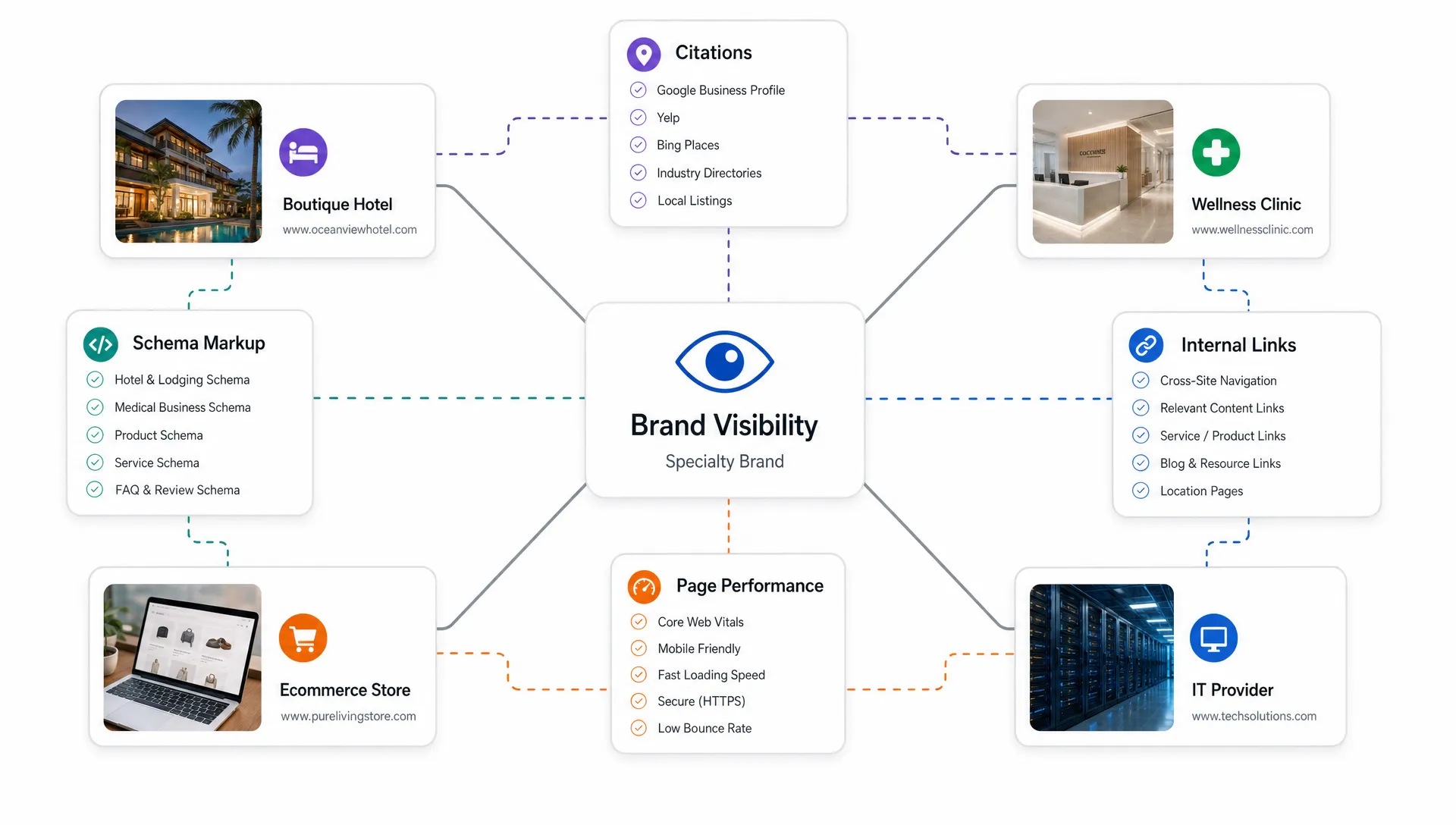
That is the uncomfortable part for specialty brands. They can have strong products, loyal customers, excellent service and solid SEO, yet still be absent from ranked AI recommendations. The problem is rarely one missing keyword. It is usually a visibility gap across entities, citations, structured data, crawlability, internal linking and proof that generative engines can reuse with confidence.
CapstonAI's core view is simple: AI can't see your business if your digital proof is scattered, ambiguous or hard to parse. Ranked AI lists expose that gap faster than traditional search ever did.
What ranked AI lists are really doing
A ranked AI list is not the same thing as a Google page one ranking. It is a generated recommendation set. The engine interprets the prompt, retrieves or relies on available sources, identifies entities, compares options and writes an answer that feels decisive.
That process compresses discovery. Instead of showing ten blue links, the AI may select three to seven brands. In a commercial search journey, that can become the entire consideration set.
To be included, a brand usually needs four things to align:
- Relevance: The brand clearly matches the user intent, location, category, price tier and use case.
- Legibility: The site explains who the brand is, what it offers and where it operates in machine-readable language.
- Corroboration: Other trusted sources mention the brand in ways that support the recommendation.
- Accessibility: Pages are crawlable, fast enough, internally linked and supported by structured data where appropriate.
GEO, or Generative Engine Optimization, focuses on making content retrievable, trustworthy and reusable inside AI-generated answers. AEO, or Answer Engine Optimization, focuses on answering specific questions directly enough for engines to quote, summarize or cite. Both still depend on classic technical SEO. If a key page is blocked, slow, thin or orphaned, AI systems have less to work with.
Why specialty brands are the first to disappear
Specialty brands often lose visibility because they are precise in the real world but fuzzy on the machine-readable web. A luxury watch retailer, regional hotel group, specialty clinic network or vertical MSP may be highly credible to customers who already know the category. Generative engines still need consistent proof before they include that brand in a ranked answer.
The entity is not clean enough
An entity is the machine-understandable identity of a business: its name, locations, category, products, services, people, relationships and authoritative pages. If those signals are inconsistent, AI search may treat the brand as less certain than a larger competitor with cleaner public data.
This happens when a brand has different names across listings, outdated locations, disconnected subdomains, weak About pages or category pages that rely on visuals instead of text. For a multi-site healthcare group or franchise retailer, even one messy location footprint can dilute confidence.
The business effect is direct. If the AI is unsure which entity you are, it is less likely to recommend you in a list where the user expects confidence.
The proof is present, but not reusable
Specialty brands often write for conversion first and retrieval second. That is understandable, but it can leave important facts buried in sliders, images, PDFs or vague brand language.
A page for a luxury watch retailer might look persuasive to a collector, but a generative engine also needs explicit facts: brands carried, authentication approach, warranty, returns, shipping, trade-ins and sourcing services. A specialty retailer such as Lume Wrist Watches is easier for AI search to understand when those facts are stated clearly, connected through internal links and supported by schema rather than left only in visual page sections.
The same principle applies to hotels, clinics and MSPs. If the page says premium experience but never states pet-friendly suites near downtown, pediatric urgent care in Austin or managed Microsoft 365 support for law firms, AI has less specific material to match against commercial prompts.
Third-party citations are thin
Generative engines often lean on sources that appear independent: review platforms, directories, association sites, local publications, product roundups, analyst pages and established media. Large brands tend to accumulate these mentions by default. Specialty brands often have stronger service quality but fewer public citations.
This contributes to big brand bias in AI search. The model is not necessarily judging the specialty brand as worse. It may simply have more corroborated evidence for the incumbent.
For AI visibility, citations matter in two ways. A brand mention helps the engine recognize that the business belongs in the category. A citation link can become the source the AI uses to justify the answer.
The site is technically visible to people, but incomplete for crawlers
A customer may load a page and understand it. A crawler may see something thinner. Common blockers include JavaScript-rendered content without reliable server-side output, incorrect canonicals, blocked resources, heavy templates, broken schema, weak XML sitemaps and slow page performance.
Page performance is not only a conversion issue. Slow or unstable pages can reduce crawl efficiency and make it harder for AI-connected systems to process the content consistently. Classic technical SEO still matters because generative engines do not replace the web layer. They depend on it.
Internal links do not explain expertise
Specialty brands often have strong individual pages but weak relationships between them. A hotel may have separate pages for rooms, events, dining, neighborhoods and seasonal offers, yet no internal structure that explains why the property is a credible answer for family stays, conferences or local experiences.
Internal linking gives search systems context. It shows which pages are central, which topics belong together and how the brand supports a specific journey. Without that structure, AI may retrieve one isolated page and miss the broader proof.
| Visibility gap | What AI may see | Business effect |
|---|---|---|
| Unclear entity data | Multiple names, categories or locations | Lower confidence in recommendations |
| Thin citations | Few independent mentions or source links | Competitors appear safer to cite |
| Vague page copy | Brand language without specific answers | Poor match for commercial prompts |
| Weak schema | Facts not structured for search systems | Missed eligibility for rich understanding |
| Crawl and speed issues | Incomplete or inconsistent page access | Less reliable retrieval and indexing |
| Poor internal linking | Disconnected proof across the site | Lower topical clarity and authority |
How to measure ranked AI invisibility
The first mistake is measuring only traditional rank. A brand can rank well for its own terms and still be absent from AI-generated lists. CapstonAI has covered why traditional rank tracking can miss this problem because AI search visibility depends on mentions, citations and answer inclusion, not only blue-link position.
A useful audit starts with a prompt map. Build a set of prompts that reflect how real buyers ask for help across the funnel. For a hotel group, that might include family-friendly hotel near a convention center, best boutique hotel for business travel and hotels with meeting rooms in a specific city. For an MSP, it might include best IT provider for dental practices, Microsoft 365 migration support near me and alternatives to a national IT vendor.
Run those prompts across ChatGPT, Google AI Overviews, Gemini, Perplexity, Claude and Copilot when those engines are relevant to your audience. Then record whether the brand appears, where it appears, whether it is cited, which page is cited and which competitors are named instead.
A practical first audit might use 50 to 200 prompts, grouped by category, location, product, service and buyer stage. The goal is not to create a universal score. The goal is to see where AI systems include your brand today and where they repeatedly choose someone else.
| Metric | What it measures | Why it matters |
|---|---|---|
| Mention rate | Share of prompts where the brand is named | Shows basic AI visibility |
| Citation rate | Share of prompts where the brand is linked or sourced | Shows whether AI can justify the mention |
| Average list position | Where the brand appears when included | Indicates recommendation strength |
| Prompt coverage | Which intents surface the brand | Reveals blind spots by journey stage |
| Competitor share of voice | How often rivals appear across the same prompts | Shows who owns AI consideration |
| Source diversity | Which pages or third-party sites are cited | Identifies citation dependency and risk |
If a specialty brand appears in 8 of 100 high-intent prompts while a larger competitor appears in 46, the issue is not only content quality. It is competitive AI share of voice. That gap points to the prompts, pages, citations and technical fixes that deserve priority.
How specialty brands become easier to rank, cite and trust
There is no single AI visibility switch. Ranked AI lists are shaped by many signals, so the fix should be layered: clarify the entity, answer the prompts, structure the proof, strengthen citations and monitor change over time.
Make the brand entity unmistakable
Start with the pages that define the business. Your homepage, About page, location pages, product category pages and service pages should use consistent names, addresses, categories and descriptions. For multi-location brands, each location should have a distinct page with complete local details and a clear relationship to the parent brand.
Structured data helps search systems understand this information. Use schema types that match the page, such as Organization, LocalBusiness, Product, Offer, FAQPage, BreadcrumbList or Review where valid. Google's structured data documentation frames schema as a way to help search understand content, not as a guarantee of visibility. That distinction matters. Schema supports eligibility and clarity, but it cannot compensate for weak proof.
Build answer-ready pages for AEO
AI assistants respond to questions. Your site should answer the questions buyers actually ask before they convert.
For a specialty ecommerce brand, that may include authenticity, warranty, returns, financing, sizing, compatibility and shipping questions. For a clinic group, it may include accepted insurance, appointment types, symptoms treated and location-specific availability. For a hotel group, it may include parking, transportation, pet policies, event capacity and neighborhood fit.
The format should be direct. Put a concise answer near the top, then add detail, proof and internal links. This improves the page for human buyers and gives AI systems a cleaner passage to summarize.
Create GEO content that compares, qualifies and proves
Generative engines often build ranked lists by comparing options. If your site never explains where your brand fits, the AI may rely on third-party descriptions instead.
Useful GEO content includes comparison pages, buyer guides, location guides, product education, service explainers and industry-specific landing pages. The point is not to publish generic top 10 posts. The point is to provide the facts an AI answer needs: who the offer is for, what makes it different, where it is available, what constraints apply and what evidence supports the claim.
For example, a regional MSP should not stop at managed IT services. It should explain supported industries, response model, security scope, compliance experience, vendor partnerships and service areas. A hotel group should connect amenities to traveler intent, such as corporate stays, weekend leisure, weddings or group blocks.
Fix crawlability, performance and machine access
Technical SEO remains the foundation. Check robots.txt, XML sitemaps, canonicals, redirects, indexability, status codes, duplicate pages and rendered HTML. Make sure key content is not hidden behind scripts that crawlers cannot reliably process.
Page performance also matters. Compress heavy images, reduce unused scripts, improve server response times and test Core Web Vitals. Faster pages help users convert and help crawlers process more of the site with fewer failures.
Some teams now add llms.txt to point AI systems and tools toward preferred content, policies and documentation. Treat it as a helpful map, not a replacement for crawlable HTML, schema, sitemaps or internal links. The strongest AI-ready architecture uses all of these together.
Earn citations that confirm your category
You cannot control every source AI systems use, but you can improve the public evidence around your brand. Update key directories, industry association profiles, review platforms, local listings, partner pages and media mentions. Where possible, make sure those sources describe the brand with the same categories, locations and differentiators used on your site.
For specialty brands, fewer high-quality citations can be more useful than many generic mentions. A respected industry directory, a credible local publication or a partner page that accurately explains your service can help generative engines connect your brand to the right prompts.
Monitor AI visibility continuously
AI answers change as engines update models, retrieve new sources and test different answer formats. A one-time audit gives a baseline. Ongoing AI brand monitoring shows whether fixes are improving mention rate, citation rate and competitor share of voice.
CapstonAI scans across major AI engines and assistants, maps prompts to mentions, tracks citations and prioritizes fixes across content, schema, metadata, llms.txt, crawlability and page performance. For agencies and in-house teams, that measurement layer turns AI visibility from guesswork into a repeatable operating process.
A practical playbook by specialty brand type
Different categories need different proof, but the pattern is consistent: make the business easier to identify, easier to compare and easier to cite.
| Brand type | Common AI blind spot | High-impact fix |
|---|---|---|
| Independent hotel chains | AI cites OTAs and travel media instead of the brand site | Strengthen location pages, amenity answers, event pages and neighborhood guides |
| Franchise or multi-site retail | Locations appear inconsistently across sources | Clean entity data, local schema, store pages and internal links by service area |
| Healthcare and education groups | AI avoids recommending because details are vague or sensitive | Publish precise, compliant service, eligibility and location information |
| MSPs and IT service providers | Generic service pages fail to match industry prompts | Build vertical pages with proof for healthcare, legal, finance or education buyers |
| Mid-market ecommerce | Marketplaces and large retailers dominate product recommendations | Add product schema, comparison content, policy answers and independent citations |
| SEO and performance agencies | Client reports stop at rank and traffic | Add AI mentions, citations and share of voice to reporting workflows |
Frequently Asked Questions
Why do ranked AI lists favor larger brands? Larger brands often have more citations, cleaner entity data, broader press coverage and more third-party mentions. AI systems tend to choose options with more corroborated evidence, especially when the prompt asks for a ranked recommendation.
Can a specialty brand appear in AI lists without ranking first in Google? Yes. Classic rankings help, but AI list inclusion also depends on entity clarity, answer quality, citations, schema, internal linking and how well the brand matches the prompt. A lower-ranking page can still be cited if it provides the clearest answer.
What is the difference between GEO and AEO? GEO makes your content easier for generative engines to retrieve, trust and reuse in AI answers. AEO makes specific answers easier to extract for question-based searches. Both depend on technical SEO, crawlability and structured data.
Does schema guarantee that AI engines will cite my brand? No. Schema improves clarity and eligibility, but it does not guarantee a citation. AI engines still need useful content, external corroboration, crawlable pages and enough relevance to the user's prompt.
How often should specialty brands monitor AI visibility? A monthly review is a practical starting point for many brands. Teams in competitive verticals, multi-location markets or seasonal categories may need more frequent checks, especially after major content, schema or technical updates.
Start with a free AI visibility audit
If ranked AI lists are leaving your specialty brand out, start by measuring the gap. A free AI visibility audit from CapstonAI shows where your brand appears across AI engines, which prompts surface competitors, which citations are being used and which pages need technical or content fixes first.
The goal is not to chase every AI answer. It is to make your business visible, credible and easy to reuse when buyers ask the questions that lead to bookings, leads, sales and trust.