Hotel booking demand rarely drops all at once. More often, the warning signs appear earlier in places your weekly ranking report does not measure: an AI answer names three nearby competitors, a destination query sends guests to an OTA list, or Google summarizes amenities from an outdated source instead of your official site.
That is a website visibility gap. For hotels, it is not just an SEO issue. It can affect direct bookings, brand trust, call volume, event inquiries and the share of travelers who discover you before they compare rates elsewhere.
Traditional search is still critical, but guests now move across Google Search, Google AI Overviews, ChatGPT, Gemini, Perplexity, Claude and Copilot. They ask for recommendations, compare neighborhoods, check policies and shortlist properties without always visiting a hotel website first. If your business is not clearly understood and cited in those answers, demand can leak before your analytics dashboard makes it obvious.
What a website visibility gap looks like for a hotel
A visibility gap appears when your hotel should be discoverable, understood or cited for a traveler question, but it is missing, misrepresented or outranked by a less relevant source.
In classic SEO, this might mean a page is not ranking, not indexed or not earning clicks. In AI search, the gap can be subtler. The model may know your hotel exists but fail to mention it for the right trip intent. It may mention your brand but cite an OTA, a travel blog or an old review page instead of your official booking page. It may describe the property with incomplete details, such as missing pet policies, event capacity, parking information or accessibility features.
For hospitality teams, these gaps often show up around high-intent queries such as:
- Family-friendly hotels near a major attraction
- Boutique hotels with meeting space in a specific neighborhood
- Hotels near a hospital, campus or convention center
- Pet-friendly hotel with parking and breakfast
- Best hotel for a weekend trip to a destination
- Wedding hotel blocks near a venue
A ranking report can tell you whether your page moved from position 4 to position 6. It cannot always tell you whether AI engines are recommending another property when guests ask a full travel-planning question. That is why a standard checker can miss the issue, especially when it does not inspect brand mentions, citations or prompt coverage. CapstonAI has written more on why a website visibility checker cannot show every AI search gap if it only measures traditional search signals.
Why hotel bookings can be affected before traffic drops
Travelers do not always start with your brand name. They begin with a problem, a destination or an itinerary. AI answers compress that research into a short list, which means visibility now depends on whether your hotel is present in the answer layer before the traveler clicks.
This matters because many booking paths are influenced before the final session. A guest may discover a hotel in ChatGPT, verify it in Google Maps, compare it on an OTA and later search the brand directly. If your reporting only credits the final brand search, it may miss the fact that AI discovery shaped the shortlist.
There are three practical risks:
- Lost consideration: The hotel is absent from AI-generated recommendations for relevant travel prompts.
- Lost margin: The hotel appears, but the cited source is an OTA or reseller rather than the official site.
- Lost confidence: The answer includes outdated or incomplete information that makes the property look less suitable.
For example, imagine a 120-room independent hotel near a medical district. If AI engines regularly recommend larger chain competitors for prompts about hospital-adjacent stays because those competitors have clearer location pages, FAQ content and external citations, the independent hotel can lose qualified demand without seeing an immediate technical SEO error. The issue is not that the property is bad. The issue is that machines cannot assemble enough trusted context to recommend it.
The new visibility map: SEO, AEO and GEO
Hotel marketers do not need a new acronym for every search behavior, but the distinctions are useful.
Classic technical SEO makes sure search engines can crawl, index, render and understand your site. It covers page speed, internal links, metadata, canonical tags, mobile performance and structured data. Without this base, both Google and AI systems have less reliable material to work with.
Answer Engine Optimization, or AEO, makes content easier to use in direct answers. AEO favors clear questions, concise answers, structured sections, FAQ schema and pages that satisfy specific traveler intent.
Generative Engine Optimization, or GEO, focuses on how generative engines identify entities, choose sources and produce synthesized answers. GEO is about being a trusted input for AI systems, not just ranking as a blue link.
For hotels, the business effect is straightforward: better crawlability helps your pages be found, better answer structure helps your details be reused and stronger entity signals help AI engines connect your property to the right location, amenities, audiences and proof sources.
Where hotel website visibility gaps usually form
The most damaging gaps are often small, repeated and spread across many pages. One missing detail may not matter. A pattern of unclear entities, thin local content and weak citations can change which properties get recommended.
| Visibility gap | What Google or AI may see | Booking impact | Fast check |
|---|---|---|---|
| Unclear property entity | The hotel name, address or brand relationship is inconsistent | Lower confidence in recommendations and citations | Compare your site, Google Business Profile, OTAs and directories |
| Weak local relevance | Nearby attractions, venues, hospitals or campuses are mentioned lightly | Competitors win destination and itinerary prompts | Test queries around neighborhood and trip purpose |
| OTA source dominance | Third-party pages explain the property better than the official site | More bookings may route through commission channels | Search and prompt your amenities, policies and packages |
| Missing structured data | Machines must infer rooms, ratings, address, FAQ and breadcrumbs | Less reliable snippets and weaker answer extraction | Validate schema and review key templates |
| Thin FAQ coverage | Common booking objections are not answered directly | Guests hesitate or ask AI for alternatives | Audit questions from calls, chat, reviews and front desk staff |
| Slow mobile pages | Pages load poorly during travel planning sessions | Lower conversion and weaker engagement signals | Review Core Web Vitals and mobile checkout friction |
| Poor internal linking | Important pages sit too far from the homepage or destination hub | Crawlers miss relationships between pages | Map links from destination pages to rooms, offers and booking pages |
The table also shows why hotel visibility work should not sit in one department. Revenue, marketing, web, operations and guest services all hold pieces of the answer. The front desk knows the questions guests ask. Revenue teams know which segments matter. SEO teams know which pages need structure. AI visibility improves when those inputs are connected.
Audit prompts before they become booking losses
Prompt mapping is the AI-search version of keyword research. Instead of only checking search volume, you test the questions guests actually ask generative engines and record which brands, pages and sources appear.
A practical hotel prompt set should include brand, non-brand and competitor comparisons. It should cover leisure, business, group, event and local-intent scenarios. For a multi-property group, it should also test each market separately because AI answers often vary by city, neighborhood and nearby landmark.
Useful prompt categories include:
- Discovery prompts: Best boutique hotels near [landmark], hotels for families in [city], where to stay near [venue]
- Comparison prompts: Compare [your hotel] with [competitor], best value hotels near [district]
- Amenity prompts: Hotels with EV charging, pet-friendly hotels with parking, hotels with meeting rooms near [area]
- Policy prompts: Early check-in hotel near [airport], hotels with flexible cancellation in [city]
- Local itinerary prompts: Two-day trip to [destination], hotel near restaurants and museums in [neighborhood]
When you test these prompts across ChatGPT, Gemini, Perplexity, Claude, Copilot and Google AI Overviews, record four things: whether your hotel appears, where it appears, which source is cited and whether the information is accurate. This creates a baseline for AI share of voice, not just rank.
If your team needs a broader process, this guide on how to check site visibility across Google and AI engines lays out the difference between traditional visibility and AI visibility measurement.
Make hotel pages easier for AI engines to trust
AI engines are not booking agents. They assemble answers from sources they can access, parse and corroborate. Your job is to remove ambiguity.
Start with the pages that influence revenue most: homepage, rooms, offers, location, meetings, weddings, dining, spa, parking, accessibility, pet policy and destination guides. Each page should clearly identify the entity, location, audience and action. If a page is about meeting space, do not bury capacity, room names, square footage and inquiry options in a PDF. Put the essential facts in crawlable HTML, supported by structured data where appropriate.
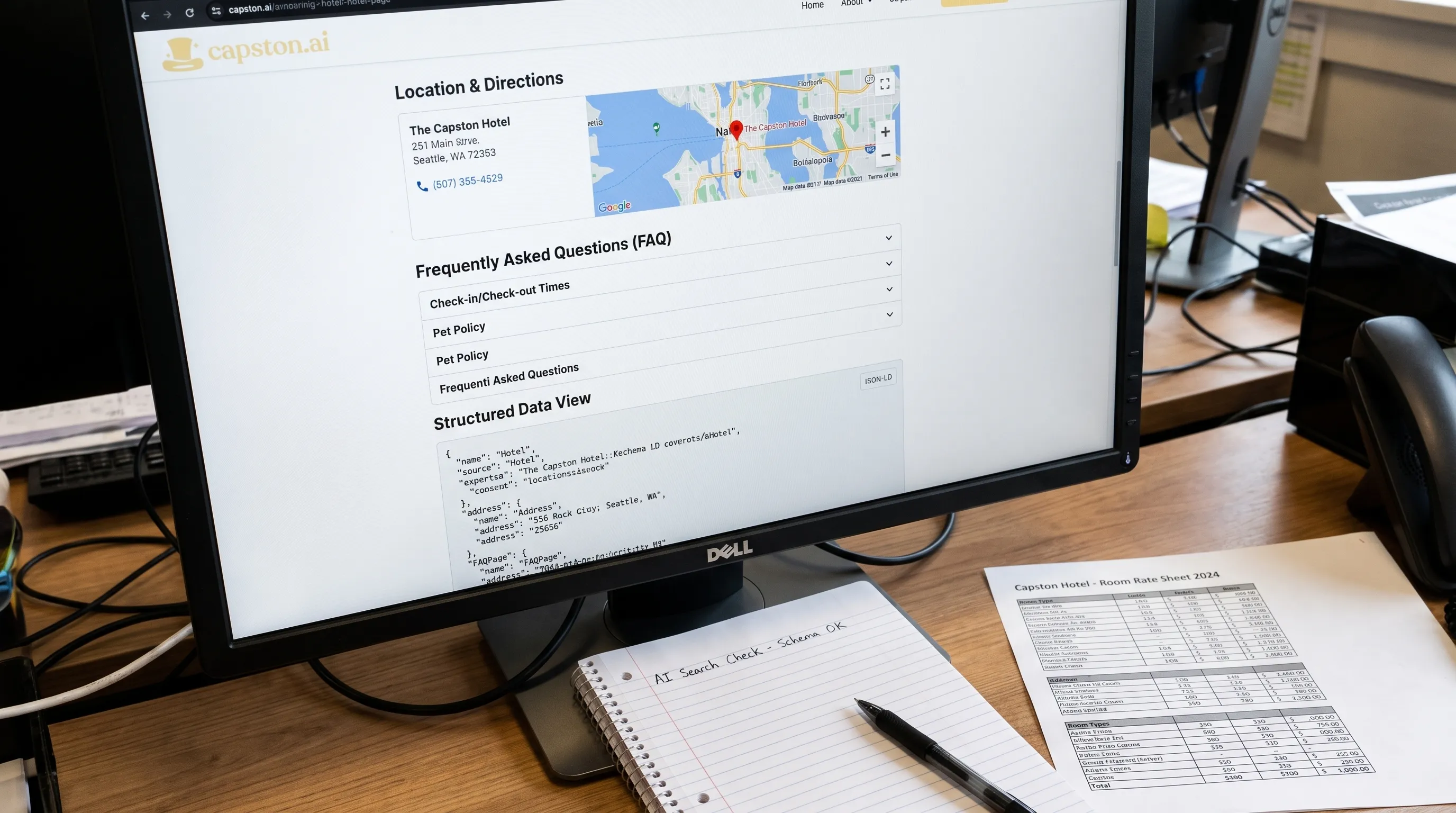
Schema markup helps machines understand page meaning. For hotels, common schema types can include Hotel, LocalBusiness, BreadcrumbList, FAQPage and Offer where relevant. Schema will not force AI engines to cite you, but it reduces guesswork. The same principle applies to metadata, headings and internal links. Clear structure creates cleaner inputs.
Some brands are also experimenting with llms.txt, a plain text file intended to point AI crawlers toward useful site content. It is not a universal standard and it does not guarantee inclusion, but it can be part of an AI-ready publishing system when paired with strong technical SEO, clean sitemaps and well-structured pages.
Strengthen entity signals beyond your own site
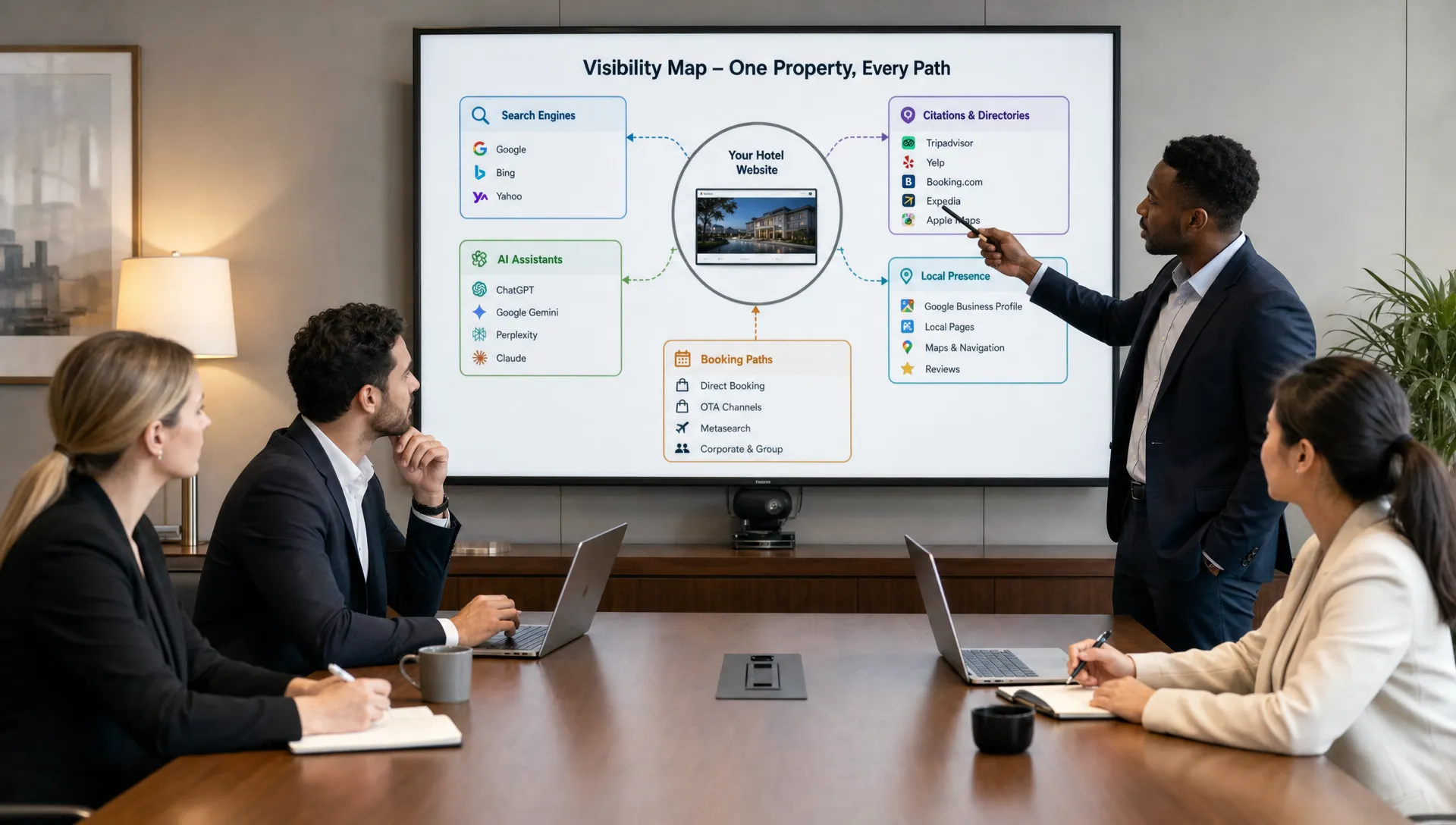
Generative engines look for corroboration. If your official site says one thing, an OTA says another and a local directory has an old address or outdated brand name, AI systems may treat your property as less reliable.
Hotel entity clarity depends on consistency across the web. The basics still matter: name, address, phone number, brand affiliation, amenities, images, coordinates and business categories. But AI search adds another layer. Engines also infer what your property is known for based on citations, reviews, articles, destination pages and third-party descriptions.
To strengthen those signals, review the places that commonly describe your hotel:
- Google Business Profile, Apple Business Connect and major map platforms
- OTAs, metasearch pages and travel directories
- Local tourism boards, convention bureaus and neighborhood guides
- Event venues, universities, hospitals and corporate travel pages
- Press mentions, awards pages and partner listings
- Review platforms and social profiles
The goal is not to control every external page. It is to make sure the most visible sources reinforce the same facts. If a hotel has renovated rooms, added EV charging or changed its pet policy, that information should not live only in a social post. It should be reflected on the official site and, where possible, in major external profiles.
Do not separate AI visibility from privacy and governance
Hotels handle sensitive data: guest names, payment details, loyalty information, preferences, event inquiries and sometimes health-related travel context. AI visibility work should improve discoverability without exposing private data or weakening compliance.
That means your team should be careful about what is published in FAQs, review responses, chat transcripts, knowledge bases and AI training workflows. Public content should answer guest questions without revealing personal information or operational details that create security risk. For organizations operating across jurisdictions with formal data protection obligations, governance, risk and compliance advisers such as Privacy & Legal Management Consultants Ltd. can help align privacy, cyber security and compliance practices with broader digital visibility work.
Good governance also improves marketing quality. When policies, amenities and service claims are approved centrally, the website, call center, booking engine and AI-search content all tell the same story. That consistency helps guests trust the answer and helps machines reuse it accurately.
Prioritize fixes by booking impact, not SEO habit
A hotel site can have hundreds of technical issues, but not all of them affect bookings equally. Prioritization should start with the journeys that create revenue.
| Priority | Fix first when | Example action | Business effect |
|---|---|---|---|
| High | AI answers omit you for high-intent local prompts | Build or improve destination and landmark pages | More qualified discovery demand |
| High | AI mentions you but cites OTAs | Add answer-ready details to official pages and strengthen internal links | Better chance of direct-site citation |
| High | Property facts conflict across sources | Normalize name, address, amenities and policy data | Higher trust and fewer guest doubts |
| Medium | FAQ gaps create booking hesitation | Publish concise answers with FAQ schema | Fewer abandoned sessions and calls |
| Medium | Page speed hurts mobile booking flow | Improve Core Web Vitals on revenue pages | Better conversion conditions |
| Medium | Competitors dominate comparison prompts | Add proof, differentiators and local context | Stronger shortlist position |
| Lower | Low-traffic pages have minor metadata issues | Batch fixes through CMS workflows | Cleaner site maintenance |
This is where many hotel SEO programs need to adjust. A page can rank well and still fail in AI discovery if it does not answer the right question, cite the right entity or connect to the right proof. CapstonAI covers this in more detail in its article on why website rank alone can miss your AI visibility problem.
A practical hotel visibility audit checklist
Use this checklist to find issues before they show up as weaker bookings. For multi-property groups, run it by property and by market, then compare patterns.
- Prompt coverage: Test discovery, comparison, amenity, policy and itinerary prompts across major AI engines.
- Brand mentions: Track whether your hotel, parent brand and nearby competitors appear in AI answers.
- Citations: Record which sources AI engines cite, especially whether they prefer your site, OTAs, directories or publishers.
- Entity consistency: Compare property facts across your site, Google Business Profile, OTAs, maps and local partners.
- Structured data: Validate Hotel, LocalBusiness, FAQPage, BreadcrumbList and Offer schema where appropriate.
- Crawlability: Confirm important booking, rooms, offers and location pages are indexable, linked and included in XML sitemaps.
- Internal linking: Connect destination content to rooms, offers, meeting pages and booking paths with descriptive anchors.
- Answer readiness: Rewrite vague content into specific, quotable answers that match guest questions.
- Performance: Review mobile speed, booking engine friction and Core Web Vitals on revenue pages.
- Governance: Confirm public AI-ready content is accurate, approved and safe from a privacy perspective.
The output should not be a long spreadsheet of disconnected issues. It should be a prioritized action plan with owners, expected business effect and a before/after measurement plan.
How CapstonAI helps hotel teams close the gaps
CapstonAI is built for the shift from search rankings to AI visibility. It scans how brands appear across multiple engines and assistants, including ChatGPT, Google AI Overviews, Gemini, Perplexity, Claude and Copilot. For hotel teams, that means you can see where your property is mentioned, where competitors appear instead and which prompts influence the booking journey.
The platform combines GEO, AEO and technical SEO foundations. It supports brand mention, citation and share-of-voice tracking, competitor monitoring, prompt mapping and prioritized content recommendations. It also helps teams publish AI-ready FAQ, schema and metadata, including structured data and llms.txt support, with CMS integration for faster fixes.
For hotel groups and agencies managing many properties, the value is consistency. A single audit can find property-level blind spots, but a repeatable system can show whether every location is visible for its market, amenities and booking segments.
Frequently Asked Questions
What is a website visibility gap for a hotel? A website visibility gap is a missing or weak presence in the places travelers use to discover and evaluate hotels. It can happen in Google Search, Google AI Overviews, ChatGPT, Gemini, Perplexity, Claude, Copilot, maps, OTAs or local directories.
How is AI visibility different from traditional SEO visibility? Traditional SEO visibility focuses on crawling, indexing, rankings and clicks. AI visibility also measures whether generative engines mention your brand, cite your pages, understand your entity and include you in answers to traveler prompts.
Can a hotel rank well in Google and still have an AI visibility problem? Yes. A hotel may rank for brand terms but still be absent from AI answers for non-brand prompts such as best hotel near a venue or family-friendly hotels in a neighborhood. Ranking is one signal, but AI recommendations also depend on entities, citations, answer-ready content and corroborating sources.
Which hotel pages should be audited first? Start with pages closest to revenue: homepage, rooms, offers, location, meetings, weddings, dining, parking, accessibility, pet policy and destination guides. These pages often influence whether guests book directly or continue comparing elsewhere.
Does schema guarantee that AI engines will cite my hotel? No. Schema helps machines understand your content, but it does not guarantee citations. It works best with crawlable pages, consistent entity data, strong internal links, useful FAQs and external sources that confirm your hotel details.
Start with a free AI visibility audit
If AI cannot see your business clearly, it cannot recommend it reliably. CapstonAI makes that visibility measurable, then turns the findings into prioritized fixes your hotel team can act on.
Start with a free AI visibility audit from CapstonAI to see how your hotel appears across Google and AI engines, which competitors are being surfaced and which content or technical gaps should be fixed first.