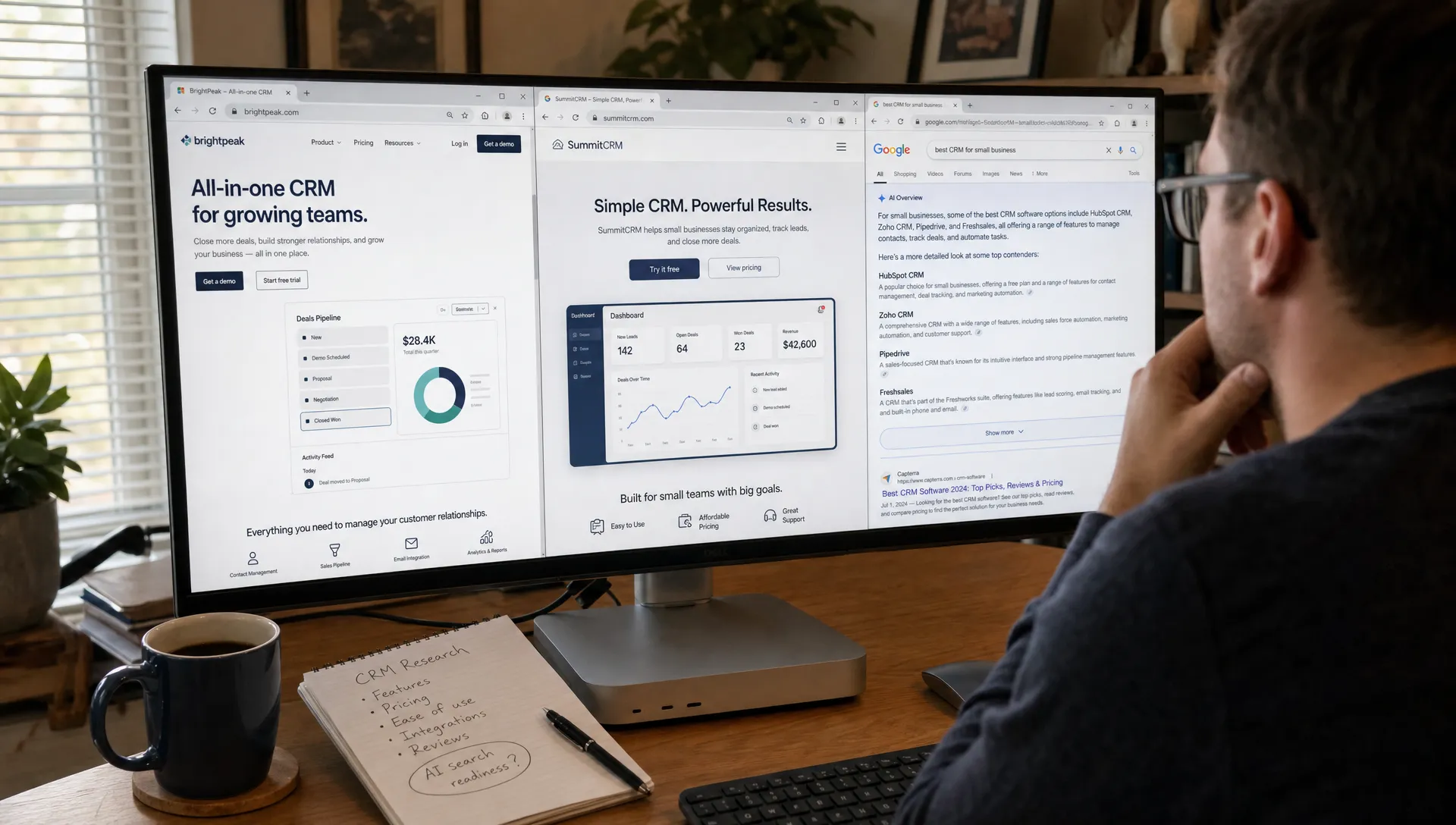
Preparing for a new search engine ai is not the same as preparing for a traditional search update. AI answer engines do not only rank pages, they retrieve information, compare sources and assemble answers that may mention a brand without sending the user to a blue link. The practical question for hotel groups, franchise brands, ecommerce teams and agencies is simple: can these systems understand, trust and cite your existing site without a costly rebuild?
For most teams, the answer is yes. A rebuild is rarely the first move. The better starting point is to measure what AI engines already see, fix the pages and metadata they struggle to interpret and create answer-ready content around the decisions your buyers actually make.
What 'new search engine ai' means in practice
The phrase new search engine ai points to a broader shift: search is moving from lists of links into generated answers. ChatGPT, Google AI Overviews, Gemini, Perplexity, Claude, Copilot and similar systems can summarize options, compare providers and cite sources inside the same answer.
That does not make classic SEO obsolete. It changes what needs to be measured. Crawlability, internal linking, structured data and page performance still matter because generative engines need accessible source material. GEO, or Generative Engine Optimization, adds a second layer: making your site easy for AI systems to reuse accurately. AEO, or Answer Engine Optimization, focuses on concise answers to specific questions.
| Traditional SEO signal | AI visibility signal | Business effect |
|---|---|---|
| Ranking position | Brand mention frequency | Whether your brand appears in generated recommendations |
| Organic sessions | Citation quality | Whether users see your site as a trusted source |
| Keyword coverage | Prompt coverage | Whether real buying questions surface your pages |
| Backlink authority | Entity consistency | Whether AI systems connect your brand to the right locations, products and services |
| Technical health | Retrieval readiness | Whether engines can access and interpret key content |
A new search engine ai also exposes gaps that standard SEO reports often miss. A page may rank well in Google yet be absent from AI summaries because it lacks clear entities, direct answers or supporting schema.
Why you usually do not need to rebuild your site
Many sites already have the raw material AI systems need: service pages, product categories, location pages, FAQs, blog posts, reviews and policies. The issue is usually not the platform. It is ambiguity.
AI systems struggle when a site hides important details inside scripts, duplicates similar pages without local context or spreads key facts across disconnected URLs. For a multi-location healthcare group, that might mean each clinic page lists a city but not the specialties, accepted services or appointment path. For an independent hotel chain, it might mean room pages describe amenities but do not answer parking, pet, family or cancellation questions.
| Symptom | Targeted fix | When a rebuild may be justified |
|---|---|---|
| Important content is hard to crawl | Improve navigation, sitemap coverage and server rendering | Core templates block search engines from core content |
| AI engines confuse locations or brands | Strengthen entity data and internal links | The information architecture is fundamentally wrong |
| Pages do not answer buyer questions | Add answer-ready sections and FAQs | The CMS cannot support structured content |
| Product data is inconsistent | Normalize attributes and schema | Catalog management is broken across systems |
| Pages are slow or unstable | Improve performance on key templates | The stack cannot meet basic performance standards |
The goal is to make the existing site more legible before deciding whether it needs to be replaced.
Step 1: measure your baseline before changing pages
Before you optimize for a new search engine ai, capture how your brand appears today. Run representative prompts across ChatGPT, Gemini, Perplexity, Claude, Copilot and Google AI experiences. Do not test only branded prompts. Test the questions prospects ask before they know your name.
For a hotel group, useful prompts include comparisons such as best boutique hotels near a conference center, pet-friendly hotels with parking in a specific city or family hotel near a landmark. For an MSP, test managed IT provider for healthcare practices, Microsoft 365 support for 200 employees or cybersecurity partner for multi-site retail.
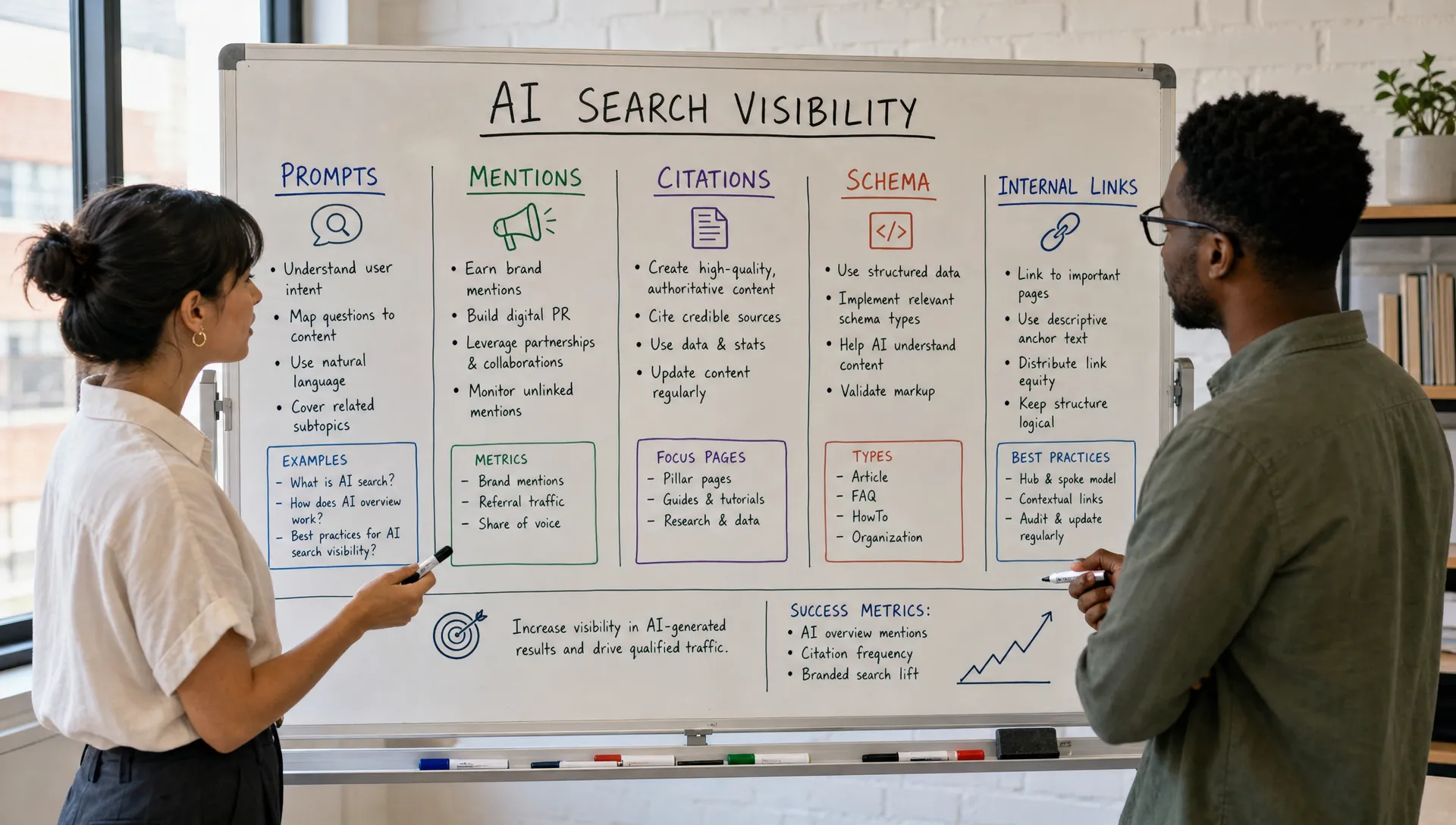
Track four signals:
- Mentions: Whether your brand appears in the answer.
- Citations: Whether your site is used as a source.
- Share of voice: How often you appear compared with competitors.
- Prompt mapping: Which questions surface you, which surface rivals and which surface no direct source.
This baseline prevents guesswork. It also gives leadership a reporting model beyond rankings and traffic. If you need a deeper diagnostic framework, CapstonAI explains what an intelligent search engine needs from your website in practical terms.
Step 2: make your entities unmistakable
AI systems reason through entities: brands, locations, products, services, people, categories and relationships. If a new search engine ai cannot connect your brand to the right services, geography or audience, it may cite a competitor with clearer signals.
Start with the information that should never be ambiguous. Your homepage should state who you serve, what you offer and where you operate. Location pages should connect each branch to its city, services, phone number, address, opening hours and appointment or booking action. Product and category pages should use consistent names, attributes and use cases.
For agencies managing site fleets, entity cleanup is often the fastest path to visibility gains because it affects hundreds of pages at once. Standardize names across title tags, headings, schema, navigation, footer content and Google Business Profile references. If your brand operates under multiple trade names, make those relationships explicit rather than assuming engines will infer them.
Internal linking matters here. Link from broad category pages to supporting service, product and location pages with descriptive anchors. Avoid generic anchors when a specific phrase helps clarify the relationship.
Step 3: turn key pages into answer-ready assets
AEO does not mean stuffing FAQs at the bottom of every page. It means making the page useful for the questions a human would ask and clear enough for an AI system to extract.
When new search engine ai systems synthesize an answer, they prefer content that states facts cleanly, separates claims from examples and provides enough context to avoid misinterpretation. A strong page usually includes a concise summary, clear headings, comparison details, eligibility or use-case information and next steps.
Product and category clarity matter outside retail ecommerce too. A supplier such as Bestex Fabricage's professional workwear range is easier for AI systems to interpret when categories, industry applications, delivery information and product types are clearly presented rather than buried in vague marketing copy.
Examples by business model
For an independent hotel chain, answer-ready content might include direct sections for parking, accessibility, airport transfer, pet rules, meeting rooms and nearby attractions. For a franchise healthcare brand, it might include conditions treated, insurance guidance, practitioner details and location-specific appointment options.
For WooCommerce or mid-market ecommerce, focus on comparison and selection help. Product pages should answer fit, materials, compatibility, delivery, returns and care instructions. Category pages should explain how to choose between product types, not just list products.
Step 4: protect crawlability and performance
A new search engine ai cannot cite what it cannot access. That sounds basic, but many modern sites still hide critical information behind scripts, tabs, filters, popups or blocked resources.
Start with crawlability. Your robots.txt should not block key templates. XML sitemaps should include canonical pages, not dead URLs or thin duplicates. Important content should be available in the rendered HTML or reliably accessible after rendering. Pagination, faceted navigation and internal search pages should be controlled so engines can reach valuable content without drowning in low-value URLs.
Performance is not only a user experience issue. Slow pages reduce the likelihood that search systems can fetch, process and evaluate content efficiently. Core Web Vitals, clean HTML, compressed assets and stable layouts help both users and crawlers.
For WordPress and WooCommerce teams, the highest-leverage fixes often sit in templates: headings, schema, breadcrumbs, image handling, caching, internal links and product attribute display. These changes can improve hundreds or thousands of URLs without redesigning the site.
Step 5: publish machine-readable trust signals
Structured data helps search and AI systems understand the type of information on a page. It does not guarantee citations, but it reduces ambiguity. Schema should match visible content and support real user decisions.
| Signal | Where it helps | Practical note |
|---|---|---|
| Organization schema | Brand identity | Include official name, logo, same-as profiles and contact details where appropriate |
| LocalBusiness schema | Multi-site brands | Keep address, phone, hours and service area consistent with visible page content |
| Product schema | Ecommerce and B2B catalogs | Align price, availability, SKU and attributes with the live product data |
| FAQPage schema | Answer-ready pages | Use only for questions answered clearly on the page |
| Article schema | Guides and resources | Clarify topic, publisher and date signals for editorial content |
| BreadcrumbList schema | Site structure | Reinforce hierarchy for users, crawlers and AI retrieval systems |
| llms.txt | AI source guidance | Treat it as an emerging support file, not a replacement for sitemaps, schema or crawlable content |
The same rule applies to metadata. Titles and descriptions should be specific enough to distinguish one page from another. A chain with 40 location pages should not rely on the same title pattern if each location serves different neighborhoods, services or audiences.
Step 6: monitor AI visibility like a market signal
Preparing for a new search engine ai is not a one-time technical project. AI answers shift as models update, competitors publish and search results change. The brands that handle this well monitor visibility the way they monitor rankings, reviews and paid search performance.
CapstonAI is built for that operating model. It scans across multiple AI engines and assistants, tracks brand mentions, citations and share of voice, maps the prompts that surface you or your competitors and turns findings into prioritized content and metadata recommendations. For WordPress-first teams, CMS integration can help publish AI-ready FAQs, schema and metadata fixes faster, while agencies can manage visibility across multiple brands or locations.
The reporting layer matters because executives rarely need another SEO dashboard. They need to know where the brand is absent, where competitors are being cited and which fixes improved visibility. For a broader view of measurement changes, see CapstonAI's guide to the real impact of AI on SEO traffic, leads and reporting.
A practical 30-day plan
You can prepare without rebuilding by sequencing the work. The first month should produce a baseline, visible fixes and a repeatable workflow.
| Timeframe | Focus | Output |
|---|---|---|
| Days 1 to 5 | AI visibility audit | Prompt set, mention baseline, citation gaps and competitor comparison |
| Days 6 to 10 | Technical review | Crawlability, sitemap, robots.txt, page speed and template issues |
| Days 11 to 18 | Entity cleanup | Brand, location, product and service consistency across key pages |
| Days 19 to 24 | AEO and GEO updates | Answer-ready sections, FAQs, internal links and metadata improvements |
| Days 25 to 30 | Structured publishing | Schema, llms.txt review, CMS updates and before-after tracking |
Use this plan on a small set of revenue-critical pages first: top service pages, best product categories, high-intent location pages and pages already ranking but not being cited. Once the workflow proves itself, extend it across templates.
For a more detailed preflight, use CapstonAI's AI search readiness checklist for brand teams to find gaps before they spread across your site fleet.
Frequently Asked Questions
Do I need a new website to prepare for AI search? Usually no. Most brands should first audit AI visibility, fix crawlability, clarify entities, improve structured data and update answer-ready sections on existing pages. A rebuild makes sense only when the CMS or site architecture prevents those fixes.
What is the difference between GEO and AEO? GEO, or Generative Engine Optimization, helps AI systems understand, trust and reuse your content in generated answers. AEO, or Answer Engine Optimization, makes pages better at answering specific user questions clearly and directly.
Which AI engines should brands monitor? Monitor the systems your audience is likely to use, including ChatGPT, Google AI Overviews, Gemini, Perplexity, Claude and Copilot. The right mix depends on your market, buyer behavior and geography.
How does structured data help a new search engine ai? Structured data gives machines explicit context about organizations, locations, products, FAQs, articles and breadcrumbs. It does not force an AI engine to cite you, but it makes your content easier to interpret correctly.
What should agencies prioritize for multi-site clients? Start with repeatable template fixes: location schema, internal linking, title patterns, crawlability, page speed, FAQ modules and consistent entity language. These changes scale better than rewriting one page at a time.
Start with visibility, not a rebuild
AI cannot recommend a business it cannot understand. CapstonAI makes that visibility measurable, then helps teams prioritize the fixes that make existing pages easier for AI engines to read, trust and cite.
Start with a free AI visibility audit from CapstonAI to see where your brand appears today, where competitors are being cited and which site improvements should come first. The audit gives your team a practical path forward before anyone commits budget to a rebuild.