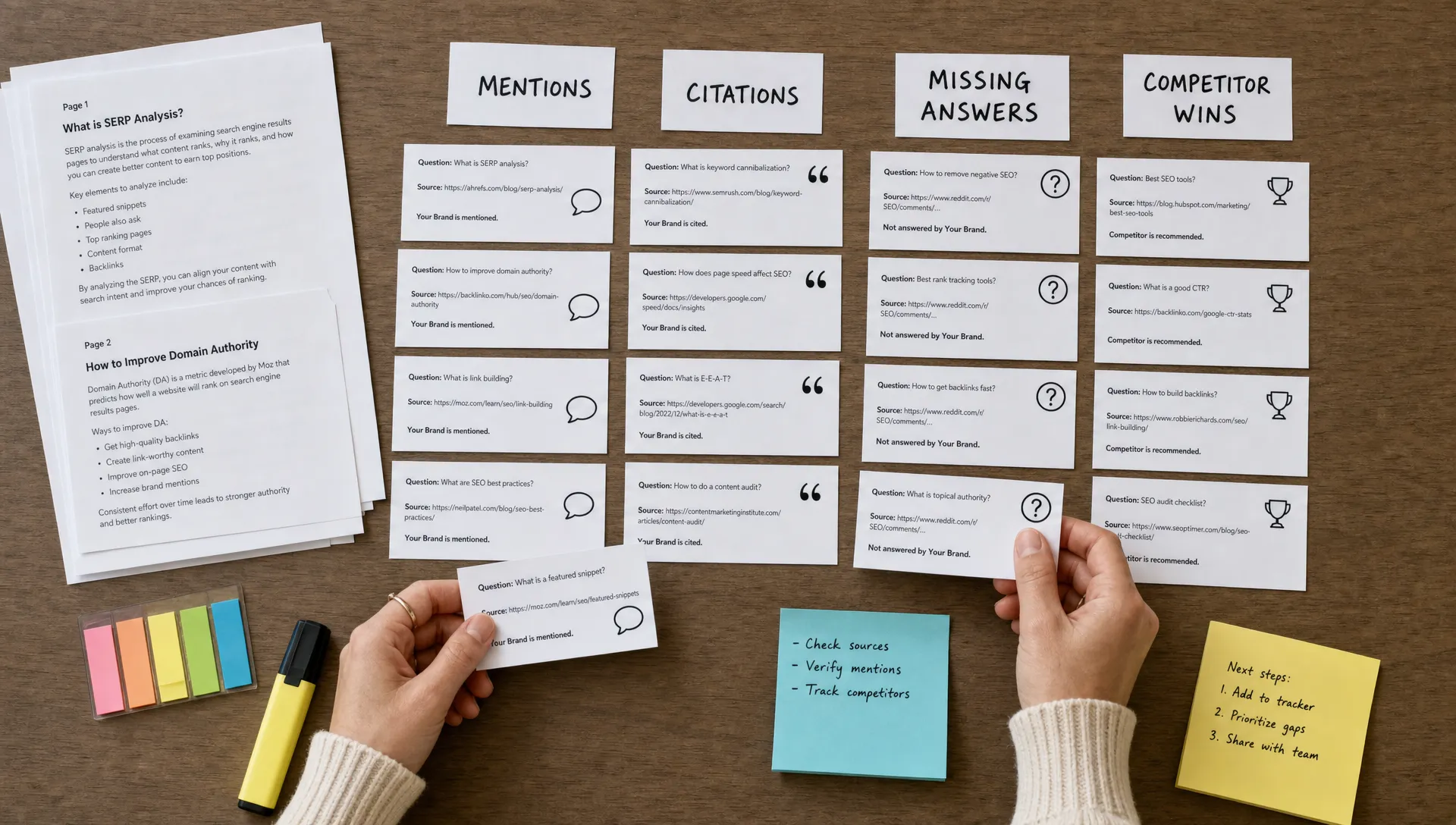
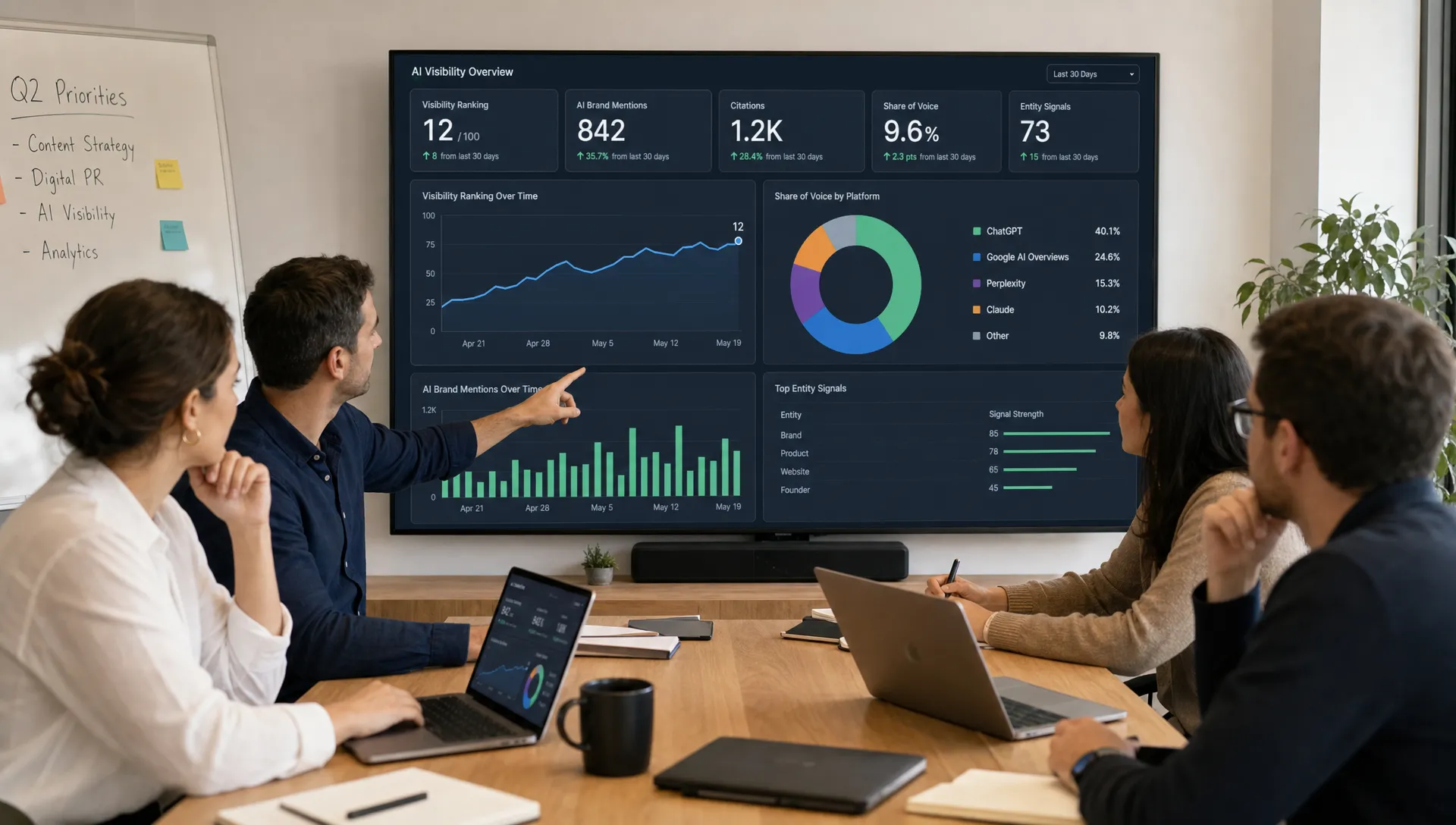
A visibility ranking can tell you where a page sits in classic search, but it cannot tell you whether ChatGPT, Google AI Overviews, Gemini, Perplexity, Claude or Copilot will mention your brand when a buyer asks for a recommendation. That gap matters because AI answers often satisfy the query before a user reaches a list of links. For hotel groups, franchises, MSPs, WooCommerce stores and agencies, the missed signal is not only traffic. It is credibility, consideration and share of voice inside the answer itself.
Traditional rank tracking still has value. It shows whether pages are indexable, competitive and aligned with search demand. The problem is that AI search does not work like a single search results page. It blends retrieval, entities, citations, training data, structured content and prompt context. If your measurement stops at position, you can look visible while your brand is absent from the conversation.
What visibility ranking measures and what it misses
Classic SEO ranking measures the position of a URL for a keyword in a search engine results page. It usually answers a narrow question: for this keyword, in this location, on this device, where does this page appear? That is useful for diagnosing organic traffic opportunities and monitoring competitors.
AI search adds a different layer. The answer engine may not show ten blue links. It may summarize options, cite two sources, mention three brands and omit the page that ranks first in Google. The unit of visibility shifts from page position to entity presence. In plain terms, the model has to understand what your business is, when it is relevant, why it is credible and which source it can safely reuse.
| Measurement area | Classic search view | AI search view |
|---|---|---|
| Primary unit | URL position | Brand, entity, answer and citation |
| Query format | Short keyword | Full question, comparison or task |
| Success signal | Rank, impression and click | Mention, citation, accuracy and share of voice |
| Content need | Keyword relevance | Reusable facts, proof, structure and context |
| Technical need | Crawlability and indexation | Crawlability, structured data, internal links and AI-readable metadata |
A modern visibility ranking program should therefore include rank data, but it should not stop there. If an AI answer names your competitor as a recommended provider and cites a third-party listicle, your number two organic rank may not protect you.
CapstonAI has explored this broader shift in detail in its article on why website rank alone misses your AI visibility problem. The short version is simple: rank is page-centric, while AI visibility is answer-centric.
Why AI search can ignore a well-ranked brand
AI engines use different systems, but the pattern we observe is consistent. They prefer content that can be parsed, trusted and assembled into a concise answer. A page can rank because it matches a keyword, earns links or has strong domain authority, yet still fail to provide the specific facts an assistant needs.
For example, an independent hotel chain may rank well for boutique hotel Chicago, but an AI answer to best hotels near Wrigley Field for families may mention only properties with clear neighborhood pages, family amenities, review signals, parking details and updated local citations. The classic keyword rank was real, but the prompt required a richer entity match.
A visibility ranking report usually compresses this complexity into one position. AI search expands the surface area. It asks whether your brand is recognized as an entity, whether its attributes are clear and whether external sources confirm the claim.
The same issue appears in healthcare franchises, education networks and MSPs. A local clinic, campus or service area may have a page, but if hours, services, staff names, accepted plans, locations and FAQs are buried in images or inconsistent templates, the brand becomes hard for generative engines to reuse.
Brand mentions are not the same as citations
A brand mention means the AI answer names your business. A citation means the answer links to or references a source. You need to track both because they create different business effects.
A mention without a citation can still influence awareness. A citation without a mention can send authority to someone else, especially if the cited page is a directory, marketplace or competitor comparison. The strongest outcome is a correct mention with a relevant citation to your own site or a trusted third-party source that supports the claim.
This is where share of voice becomes useful. Instead of asking whether one page ranks, ask how often your brand appears across a prompt set compared with competitors. For an e-commerce brand, that prompt set might include product comparisons, use cases, shipping questions, warranty questions and alternatives. For a travel group, it might include destination, amenity, event and neighborhood prompts.
CapstonAI’s overview of AI visibility metrics breaks this into practical signals: mentions, citations, share of voice, accuracy and sentiment. Those signals reveal gaps that a rank tracker cannot see.
Where visibility ranking breaks down in real buyer journeys
The biggest miss happens when keyword tracking is built around old query behavior. Buyers now ask assistants in full sentences. They include constraints, intent and context in the prompt.
A classic keyword might be MSP Chicago. A real AI search prompt may be find a managed IT provider in Chicago that supports law firms, Microsoft 365, cybersecurity compliance and onsite response. Ranking for the short keyword helps, but the answer engine needs service specificity, industry proof, location confidence and source validation.
For a service organization, entity clarity can be just as important as search volume. A homepage such as Ons Plekske, a day program for young people with mild intellectual disabilities or autism shows the type of facts AI systems need to understand: who the organization serves, what activities it offers, where people can find contact details and how the service is framed. The same principle applies to hotels, clinics, schools, stores and agencies. Clear facts reduce ambiguity.
The technical reasons brand mentions disappear
AI search visibility is not only a content problem. Technical SEO still matters because generative engines need access to clean, fast and structured pages before they can reuse the information.
Crawlability comes first. If key pages are blocked, thin, duplicated or dependent on scripts that hide essential copy, AI retrieval systems may miss them. Page performance also matters for business outcomes. A slow page may still be indexed, but it can reduce crawl efficiency, weaken user experience and lower conversion after the click.
Structured data gives machines a second way to understand your content. Organization, LocalBusiness, Hotel, Product, Service, FAQPage, BreadcrumbList and Article schema can clarify entity relationships. Schema is not a guarantee of AI citation, but it reduces the work an engine has to do to identify names, locations, offers, ratings, prices, authors and page purpose.
The emerging llms.txt file is another signal to watch. It is not a universal ranking lever and not every AI system honors it. Used carefully, it can point AI crawlers toward important documentation, policy pages, product information and canonical explanations. Treat it as part of an AI-ready metadata layer, not as a replacement for strong site architecture.
How to diagnose missed mentions before rewriting content
Do not start by rewriting every page. Start with measurement. A useful AI visibility audit compares your brand, competitors and priority prompts across multiple generative engines. The goal is to find where the answer already includes you, where it cites you, where it cites others and where it gets facts wrong.
A practical prompt set usually includes four categories:
- Discovery prompts, such as best provider, store, hotel or clinic for a specific need.
- Comparison prompts, such as your brand versus a competitor or alternatives to a known provider.
- Task prompts, such as how to choose, book, buy, migrate, install or troubleshoot.
- Local or segment prompts, such as near me, for families, for franchises, for WooCommerce or for regulated industries.
A visibility ranking score becomes more useful when it sits beside these answer-level signals. For each prompt, record whether your brand was mentioned, whether it was cited, which competitors appeared, what sources were used and whether the answer was accurate.
That audit often reveals fixable patterns. A hotel may need stronger amenity pages and local internal links. A WooCommerce store may need clearer product schema, comparison content and return policy markup. An agency may need service pages that connect capabilities to industries, not just a generic list of deliverables.
Fixes that improve AI visibility without abandoning SEO
The fix is not to abandon visibility ranking. The fix is to expand it into a system that measures both search position and AI answer presence. Classic technical SEO, GEO and AEO work best when they reinforce each other.
GEO, or Generative Engine Optimization, focuses on making content useful and trustworthy for AI-generated answers. AEO, or Answer Engine Optimization, focuses on structuring concise answers to specific questions. Traditional SEO keeps the foundation healthy through crawlability, indexation, internal linking, performance and content quality.
Start with pages that already matter to revenue. For a hotel group, that may be location, room, amenity and destination pages. For a franchise, it may be local service pages. For an MSP, it may be industry solution pages. For e-commerce, it may be category, product and comparison pages.
Then improve the signals AI engines can reuse:
- Write direct answers to high-intent questions near the relevant page section.
- Add entity-rich details, including locations, service areas, product attributes and eligibility requirements.
- Use schema that matches the page type and keep it consistent with visible content.
- Strengthen internal linking so related pages explain the same entity from different angles.
- Publish FAQs that answer real buyer objections, not generic filler questions.
- Keep metadata, titles and headings specific enough for both users and machines.
Selecting tools also matters. If you are comparing platforms, look for prompt tracking, citation monitoring, competitor benchmarking and prioritized fixes, not only keyword rank dashboards. CapstonAI covers that evaluation process in its guide on how to choose an SEO platform for AI visibility.
A simple operating model for teams
Teams move faster when AI visibility work is assigned to clear owners. SEO teams should own technical foundations, prompt tracking and schema validation. Content teams should own answer quality, entity clarity and proof points. Developers or CMS owners should own page performance, templates, structured data deployment and llms.txt maintenance.
Agencies managing site fleets need an extra layer: repeatability. A healthcare franchise with 80 locations cannot manually reinvent every local page. It needs templates that expose the right facts for each location while avoiding thin duplication. The same is true for multi-property hospitality groups and multi-brand retail portfolios.
Measure before and after every change. The useful comparison is not whether one keyword moved from position six to position four. It is whether priority prompts now mention the brand, cite the correct page, describe the offer accurately and reduce competitor dominance in the answer.
Frequently Asked Questions
Can a visibility ranking tool measure AI search? It can measure part of the picture if it includes prompt-level AI answer tracking. A traditional rank tracker alone usually cannot measure mentions, citations, answer accuracy or share of voice across generative engines.
Why does ChatGPT mention competitors that rank below us? AI systems may rely on different sources than the live search results page. They may favor clearer entity data, stronger third-party citations, more complete comparison content or pages that answer the prompt more directly.
Do schema and llms.txt guarantee AI citations? No. Schema and llms.txt help machines understand and discover content, but they do not force an AI engine to cite your page. They work best with crawlable pages, strong internal linking, accurate content and external proof.
Which AI engines should brands monitor? Most teams should monitor ChatGPT, Google AI Overviews, Gemini, Perplexity, Claude and Copilot. The mix should match where prospects research decisions and how important citations, summaries or local recommendations are to your buying journey.
Start with a free AI visibility audit
If your SEO reports look healthy but AI answers do not mention your brand, start with a baseline. Check priority prompts across the major AI engines, compare competitor share of voice and identify which pages need clearer metadata, schema, FAQs, internal links or crawlability fixes.
CapstonAI helps brands, agencies and in-house teams measure how AI search sees their business, then turns the findings into prioritized actions. Start with a free AI visibility audit to see where your brand is mentioned, where it is missing and what to fix first.