When a buyer asks ChatGPT, Gemini, Perplexity or Google AI Overviews which product to choose, an AI web search engine is not only looking for a persuasive product page. It is looking for usable evidence: facts it can retrieve, verify, compare and cite inside an answer. If your proof is buried in images, vague copy or disconnected pages, your product may be accurate and still invisible.
For brands, retailers, hotels, franchise groups and agencies, this changes the job of product content. Classic SEO still matters, but ranking a page is no longer the only objective. Your evidence must be structured enough for machines, credible enough for generative engines and clear enough for buyers who want an answer before they ever reach your website.
What an AI web search engine treats as product evidence
Product evidence is any information that helps an answer engine decide whether a claim about your product, service, location or brand is reliable enough to mention. That includes obvious assets like product descriptions and reviews, but it also includes schema markup, internal links, policy pages, comparison content, third-party citations, author information and technical signals.
The key point: generative engines do not evaluate a page in isolation. They assemble answers from retrieved passages, known entities, indexed pages, cited sources and model knowledge. A product page with strong copy but weak evidence can lose visibility to a competitor with clearer specifications, better structured data and more consistent corroboration across the web.
Product evidence has layers
A useful way to audit product evidence is to separate what buyers see from what retrieval systems can reuse. The strongest pages usually support both.
| Evidence layer | What it includes | Business effect |
|---|---|---|
| Product facts | Specifications, pricing context, availability, service area, use cases | Reduces ambiguity in AI answers and buyer comparisons |
| Trust proof | Reviews, testimonials, awards, certifications, warranty details | Supports credibility and reduces perceived risk |
| Entity clarity | Brand names, product names, locations, categories, founders, parent brands | Helps engines connect the right business to the right query |
| Machine readability | Schema, metadata, headings, FAQ blocks, llms.txt, clean HTML | Makes evidence easier to crawl, parse and reuse |
| External corroboration | Mentions, citations, comparison pages, directories, partner sites | Increases confidence when engines synthesize answers |
This is where Generative Engine Optimization (GEO) and Answer Engine Optimization (AEO) overlap with technical SEO. GEO focuses on being represented correctly in generated answers. AEO focuses on becoming the source for direct answers. Technical SEO keeps the pages crawlable, fast and structured.
Why evidence is not the same as marketing copy
Marketing copy can state that a product is “premium,” “reliable” or “built for teams.” Evidence explains what that means. For a hotel, evidence might include room types, cancellation policies, nearby landmarks, accessibility features and review themes. For an IT service provider, it might include supported platforms, response models, compliance experience and service territories.
An AI web search engine has to convert messy web content into a concise response. Specific claims travel better than adjectives. “24-hour front desk in downtown Austin with valet parking” is more reusable than “exceptional guest service.” “WooCommerce store with same-day local delivery in Phoenix” is more useful than “fast fulfillment.”
That precision affects revenue. If AI answers cannot identify who you serve, where you operate or why your product is credible, they are more likely to recommend a competitor with clearer evidence.
The signals AI systems can reuse
Every generative engine has its own retrieval and ranking behavior, but the common pattern is simple: the system needs to find relevant evidence, assess whether it is trustworthy and then decide whether to cite or summarize it. That process favors content that is specific, consistent and technically accessible.
Source clarity and entity consistency
Entity consistency means your brand, products, locations and categories are described the same way across your site and the wider web. This matters because AI systems need to know that “CapstonAI,” “Capston AI” and a specific domain are the same business, or that a hotel name refers to one property rather than a chain-wide brand.
For product evidence, entity clarity starts with basics: exact product names, category labels, location names, organization schema and clear relationships between pages. A multi-location healthcare brand, for example, should not leave engines guessing which services belong to which clinic.
Internal linking also helps. If your product page links to relevant FAQs, comparison pages, location pages and policy content, it gives retrieval systems a clearer map of the evidence. Internal links are not only navigation. They are signals that connect claims to supporting context.
Structured data, schema and AI-ready metadata
Structured data turns page information into a format machines can parse more reliably. Product, Organization, LocalBusiness, FAQPage, Review and Breadcrumb schema can all help, when used accurately and matched to visible page content. Google’s own documentation on structured data for search is a practical baseline for what search systems expect.
An AI web search engine can still read normal HTML, but schema reduces interpretation work. A product page that clearly marks price, availability, aggregate rating, brand and product category gives engines cleaner data than a visually attractive page where those details are scattered across scripts or images.
AI-ready metadata goes further. Clear titles, descriptions, headings, canonical tags, Open Graph data and well maintained XML sitemaps help both classic crawlers and generative systems understand page purpose. Some brands are also experimenting with llms.txt to give AI crawlers a concise map of important content, policies and preferred references.
Reviews, comparisons and third-party corroboration
AI answers often lean on corroboration. If your site says one thing, but reviews, directories, partner pages and independent publications confirm it, the claim becomes easier to trust. That is especially important for high-consideration products where buyers compare risk, performance and support before contacting sales.
Consider specialized product categories like mining hardware. A provider offering ASIC miner sales, hosting, repair services and cooling options needs more than a catalog page. Buyers want proof around machine types, hosting locations, repair support and operating conditions. A clear example is a company positioned around crypto mining hardware and hosting services, where the product evidence must cover both equipment and ongoing operational support.
For hotels, corroboration may come from review platforms, travel guides and local business listings. For e-commerce, it may come from buyer reviews, marketplace mentions, comparison articles and manufacturer references. For MSPs, it may come from partner directories, certifications and case studies.
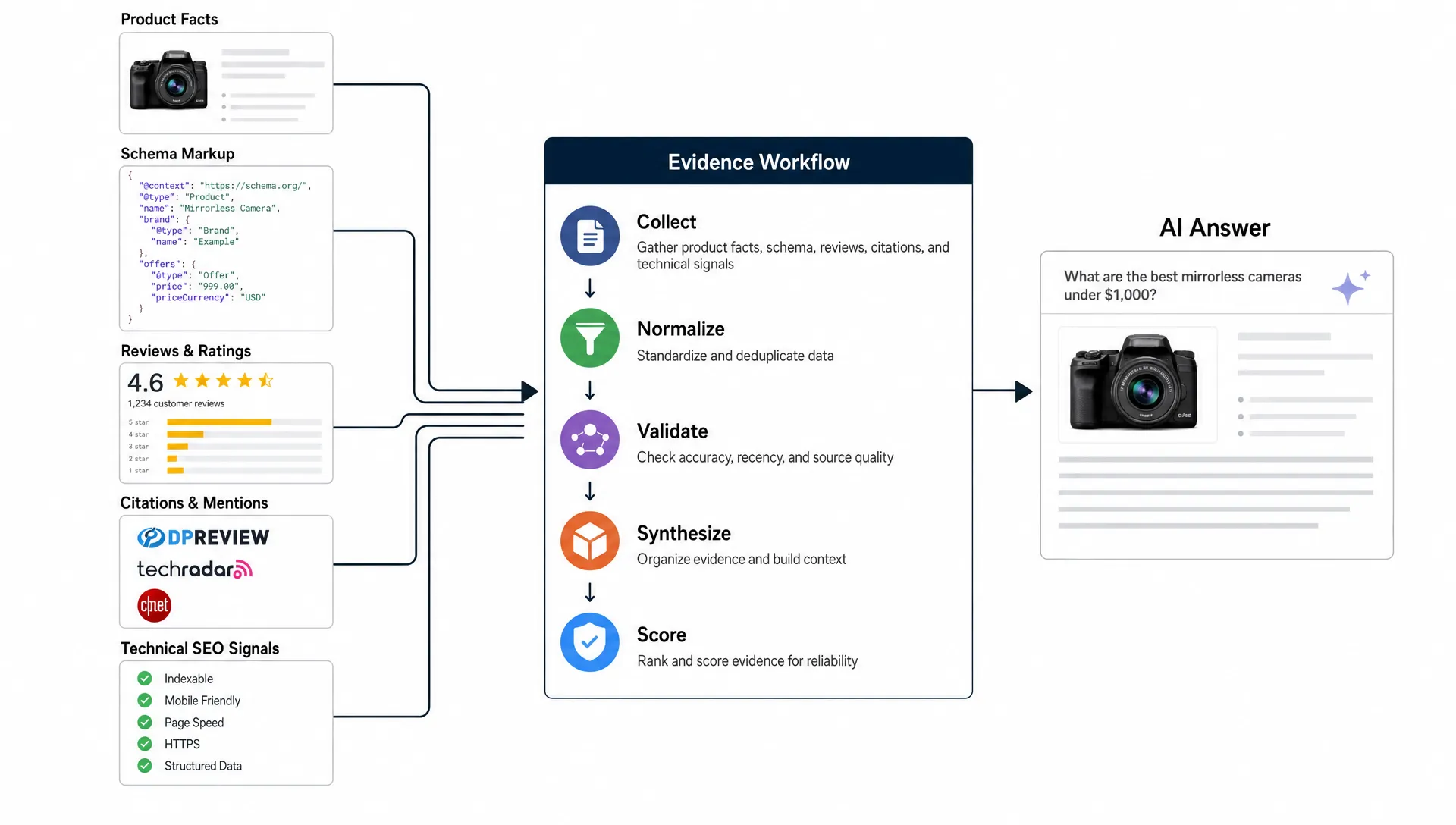
How generative engines turn evidence into answers
Generative engines do not simply “rank ten blue links.” They retrieve passages, summarize facts and sometimes cite sources. The exact mechanics vary by system, but most answer experiences involve three practical stages: discovery, selection and synthesis.
Retrieval, citation and synthesis
Discovery is the crawl or retrieval step. If a page is blocked, slow, hidden behind scripts or missing from internal navigation, it may not be used. Selection is the quality and relevance step. The system compares available sources, entities and passages against the user’s prompt. Synthesis is the answer step, where the model compresses selected evidence into a response.
This is why citation tracking matters. A brand may be mentioned without a link, cited with a link or omitted entirely. Those are different visibility outcomes. If you want a deeper view of the citation side, CapstonAI has a separate guide on how AI-driven search engines choose sources to cite.
A strong product evidence strategy aims for both mention and citation. Mentions influence awareness. Citations drive credibility and clicks. Together, they form part of your AI search share of voice.
Brand mentions and share-of-voice patterns
Share of voice in AI search means how often your brand appears compared with competitors across a defined set of prompts. For example, a regional hotel group might track prompts like “best boutique hotels near downtown Nashville” or “family-friendly hotels with parking near Boston attractions.” An e-commerce brand might track “best WooCommerce stores for sustainable office supplies” or “alternatives to [competitor].”
An AI web search engine may mention your competitor because their evidence is easier to summarize, not because their product is better. That distinction matters. The fix is not to publish more generic content. The fix is to map the prompts where you are absent, identify the missing evidence and improve the pages that should answer those questions.
CapstonAI supports that work with AI visibility scans, brand mention tracking, citation tracking, competitor monitoring and prompt mapping across engines such as ChatGPT, Google AI Overviews, Gemini, Perplexity, Claude and Copilot.
Technical SEO still decides what can be retrieved
Technical SEO remains the foundation. If engines cannot crawl, render or interpret the page, better product copy will not solve the visibility gap. The same applies when pages load slowly, duplicate each other, bury key content in tabs or rely on client-side rendering that makes important evidence harder to access.
For product evidence, focus on crawlability, indexability, internal linking and page performance. A clean information architecture helps engines understand which page is the authoritative source for a claim. Fast, stable pages reduce friction for crawlers and users. Descriptive headings help passage retrieval systems identify the right block of text.
The business effect is direct. A franchise brand with hundreds of location pages can lose AI visibility if service evidence is inconsistent by location. A WooCommerce store can lose comparison visibility if product attributes are not structured. An agency managing site fleets can create measurable gains by fixing repeatable technical patterns across many clients.
A practical product evidence scorecard
A good audit does not start with opinions about content quality. It starts with observable gaps. Choose a set of priority products, services or locations, then evaluate whether each page gives AI systems enough proof to retrieve and reuse.
Score pages against seven questions
Use a simple 0 to 2 score for each question: 0 means missing, 1 means partial and 2 means clear. A page scoring below 10 deserves attention before you create more content around it.
- Does the page state exactly what the product or service is, who it is for and where it applies?
- Are product facts visible in HTML rather than trapped in images, PDFs or scripts?
- Does the page use accurate schema that matches visible content?
- Are claims supported by reviews, specifications, policies, case studies or third-party references?
- Do internal links connect the page to related FAQs, comparisons, locations and support content?
- Are brand, product, location and category entities named consistently across the site?
- Does the page load quickly, render cleanly and avoid crawl barriers?
When an AI web search engine evaluates this evidence, it is not rewarding a checklist for its own sake. It is reducing uncertainty. The clearer the evidence, the easier it is for a generated answer to include your product accurately.
Make evidence measurable across engines
AI search performance should be measured across multiple answer surfaces because each system behaves differently. Google AI Overviews may cite search-indexed pages. Perplexity often shows citations prominently. ChatGPT, Gemini, Claude and Copilot may vary based on browsing mode, partnerships, prompt wording and freshness.
A useful measurement plan includes three parts: a stable prompt set, recurring scans and competitor benchmarks. Track brand mentions, citations, sentiment, answer position, factual accuracy and share of voice. Review changes before and after page improvements so the team can connect fixes to outcomes.
CapstonAI’s guide to measuring AI performance across search engines explains this broader measurement problem in more detail. For product evidence, the takeaway is simple: you need a repeatable view of where your evidence is strong, where competitors are being cited and which pages need work.
What to fix first
Not every page needs the same level of evidence. Start with pages tied to revenue: booking pages, product category pages, service pages, location pages and comparison pages. These are the URLs most likely to influence AI-assisted decisions.
High-impact fixes for revenue pages
Begin with the fixes that remove ambiguity. Rewrite vague product sections into specific factual blocks. Add FAQ content that answers real buyer prompts. Implement schema where it is accurate. Link supporting pages together. Update metadata so each page has a clear role. Make sure the page is crawlable, indexable and fast enough to be reliably retrieved.
For a hotel group, that might mean adding structured property amenities, neighborhood context, parking details, pet policies and event space information. For a healthcare franchise, it might mean mapping services to locations with consistent provider and insurance information. For an MSP, it might mean documenting supported platforms, response models, certifications and service areas.
Turn evidence into an operating rhythm
AI visibility is not a one-time content project. Product details change, competitors publish new evidence and generative engines adjust how they retrieve information. Treat product evidence as an operating rhythm: scan, diagnose, fix, publish and measure again.
CapstonAI is built around that loop. It helps teams see where brands are mentioned or missing, which prompts surface competitors, which pages need AI-ready FAQ or schema updates and where CMS-integrated fixes can improve visibility. The goal is not to chase every AI answer. It is to make your most important evidence easier for machines and buyers to trust.
Frequently Asked Questions
Does every AI web search engine evaluate product evidence the same way? No. Each system has different retrieval methods, citation behavior and freshness signals. The practical response is to measure across multiple engines and improve the evidence that matters across all of them: clear facts, crawlable pages, structured data, consistent entities and credible corroboration.
Is schema enough to improve AI product visibility? Schema helps, but it is not enough by itself. The marked-up data must match visible content, and the page still needs useful product details, internal links, reviews, citations and strong technical SEO.
How often should product evidence be audited? Revenue-driving pages should be checked whenever products, policies, locations or competitive positioning change. Many teams also review AI visibility monthly so they can spot shifts in mentions, citations and share of voice before traffic or leads are affected.
What is the difference between GEO and AEO? GEO, or Generative Engine Optimization, focuses on how your brand appears in generated AI answers. AEO, or Answer Engine Optimization, focuses on structuring content so engines can use it for direct answers. Both depend on technical SEO, credible evidence and clear entities.
Start with a free AI visibility audit
If AI systems are already answering your prospects, the first step is to see what they currently say. A free CapstonAI visibility audit shows where your brand appears, where competitors are cited, which prompts matter and which product pages need stronger evidence.
From there, your team can prioritize fixes that connect directly to business outcomes: better AI mentions, more accurate citations, clearer product comparisons, stronger booking or lead paths and fewer blind spots across ChatGPT, Gemini, Claude, Perplexity, Copilot and Google AI Overviews.
Start with a free AI visibility audit from CapstonAI and turn your product evidence into something AI systems can find, understand and reuse.