A seo content ai workflow is not simply a faster way to draft copy. It is a set of controls that helps teams publish useful pages without losing factual accuracy, brand consistency or visibility in AI answers. For hotel groups, franchise networks, MSPs, WooCommerce stores and agencies, the business issue is straightforward: if generative engines cannot verify who you are, what you offer and why your page is reliable, they may ignore you or cite a competitor.
SEO teams used to optimize mainly for search result pages. In 2026, many prospects meet brands inside ChatGPT, Google AI Overviews, Gemini, Perplexity, Claude and Copilot before they click. These systems compress the web into answers, so content has to be readable by people, crawlable by search engines and reusable by AI systems without distorting the facts.
Why accuracy and visibility now move together
From search results to AI answers
Generative Engine Optimization, or GEO, improves how a brand is represented inside AI-generated answers. Answer Engine Optimization, or AEO, structures content so assistants can answer a specific user question from it. Neither replaces classic technical SEO. They depend on crawlability, internal linking, structured data, page performance and clear entity signals.
That changes the role of content operations. A blog post, location page or product guide is no longer only competing for a blue link. It may become a source for an answer that summarizes several brands in one paragraph. If your page is vague, outdated or technically difficult to parse, the model has less reason to use it.
Accuracy is a visibility signal
Accuracy protects trust, but it also affects discoverability. AI systems tend to favor content that is consistent across pages, supported by clear evidence and easy to map to known entities. A franchise brand with mismatched location names, a hotel group with inconsistent amenity descriptions or an ecommerce store with conflicting product specs creates uncertainty.
The fix is not to publish slower. It is to build a workflow where AI accelerates research, outlining, metadata and quality checks while humans approve the facts that affect revenue, compliance and brand reputation.
What a seo content ai workflow has to protect
A workflow should protect three things at the same time: factual integrity, AI readability and search performance. If one is missing, the page may still rank or publish quickly, but it is less dependable as an asset for AI search.
| Risk | Where it appears | Workflow control | Business effect |
|---|---|---|---|
| Incorrect claims | AI drafts, refreshed pages, old templates | Source checks and subject matter review | Fewer support issues and stronger trust |
| Weak entity clarity | Brand pages, location pages, product catalogs | Consistent names, schema and internal links | Better recognition across AI answers |
| Missing citations | Guides, comparison pages, regulated topics | Approved references and proof blocks | Higher credibility for people and models |
| Technical blind spots | Blocked pages, slow pages, broken canonicals | Crawl checks, performance tests and schema validation | More pages eligible to be discovered |
| Poor AI visibility tracking | Post-publish reporting | Prompt monitoring, mention tracking and share of voice | Faster prioritization of fixes |
The table is deliberately practical. The goal is not to make every page longer. It is to make every important page clearer, easier to verify and easier for AI systems to reuse accurately.
Step 1: Build briefs from entities, intent and proof
Entity clarity comes before drafting
AI tools perform better when the brief is specific. Start with entities, which are the named things that search systems connect: your brand, locations, services, products, people, certifications, neighborhoods, SKUs, tax forms, amenities and competitors.
A strong seo content ai process turns those inputs into instructions the model can follow: target audience, page purpose, approved claims, disallowed claims, internal link opportunities, schema type and required proof. For a hotel chain, the brief should separate brand-level attributes from property-specific amenities. For a healthcare franchise, it should distinguish national services from services available at a single location.
Proof beats model memory
Do not ask a model to remember facts that matter. Give it the current source material. That can include approved brand pages, product feeds, menu data, location spreadsheets, support docs, compliance copy, customer FAQs and internal subject matter notes.
Regulated or finance-adjacent topics need extra care. For example, if an article discusses federal excise filing, reviewers should verify the process against IRS materials or a specialized filing provider such as IRS-authorized eFile Excise 720, rather than letting a model summarize requirements from memory. The same principle applies to medical services, warranties, travel policies and legal disclaimers: AI can structure the content, but the proof source has to be explicit.
Step 2: Draft for the journey, then review for truth
Use AI for structure and variants
AI is useful for turning a brief into outlines, title options, meta descriptions, FAQ drafts, schema suggestions and alternative explanations for different audience segments. It can also help normalize page templates across hundreds of locations or product categories.
The job of a seo content ai draft is to shorten the distance from research to review, not to replace review. A first draft should make the page easier for an editor to evaluate. It should not hide weak claims behind polished language.
Put human review where risk is highest
The review layer should be proportional to risk. A low-stakes glossary update may need a light editorial pass. A page about pricing, health services, tax rules, hotel fees or product safety needs a stricter check before publishing.
A practical reviewer should confirm:
- Every factual claim matches an approved source.
- Brand names, location names, product names and service names are current.
- The page answers the search intent without adding unsupported claims.
- The internal links point to relevant pages, not just high-priority pages.
- The schema reflects the visible page content.
For a deeper breakdown of where automation helps and where human judgment matters, CapstonAI has a detailed guide on AI for SEO and human review.
Step 3: Add GEO and AEO cues without forcing the writing
Make answers easy to extract
AI answers often reuse passages that are direct, entity-rich and easy to attribute. That does not mean every page should become a list of snippets. It means the page should include clear answer blocks where the user’s question requires one.
A seo content ai workflow should make these elements repeatable: a concise answer near the top of the page, descriptive headings, comparison tables where useful, FAQ sections for real buyer questions and citations or proof notes for claims that need support. For product or service pages, include the exact entity names that customers and AI systems need to connect.
Support AI crawlers and knowledge graphs
Structured data helps search engines understand page meaning. Organization, LocalBusiness, Product, FAQPage, Article, BreadcrumbList and Review schema can all be useful when they match the actual page. Schema is not a visibility shortcut. It is a clarification layer.
Teams should also understand llms.txt, a plain text file that can point AI systems toward useful public documentation and content. It does not guarantee inclusion in AI answers, but it can reduce friction when paired with crawlable pages, consistent internal links and strong metadata. If your team is defining editorial standards for AI-assisted work, the CapstonAI article on Google AI content standards is a useful companion.
Step 4: Keep classic technical SEO in the loop
Technical defects become AI visibility defects
AI visibility is still constrained by technical access. If a page is blocked by robots rules, buried behind JavaScript, slowed by heavy media or disconnected from internal links, AI systems and search engines have less to work with. The same is true for broken canonicals, duplicate location pages and inconsistent redirects.
A seo content ai workflow loses value when the final page cannot be crawled, rendered or understood. Before publishing, technical checks should confirm indexability, canonical tags, sitemap inclusion, page speed, mobile rendering, image weight and schema validity.
Internal links tell models what matters
Internal linking is not just a PageRank tactic. It explains relationships. A hotel’s wedding venue page should link to the specific property, room blocks, catering details and nearby attractions. A WooCommerce category page should connect to buying guides, top products, return policy pages and support content.
For AI systems, these relationships help connect entities and reduce ambiguity. For users, they shorten the path from research to booking, quote request, appointment or checkout. That is the business reason technical SEO remains part of the AI search conversation.
Step 5: Measure what AI systems say after publishing
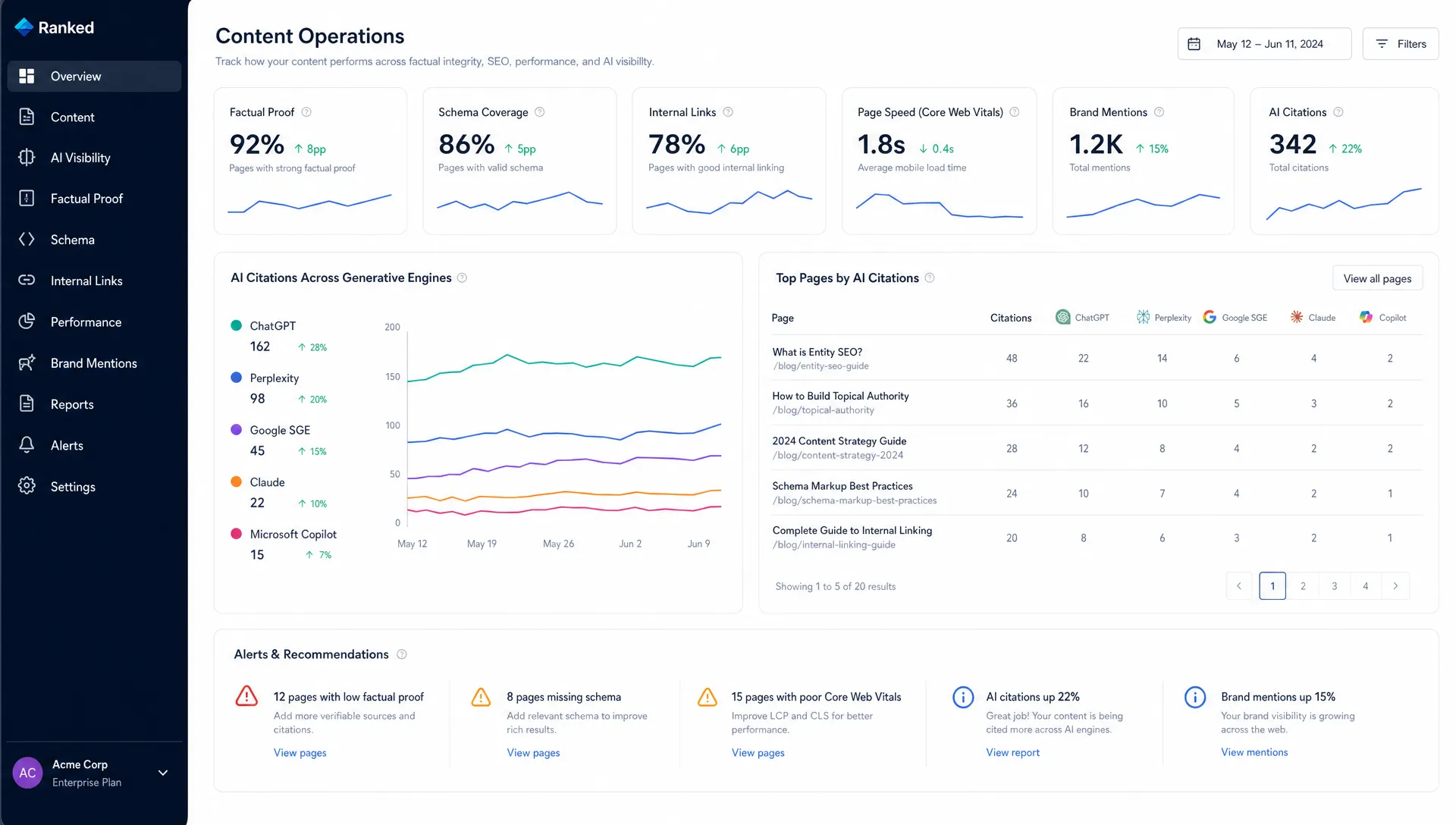
Track prompts, mentions, citations and share of voice
Publishing is not the end of the workflow. Visibility has to be observed. The same page can perform well in traditional organic search but remain absent from AI answers, especially if competitors have stronger entity signals or more citation-worthy content.
This is where seo content ai becomes a measurable visibility program. Track representative prompts across ChatGPT, Google AI Overviews, Gemini, Perplexity, Claude and Copilot. Look at whether your brand appears, whether it is cited, which page is referenced, which competitors appear and whether the answer is accurate.
| Metric | What it tells you | How teams use it |
|---|---|---|
| AI mention rate | How often your brand appears for tracked prompts | Identify invisible services, products or locations |
| Citation quality | Whether AI systems cite your site or third parties | Strengthen pages that should be the source of truth |
| Share of voice | How often you appear compared with competitors | Prioritize content and technical fixes by opportunity |
| Prompt gaps | Questions where rivals appear and you do not | Build briefs for missing pages or sections |
| Accuracy defects | Wrong hours, outdated offers or incorrect descriptions | Fix source pages and reduce customer confusion |
Close the loop with prioritized fixes
Good reporting should lead to action. If AI systems mention a competitor for best boutique hotel in a neighborhood, inspect the pages they cite. Are their location pages clearer? Do they include better structured data? Are reviews, amenities and local entities easier to parse? The workflow should turn that answer into a specific fix, not a vague content idea.
CapstonAI is built around this measurement-first approach: scan visibility across AI engines, map which prompts surface your business or your rivals, diagnose blind spots and publish AI-ready metadata, FAQ, schema and structured updates through supported CMS workflows.
How this looks for hotels, franchises, ecommerce and agencies
For independent hotel chains and travel groups, the workflow protects property-level accuracy. AI answers may compare amenities, parking, pet policies, accessibility, wedding capacity or proximity to landmarks. If those details differ across the website, booking engine and third-party profiles, the model may choose a clearer competitor.
For multi-site franchises, entity consistency is the main challenge. Each location needs accurate name, address, phone, hours, services, practitioner or staff details where relevant and local proof. The national brand also needs internal links that clarify which services belong to which locations.
For ecommerce and WooCommerce teams, AI search often compresses product comparisons. Specs, compatibility, inventory language, return terms and support content should be consistent across product pages, category pages and help articles. Clean schema and fast pages help users and crawlers reach the same answer.
For agencies and MSPs managing site fleets, a seo content ai workflow also creates a repeatable QA trail. Teams can show clients what changed, why it changed, what prompts were affected and whether AI mentions improved after the fix.
Governance rules that keep the workflow practical
The best workflow is the one the team can run every week. Keep the system small enough to repeat, then improve it as you learn. Assign one owner for factual sources, one for technical QA and one for AI visibility reporting. In a smaller team, those roles may belong to the same person, but the checks should remain separate.
Use versioned briefs for recurring page types. A franchise location page, hotel property page, product category page and service comparison guide should not start from scratch every time. Each template can define required entities, approved claims, schema rules, internal link patterns and review steps.
Avoid using AI output as the source of record. Your CMS, product database, location feed, booking engine, compliance documentation and analytics should remain the source systems. AI should help transform and test that information, not become the place where facts are invented.
Frequently Asked Questions
What is an AI workflow for SEO content? It is a repeatable process for researching, drafting, reviewing, publishing and measuring content with AI support. A seo content ai workflow adds specific safeguards for factual accuracy, entity clarity, technical SEO and AI visibility tracking.
Can AI-written content rank in Google and appear in AI answers? Yes, if the content is useful, accurate, original enough to satisfy the user’s intent and technically accessible. The problem is not AI assistance. The problem is publishing unsupported or generic content without review.
How often should teams check AI visibility? Weekly or biweekly checks are practical for active brands, especially when competitors publish often or when locations, offers and inventory change. More important than frequency is using the same prompt set so results can be compared over time.
Does schema guarantee citations in ChatGPT, Gemini or Perplexity? No. Schema helps clarify meaning, but citations depend on many factors, including crawlability, page authority, content quality, query fit and how each system retrieves sources. Treat schema as one visibility input, not the whole strategy.
Where should a team start if it has hundreds of pages? Start with pages tied to revenue or trust: core service pages, top product categories, high-value locations, comparison pages and FAQs that sales or support teams answer repeatedly. Then expand the workflow to lower-priority content.
Start with a free AI visibility audit
Before adding more pages, find out what AI systems already say about your brand. Track whether ChatGPT, Gemini, Claude, Perplexity, Copilot and Google AI Overviews mention you, cite you accurately or skip you in favor of competitors.
CapstonAI helps brands, retailers, agencies and multi-site teams measure that visibility, diagnose blind spots and turn key pages into assets AI systems can read, trust and reuse. If you want a clear starting point, start with a free AI visibility audit and use the findings to prioritize the next set of fixes.