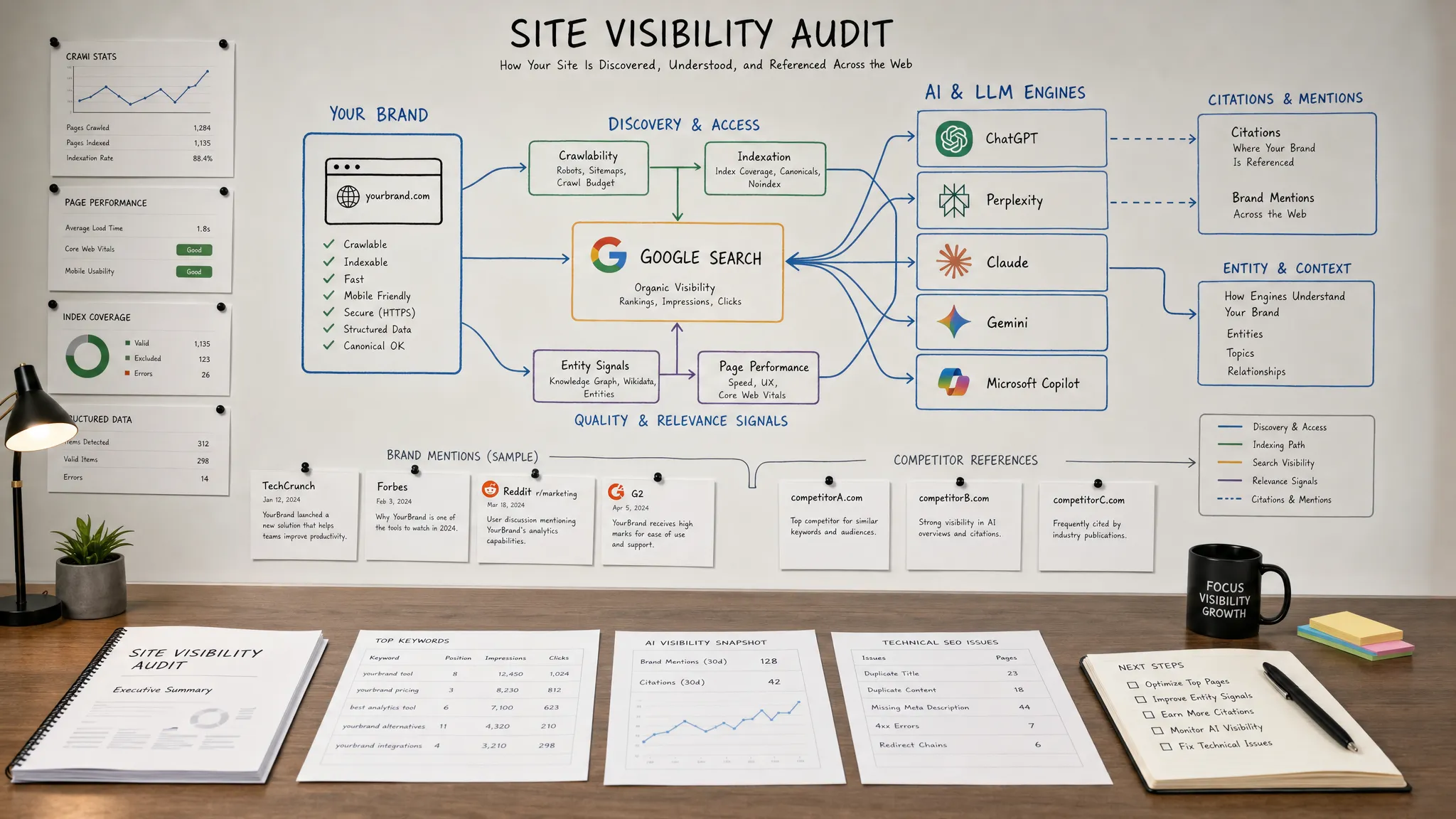
Checking site visibility used to mean answering one question: can people find us on Google? In 2026, that is still essential, but it is no longer enough.
Your prospects now ask ChatGPT, Gemini, Perplexity, Claude, Copilot, and Google AI Overviews for recommendations, comparisons, local options, product advice, and service providers. If those engines mention competitors and not you, your site may look healthy in traditional SEO reports while losing demand in AI-generated answers.
To check site visibility properly, you need two views at the same time: classic Google visibility and AI search visibility. The first tells you whether search engines can crawl, index, rank, and send traffic to your pages. The second tells you whether generative engines can understand your entity, trust your content, cite your pages, and include your brand in answers.
What site visibility means across Google and AI engines
Site visibility is the measurable ability of your website and brand to appear when potential customers search, compare, and make decisions.
In Google, visibility is usually measured through impressions, rankings, clicks, click-through rate, indexed pages, rich results, local pack presence, and page performance. These signals are available through tools such as Google Search Console, analytics platforms, rank trackers, and crawl diagnostics.
In AI engines, visibility is measured differently. Generative engines do not always show a classic list of ten blue links. They synthesize answers. That means you need to check whether your brand is mentioned, whether your site is cited, whether the answer describes your business accurately, and how your share of voice compares with competitors across repeatable prompts.
This is where GEO and AEO become important. Generative Engine Optimization focuses on making your brand and content easier for AI systems to find, understand, and reuse. Answer Engine Optimization focuses on structuring pages so they directly answer the questions buyers ask. Both depend on strong technical SEO, because a page that cannot be crawled, rendered, or trusted is unlikely to perform well in Google or AI search.
If your team is still separating these topics, it helps to understand the difference between on-site AI search and external AI discoverability. CapstonAI explains that distinction in its guide to AI site search vs AI search visibility.
Start with Google: can your site be crawled, indexed, and understood?
Before testing AI engines, verify the basics. AI visibility is not a workaround for poor crawlability. Generative systems often rely on web indexes, citations, structured sources, third-party references, and search results. If Google and Bing struggle to access your site, AI engines may also miss or misunderstand it.
Google Search Central is clear that discovery, crawling, indexing, and serving are the foundation of search visibility. Its Search Essentials documentation outlines the technical requirements that make a site eligible to appear in Google Search.
Use Google Search Console to check:
- Indexing status: Confirm that important pages are indexed and that excluded pages are intentionally excluded.
- Sitemaps: Make sure XML sitemaps are submitted, current, and free of large mismatches.
- Robots.txt and meta robots: Check that key pages are not blocked from crawling or indexing.
- Canonical tags: Verify that canonical URLs point to the preferred version of each page.
- Manual actions and security issues: Resolve anything that reduces trust or eligibility.
- Core Web Vitals: Review loading performance, interactivity, and layout stability for important templates.
For a hotel group, this means checking every property page, destination guide, offer page, and booking path. For a franchise or healthcare network, it means checking every location page and service page. For a WooCommerce store, it means checking category pages, product pages, policy pages, and structured product data.
The business effect is direct: if priority pages are not indexed, they cannot earn impressions, citations, AI references, bookings, leads, or sales.
Measure Google visibility beyond rankings
Rankings still matter, but they are not the whole visibility picture. A page can rank but earn few clicks if a Google AI Overview, local pack, shopping result, review module, or competitor snippet satisfies the query first.
Google Search Console provides verified first-party data on impressions, clicks, click-through rate, and average position. The Performance report documentation explains how these metrics are calculated and filtered.
A practical Google visibility review should include the following metrics:
| Metric | What it shows | Why it matters |
|---|---|---|
| Indexed priority pages | Whether Google can include key pages in search results | No indexation means no organic visibility |
| Impressions | How often pages appear in search results | Indicates demand and eligibility |
| Clicks | How often users reach the site from Google | Connects visibility to traffic |
| CTR | Whether search results attract attention | Helps diagnose weak titles, snippets, or SERP displacement |
| Average position | Approximate ranking trend | Useful when grouped by query type and page template |
| Rich result eligibility | Whether structured data can enhance results | Improves clarity for search engines and users |
| Core Web Vitals | Page experience across key templates | Slow or unstable pages can reduce conversion and discovery quality |
Do not evaluate these metrics in isolation. A drop in clicks with stable impressions may indicate that search results are being answered directly by AI Overviews or other SERP features. A drop in impressions may indicate weaker rankings, indexation issues, lost demand, or content that no longer matches intent.
For more detail on metrics that extend beyond classic SEO reports, see CapstonAI’s guide to measuring AI performance across search engines.
Then check visibility inside AI engines
AI engines require a different audit process because they do not provide a universal version of Search Console. There is no single dashboard from ChatGPT, Gemini, Claude, Perplexity, Copilot, and Google AI Overviews that tells you every time your brand was considered, omitted, mentioned, or cited.
That means you need to build a repeatable prompt set and test it across engines. The goal is not to ask random questions once. The goal is to measure consistent visibility across the journeys that matter to your customers.
Start with prompts that reflect real buyer intent:
- Brand prompts: Ask about your company, locations, products, services, and policies.
- Category prompts: Ask for the best providers, hotels, stores, clinics, schools, agencies, or software options in your market.
- Comparison prompts: Ask how your brand compares with named competitors.
- Local prompts: Ask for options near a city, neighborhood, landmark, or service area.
- Problem prompts: Ask how to solve the issue your product or service addresses.
- Transactional prompts: Ask where to book, buy, request a quote, schedule a demo, or contact a provider.
Record the same fields every time: engine, date, location setting if available, prompt, whether your brand appeared, where it appeared in the answer, which sources were cited, whether the description was accurate, and which competitors were included.
This process is especially important for AI Overviews because Google can display generated summaries above traditional organic results. CapstonAI’s analysis of AI Overviews and CTR impact explains why monitoring visibility inside these summaries matters even when your classic rankings look stable.
Track mentions, citations, and share of voice
AI visibility is not binary. Your site is not simply visible or invisible. You need to know how often you appear, how accurately you are represented, and whether AI engines trust your pages enough to cite them.
Use these core AI visibility metrics:
| AI visibility metric | Definition | Business question it answers |
|---|---|---|
| Brand mention | Your brand appears in an AI-generated answer | Are AI engines aware of us for this topic? |
| Citation | Your website or page is linked as a source | Do engines trust our content enough to reference it? |
| AI share of voice | Your presence compared with competitors across a prompt set | Are we winning or losing answer space? |
| Prompt coverage | Percentage of target prompts where your brand appears | Which buyer journeys include us? |
| Sentiment and accuracy | Whether the answer describes you correctly | Are prospects seeing reliable information? |
| Source diversity | Types of sources cited for your brand | Are engines relying on your site, directories, reviews, media, or competitors? |
Share of voice is often the most useful executive metric. If ten high-intent prompts matter to a hotel group, and competitors appear in seven while the official brand appears in two, the issue is easy to explain. It is not an abstract SEO concern. It is missed consideration in the channels where travelers are asking for recommendations.
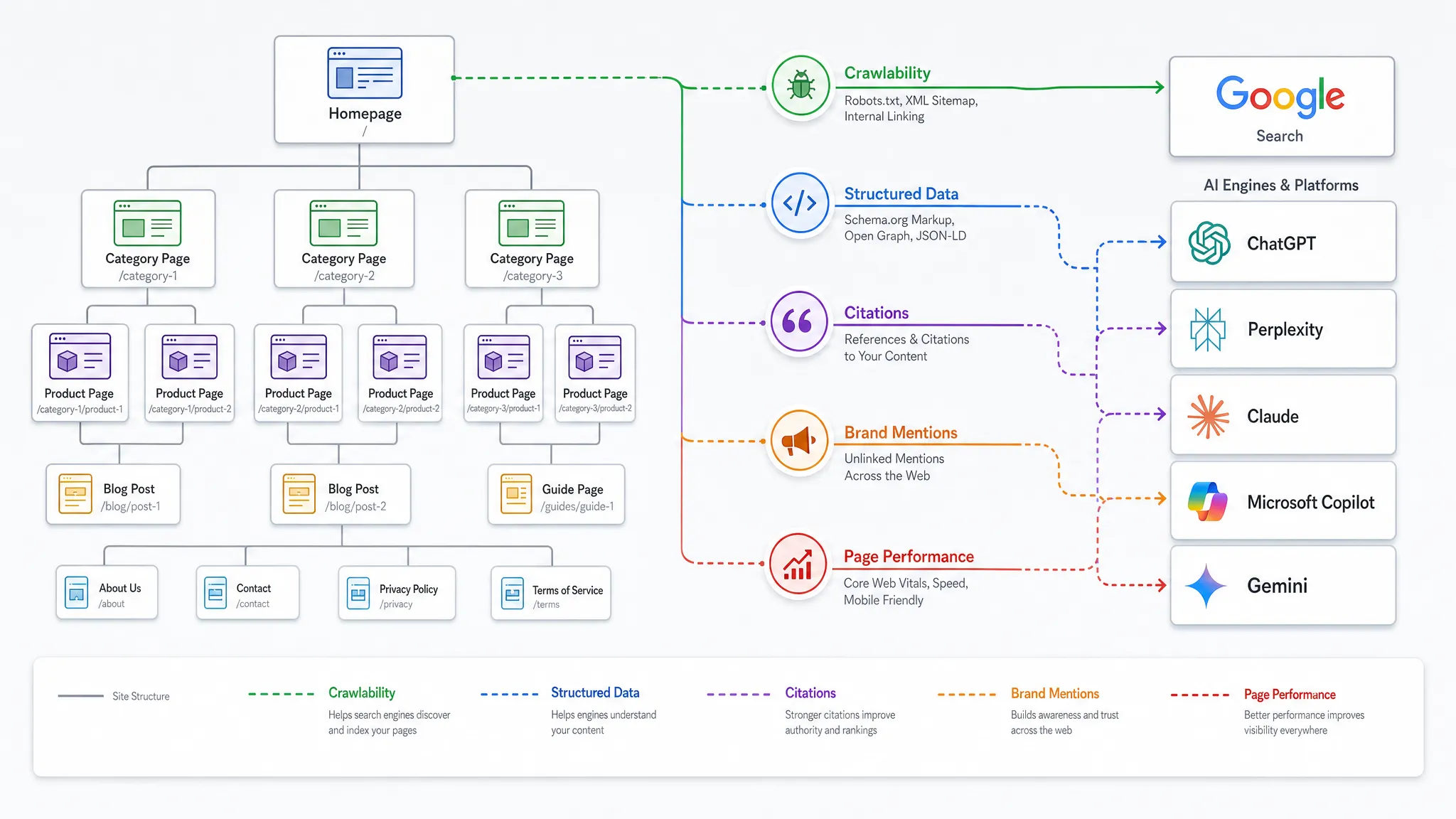
Diagnose what AI engines miss about your business
Once you know where you appear and where you do not, look for the reason. AI engines can miss a business for several practical reasons, many of which are fixable.
The most common visibility gaps include thin entity signals, weak structured data, inconsistent naming, poor internal linking, outdated third-party profiles, blocked pages, slow templates, missing location details, and content that answers marketing claims but not buyer questions.
Entities are especially important. An entity is a clearly identifiable thing, such as a brand, hotel, clinic, campus, product, service, founder, location, or organization. Search engines and AI systems use entity relationships to understand what your business is, where it operates, what it offers, and how it compares with alternatives.
Schema markup helps make those facts explicit. Schema.org provides a shared vocabulary for structured data, and Google supports several structured data types for enhanced search features. For AI visibility, schema is not a magic ranking lever, but it helps machines interpret pages consistently.
For example, a multi-location healthcare brand should make each location page clear about the organization, address, phone number, services, insurance or appointment information where applicable, hours, practitioner details if relevant, and links to related service pages. A travel group should make property pages clear about amenities, location, booking options, room types, policies, and nearby attractions. An e-commerce site should make product pages clear about price, availability, reviews, shipping, returns, variants, and product identifiers where appropriate.
llms.txt can also support AI readiness by giving AI crawlers and tools a concise map of important content. It should be treated as a helpful machine-readable guide, not as a substitute for crawlable pages, strong internal links, accurate schema, and useful content.
Fix visibility issues in priority order
A good audit does not stop at screenshots from AI tools. It turns findings into a prioritized repair plan. The right order matters because technical blockers can make content improvements invisible.
| Finding | Likely cause | Priority fix |
|---|---|---|
| Important pages not indexed in Google | Crawl blocks, canonical errors, no internal links, low-quality duplicates | Resolve crawlability, canonicalization, sitemap, and internal link issues first |
| Pages rank but earn weak CTR | Poor title tags, weak meta descriptions, SERP features, mismatch with intent | Rewrite snippets, improve page targeting, monitor AI Overview presence |
| AI engines mention competitors but not you | Weak entity signals, limited authoritative content, few citations | Build answer-ready pages, strengthen brand facts, earn and update trusted references |
| AI engines cite third parties but not your site | Your pages are thin, hard to parse, or less authoritative | Improve original content, schema, FAQ sections, internal links, and source clarity |
| AI answers describe your brand incorrectly | Inconsistent public data or outdated pages | Correct website facts, structured data, profiles, directories, and location pages |
| Visibility varies by location or brand | Fragmented multi-site architecture or inconsistent templates | Standardize templates, schema, metadata, and local entity signals |
For many teams, the fastest wins come from aligning technical SEO, structured data, and answer-ready content on the pages that already matter commercially. That might be a hotel property page, a location page, a service page, a category page, or a high-margin product collection.
Answer-ready content does not mean adding long generic FAQs to every page. It means answering the questions a buyer would ask before taking action. Examples include availability, service area, price drivers, booking process, shipping conditions, credentials, policies, comparisons, and next steps.
Adapt the audit to your business model
The same visibility framework applies across industries, but the pages and prompts differ.
For independent hotel chains and travel groups, test prompts around destinations, family stays, business travel, amenities, pet policies, event spaces, and direct booking. Compare whether AI engines cite the official property pages or rely on OTAs, review sites, and travel blogs.
For franchise, healthcare, education, and retail networks, focus on local intent. Each location should have a crawlable page, consistent naming, structured business details, clear services, and internal links from brand and regional pages. Visibility gaps often appear when AI engines can see the parent brand but cannot confidently connect it to local services.
For IT service providers and MSPs managing site fleets, the audit should identify repeatable template issues. If one WordPress template lacks schema, weak internal links, or slow performance, the same issue may affect dozens or hundreds of sites.
For mid-market e-commerce and WooCommerce stores, check product, collection, comparison, and buying guide prompts. AI engines often synthesize product recommendations from a mix of merchant pages, reviews, marketplaces, and editorial content. If your product data is unclear or your category pages do not answer purchase questions, you may lose visibility even when your site is technically indexable.
For agencies and in-house digital teams, the key is repeatability. A one-time AI prompt test is useful for diagnosis, but ongoing measurement is what proves whether fixes improve mentions, citations, and share of voice.
How often should you check site visibility?
For active brands, visibility should be monitored on a regular cadence and after major changes. Google rankings fluctuate, AI answers vary, and competitors publish new content. A quarterly manual review is better than nothing, but it may miss important shifts.
A practical cadence is:
- Weekly or biweekly: Track priority AI prompts, branded queries, competitor mentions, and critical alerts.
- Monthly: Review Search Console trends, indexed page coverage, Core Web Vitals, schema health, and content performance.
- After site releases: Recheck crawlability, redirects, canonicals, robots rules, structured data, and page speed.
- After major content updates: Re-run AI prompt tests and compare citations, accuracy, and share of voice.
- After market changes: Add new competitor, product, location, or category prompts as needed.
The point is not to create more reporting for its own sake. The point is to connect visibility checks to decisions: which pages to fix, which prompts to defend, which competitors to monitor, and which content gaps are costing leads, bookings, or revenue opportunities.
A practical workflow to check site visibility
Use this sequence when you need a clean baseline across Google and AI engines.
- Define the journeys: Choose the branded, category, local, comparison, and transactional prompts that reflect how buyers search.
- Pull the Google baseline: Review indexation, impressions, clicks, CTR, average position, rich results, and Core Web Vitals for priority pages.
- Run AI visibility scans: Test the same prompt set across ChatGPT, Google AI Overviews, Gemini, Perplexity, Claude, and Copilot.
- Measure competitors: Track which rivals appear, how often they appear, and which sources support their visibility.
- Audit AI readiness: Check schema, metadata, entities, llms.txt, internal linking, crawlability, and page performance.
- Prioritize fixes: Resolve blockers first, then improve answer-ready content and structured data on commercial pages.
- Re-test and compare: Measure before and after results for mentions, citations, accuracy, and share of voice.
CapstonAI is built for this workflow. It scans visibility across multiple AI engines and assistants, tracks brand mentions, citations, prompts, competitors, and share of voice, then turns findings into prioritized recommendations. For WordPress-first teams, CapstonAI also supports CMS integration for publishing AI-ready FAQ, schema, metadata, and llms.txt improvements.
If you want a structured starting point before choosing tools or building a process, CapstonAI’s AI search readiness checklist for brand teams is a useful companion to this audit.
Frequently Asked Questions
How do I check site visibility in Google? Start with Google Search Console. Review indexing, impressions, clicks, CTR, average position, sitemap status, page experience, and structured data issues. Then compare those findings with analytics, rank tracking, crawl diagnostics, and conversion data.
How do I check site visibility in AI engines? Build a repeatable prompt set and test it across ChatGPT, Google AI Overviews, Gemini, Perplexity, Claude, and Copilot. Track whether your brand is mentioned, whether your pages are cited, how accurate the answer is, and which competitors appear.
Does ranking well in Google guarantee AI visibility? No. Strong Google visibility helps, but AI engines may cite different sources, summarize third-party content, or omit brands that lack clear entity signals, structured data, authoritative content, or consistent public information.
What is the difference between GEO and AEO? GEO focuses on improving how generative engines understand, mention, and cite your brand. AEO focuses on structuring content so answer engines can extract clear responses to user questions. Both work best when classic technical SEO is strong.
Does schema help AI search visibility? Schema helps machines understand your pages by making key facts explicit. It does not guarantee mentions or citations, but it can improve clarity for search engines and AI systems when combined with crawlable pages, useful content, and consistent entity signals.
What is llms.txt, and should every site use it? llms.txt is a machine-readable file that can point AI tools toward important site content. It is useful for AI readiness, but it should complement core SEO work such as crawlability, internal linking, schema, metadata, and page performance.
Start with a free AI visibility audit
If you want to check site visibility across Google and AI engines without guessing, start with a measurable baseline. CapstonAI shows what AI engines see, what they miss, which prompts surface your brand, and where competitors are winning visibility.
Use CapstonAI to start with a free AI visibility audit and turn the findings into prioritized fixes for crawlability, structured data, metadata, content, citations, and AI share of voice.